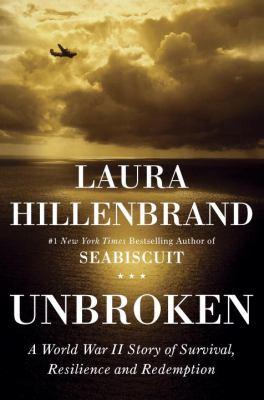
Unbroken
by Laura Hillenbrand
★ Top 10 book of 2001 · #6 on Best Books of 2001
In 1943 a bomber goes down in the Pacific, and its bombardier, Louis Zamperini, climbs onto a raft. A rebellious youth turned Olympic runner, he faces sharks, starvation, and captivity, relying on ingenuity, humor, and sheer will.
Best for: Readers who want a gripping true tale of World War II survival
Unbroken is #6 on BookWard's Best Books of 2001, out of 35 2001 books that cleared our data bar.
What Unbroken is about
Louis Zamperini was a restless kid in Torrance, California, who stole what he could and took plenty of teasing for his Italian family. His older brother Pete steered that energy toward the track, and the boy grew into a runner fast enough to earn the nickname the Torrance Tornado. In 1936 he made the U.S. Olympic Team and finished eighth in the 5,000 meters in Berlin.
When war came, he joined the Army Air Corps and flew as a bombardier in the Pacific. Laura Hillenbrand follows him through a crash that killed most of his crew, forty-seven days adrift on a raft, and more than two and a half years in three Japanese prisoner of war camps. Her biography is a study in how far a person can be pushed and what keeps them going. It suits readers who enjoy true stories of endurance, and anyone curious about the human side of the Pacific war.
Unbroken on the Best Books of 2001
Unbroken came out in 2001. Of the 35 books first published in 2001 that met BookWard's data bar, it ranks #6 on our Best Books of 2001 list.
Why it made the list: 320 readers have shelved it on Open Library; readers rate it 4.2 out of 5 (40 ratings); 20 are reading it right now. The list ranks each year’s books on how many readers have picked them up, how highly readers rate them, and how many are reading them right now.
Nearby on the 2001 list
- Point Blanc Anthony Horowitz, #4
- Getting Things Done David Allen, #5
- Deception Point Dan Brown, #7
- Atonement Ian McEwan, #8
See all Best Books of 2001 Best books by year
More years: Best Books of 2000 Best Books of 2002.
The numbers behind it
- Readers: 243 want to read it, 20 are reading it now and 57 have read it, according to Open Library.
- Ratings: 4.2 out of 5 from 40 Open Library ratings.
| Signal | This book (0 to 100) | Weight |
|---|---|---|
| Reach | 69 | 55% |
| Reader love | 80 | 25% |
| Being read right now | 74 | 20% |
Questions about Unbroken
When was Unbroken published?
Unbroken by Laura Hillenbrand was first published in 2001.
Was Unbroken one of the best books of 2001?
Unbroken is #6 on BookWard's Best Books of 2001, out of 35 2001 books that cleared our data bar. 320 readers have shelved it on Open Library; readers rate it 4.2 out of 5 (40 ratings); 20 are reading it right now.
Why is Unbroken on the Best Books of 2001 list?
320 readers have shelved it on Open Library; readers rate it 4.2 out of 5 (40 ratings); 20 are reading it right now.
More of the best books of 2001
- American Gods Neil Gaiman, #1
- Eat That Frog! 21 Great Ways to Stop Procrastinating and Get More Done in Less Time Brian Tracy, #2
- Crucial Conversations Kerry Patterson, #3
- Point Blanc Anthony Horowitz, #4
- Getting Things Done David Allen, #5
- Deception Point Dan Brown, #7
See the full Best Books of 2001, the Top 100, or new books on Rising.
How we know
This page uses public data: Open Library reader counts and ratings, and Wikipedia page views for recent years. The description is paraphrased from real source text. Rankings reflect reading interest, not quality or sales, and can be affected by data gaps. Lists update monthly.
Suits mature teens and adults who want a gripping true story.
Depends on the edition you pick.
A true survival story that moves like a thriller. 60% taste match
 BookWard’s take
A true survival story that moves like a thriller
Hillenbrand follows Louis Zamperini from a delinquent boyhood in Torrance through the Berlin Olympics to a bomber crash in the Pacific, and the book grabs you early and rarely lets go. It moves fast for a biography, and Zamperini is drawn as a real, stubborn, funny person rather than a monument. The storytelling is led by scene and momentum, so the page-turning energy comes from the narrative itself, while the research shows in the quality of the detail. The ending is fully resolved, and the darkness feels earned by what actually happened rather than used for shock. It is a book about endurance that mostly avoids easy uplift, though the overall mood leans hopeful.
A full-scale life and war story that runs long, though it stays purposeful where BookWard prefers tighter books.
Raft, camps and war keep moving, so it reads faster than most biographies.
The material is extraordinary, but the shape is a familiar survivor biography rather than a new form.
Clear, vivid and propulsive prose without much ornament, favoring momentum over flourish.
It balances the two, with events driving the plot and Zamperini's character shaping how we read them.
Though much of it is harrowing, the book is built around resilience and recovery.
A broadly chronological life story with a conventional biographical shape.
Mostly serious, with flashes of Zamperini's humor surfacing under pressure.
Hunger, torture and cruelty make this a dark book, with real suffering on the page.
Suffering and endurance carry strong feeling throughout.
See all 50 dialsEvery position, side by side with this book
Where it lines up
- PaceBookWard 8 · book 8
- Character depthBookWard 8 · book 8
- EndingBookWard 8 · book 8
Where it pulls apart
- LengthBookWard 1 · book 6
- Familiar tropesBookWard 10 · book 6
- OpeningBookWard 10 · book 8
A full-scale life and war story that runs long, though it stays purposeful where BookWard prefers tighter books.
It opens on a crash in the Pacific with a man pulling himself onto a raft, which grips at once.
Survival and redemption arcs are familiar territory, but the specifics of Zamperini's life keep it from reading as formula.
A documented life told in clear cause and effect, so events follow one another without gaps or contrivance.
Raft, camps and war keep moving, so it reads faster than most biographies.
The material is extraordinary, but the shape is a familiar survivor biography rather than a new form.
Zamperini is shown as delinquent, athlete, airman and survivor, with real contradictions and a specific personality.
His story reaches a clear resolution, which BookWard likes.
It leans toward inspiration and redemption, though much of the telling stays grounded in plain events.
The brutality comes from what actually happened to him, not from effect, so the darkness is earned.
This is a researched biography built on documented events, which suits BookWard's appetite for solid footing.
Hillenbrand has a recognizable narrative style, though she keeps herself mostly out of the way of the story.
Story first: the book is driven by what happens to one man, not by an argument.
Events are mostly dramatized in scene, with background explained only as needed.
The sections move from boyhood to Olympics to raft to camps, each with its own energy.
Clear, vivid and propulsive prose without much ornament, favoring momentum over flourish.
It balances the two, with events driving the plot and Zamperini's character shaping how we read them.
Though much of it is harrowing, the book is built around resilience and recovery.
A broadly chronological life story with a conventional biographical shape.
Mostly serious, with flashes of Zamperini's humor surfacing under pressure.
Easy to read and carried along by story, though emotionally heavy in places.
It stays closely with Zamperini, with only occasional looks at others around him.
Largely linear, following his life in order from boyhood onward.
Entirely grounded in real events, however extraordinary they sound.
Zamperini, family, crewmates and captors give it a moderate cast, centered on one man.
A global war and Pacific ocean give it wide scope, anchored in a single life.
Action-heavy, built around crashes, drifting and camp life, with inner states in support.
Mostly narrated event, with speech used selectively for moments that matter.
Relationships appear, but they are not what the book is about.
Wartime Pacific and prison camps are far from most readers' experience.
Set in the 1930s and 40s, a historical period well behind us.
Stories of endurance and survival keep their force across generations.
A straightforward biographical narrator you can trust to report what happened.
Cruelty and endurance are shown with clarity, though some questions of forgiveness stay open.
Rich in the physical detail of ocean, raft, hunger and camp life.
Strongly narrative, reading more like a novel than an analytical history.
Close and sympathetic toward its subject rather than distant or clinical.
A complete standalone book.
Real events deliver reversals, though the broad arc is known in outline.
Often hard to read, but it offers some comfort through its survivor's resolve.
Hunger, torture and cruelty make this a dark book, with real suffering on the page.
Suffering and endurance carry strong feeling throughout.
Humor appears as wry, dry resilience rather than broad comedy.
Camp brutality and wartime violence are depicted directly and often.
Essentially absent from the narrative.
War and national conflict frame the story, but it is not a political argument.
Accessible language that a general reader can follow with ease.
The author's sympathy is clear, but the narration mostly lets events speak.
It looks back at a past war, with recovery pointing gently forward.
It believes in endurance and redemption without ignoring cruelty.
Review written by BookWard, dial version 1, November 2026.
Who is Unbroken right for?
Suits mature teens and adults who want a gripping true story. It contains graphic wartime violence, starvation and torture, so sensitive readers should expect disturbing passages.
Easy to read and carried along by story, though emotionally heavy in places.
Hunger, torture and cruelty make this a dark book, with real suffering on the page.
Suffering and endurance carry strong feeling throughout.
Camp brutality and wartime violence are depicted directly and often.
Book CompanionUnbroken: ideas, characters, themes
Louis Zamperini's life shows how stubborn will, humor and a refusal to be reduced can carry a person through extreme suffering.
- A troubled boyhood. Zamperini grows up in Torrance, California, as a petty thief and troublemaker, bullied for his Italian background and beaten by his father.
- Running changes him. His older brother Pete coaches him and rings a bike bell as he runs home from school, steering him toward the track.
- The Berlin Olympics. He earns a place on the 1936 U.S. Olympic team and finishes eighth in the 5,000 meters, treating it as a try-out for Tokyo.
- From athlete to airman. When war ends his running career, he joins the Army Air Corps and becomes a bombardier.
- Crash, raft and captivity. His plane goes down in the Pacific in 1943, and he drifts for 47 days before surviving more than two and a half years as a prisoner of war.
Characters
Louis Zamperini
Subject
A delinquent turned Olympic runner and bombardier whose will is tested by the ocean and by imprisonment.
Pete Zamperini
Older brother
Louis's coach and champion, who teaches him that a moment of pain is worth a lifetime of glory.
James Sasaki
Acquaintance
A man Louis meets at the college track facility and presumes to be Japanese-American.
Themes
The capacity to keep going when everything is stripped away.
Recovering will and identity after great harm.
Finding a way back from damage, whether inflicted or self-made.
Refusing to be broken by those with power over you.
The bonds with family and comrades that help a person survive.
Discussion questions
- How does Zamperini's troubled childhood shape the way he later survives?
- Why does Pete's line about pain and glory matter so much to the story?
- What role does humor play in keeping a person going under extreme conditions?
- How does the book balance inspiration against the brutality it describes?
- What does the book suggest about the difference between surviving and recovering?
Personalize your Book Companion
This is the general edition. In BookWard, the Companion is written for you: your reading profile, your notes, and spoiler-safe to the page you are on.
Buy, listen or borrow Unbroken
Each link opens a search for this book on that store, in a new tab.
Read on a device
Borrow
Reviews and community
If you liked Unbroken
Two true stories braided together: a fair and a killer
EnduranceAlfred LansingA true survival story that reads like a tightly built thriller
In the Heart of the SeaNathaniel PhilbrickA tight, gripping history of the whaleship Essex and its survivors
Between Shades of GrayRuta SepetysA girl's drawings carry a family through Stalin's Siberian deportation
Find your own best books
Add what you have read, rate it, and BookWard will recommend what to read next.
Free to start. No credit card needed.