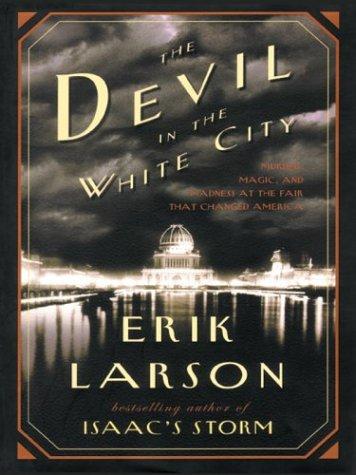
The Devil in the White City
by Erik Larson
★ Top 25 book of 2003 · #12 on Best Books of 2003
Erik Larson brings Chicago in 1893 to life by weaving together the true stories of two men: the architect behind the World's Fair, striving to secure America's place in the world, and a very different man in the same city.
Best for: Readers who like narrative non-fiction that reads like a thriller.
The Devil in the White City is #12 on BookWard's Best Books of 2003, out of 52 2003 books that cleared our data bar.
What The Devil in the White City is about
Two very different men shape this account of Chicago's 1893 World's Columbian Exposition. Daniel Burnham, the architect behind the fair, battles a fire, doubts about the safety of his buildings and a shortage of money to deliver a showpiece the nation could be proud of. Meanwhile H. H. Holmes, a charming man widely considered the first serial killer in the United States, lured his victims, mainly women, to their deaths in his elaborately constructed "Murder Castle," with secret rooms, torture chambers, and a large furnace to cremate bodies.
Erik Larson weaves the two stories together across four parts, set in Chicago from 1890 to 1893 and in Philadelphia around 1895, and adds the assassination of Mayor Carter Harrison III days before the fair closed. Built on careful research yet told like a story, it explores ambition, progress and evil in an America entering the modern age. History readers and true crime fans will find plenty here.
The Devil in the White City on the Best Books of 2003
The Devil in the White City came out in 2003. Of the 52 books first published in 2003 that met BookWard's data bar, it ranks #12 on our Best Books of 2003 list.
Why it made the list: 531 readers have shelved it on Open Library; readers rate it 3.9 out of 5 (63 ratings); 24 are reading it right now. The list ranks each year’s books on how many readers have picked them up, how highly readers rate them, and how many are reading them right now.
Nearby on the 2003 list
- How to Train Your Dragon Cressida Cowell, #10
- We Need to Talk About Kevin Lionel Shriver, #11
- Thomas and Friends Reverend W. Awdry, #13
- Eleven Minutes Paulo Coelho, #14
See all Best Books of 2003 Best books by year
More years: Best Books of 2002 Best Books of 2004.
The numbers behind it
- Readers: 419 want to read it, 24 are reading it now and 88 have read it, according to Open Library.
- Ratings: 3.9 out of 5 from 63 Open Library ratings.
| Signal | This book (0 to 100) | Weight |
|---|---|---|
| Reach | 79 | 55% |
| Reader love | 40 | 25% |
| Being read right now | 71 | 20% |
Questions about The Devil in the White City
When was The Devil in the White City published?
The Devil in the White City by Erik Larson was first published in 2003.
Was The Devil in the White City one of the best books of 2003?
The Devil in the White City is #12 on BookWard's Best Books of 2003, out of 52 2003 books that cleared our data bar. 531 readers have shelved it on Open Library; readers rate it 3.9 out of 5 (63 ratings); 24 are reading it right now.
Why is The Devil in the White City on the Best Books of 2003 list?
531 readers have shelved it on Open Library; readers rate it 3.9 out of 5 (63 ratings); 24 are reading it right now.
More of the best books of 2003
- Harry Potter and the Order of the Phoenix J. K. Rowling, #1
- Into the Wild Erin Hunter, #2
- The Kite Runner Khaled Hosseini, #3
- Don't Let the Pigeon Drive the Bus! Mo Willems, #4
- A Short History of Nearly Everything Bill Bryson, #5
- The Da Vinci Code Dan Brown, #6
See the full Best Books of 2003, the Top 100, or new books on Rising.
How we know
This page uses public data: Open Library reader counts and ratings, and Wikipedia page views for recent years. The description is paraphrased from real source text. Rankings reflect reading interest, not quality or sales, and can be affected by data gaps. Lists update monthly.
It suits mature teens and adults who enjoy history told as narrative.
Depends on the edition you pick.
Two true stories braided together: a fair and a killer. 58% taste match
 BookWard’s take
Two true stories braided together: a fair and a killer
Larson tells the story of Daniel Burnham, the architect behind the 1893 World's Fair, alongside H. H. Holmes, widely considered America's first serial killer. The two threads run in parallel through Chicago, and the book is built for momentum rather than reflection. It moves fast, and Larson's narrative style is distinctly his own. This is nonfiction that favors scene over argument, so expect storytelling rather than analysis. The rigor is solid, with the research carrying the storytelling instead of replacing it. Darkness and violence are present but not relentless, since the fair's engineering struggles take up as much room as the crimes. A reader who wants a hook right away may find the opening slower than expected, because the book eases in with the fair.
A full-scale historical narrative with two threads to carry, longer than BookWard's taste for tight books.
Alternating between the fair and the killer keeps it moving, close to BookWard's quick preference.
Pairing an architectural triumph with a serial killer's story is an unusual and fresh way to frame history.
Clear and vivid prose, more polished than plain but not ornate.
The events drive the book, though Burnham and Holmes both shape it as people.
Triumph and horror sit side by side, so the outlook is balanced between the two.
The interwoven dual narrative is a deliberate structural choice, though the order stays chronological.
A serious subject treated seriously, with little room for humor.
The serial killer thread is dark, balanced by the fair's brighter story.
Absorbing and sometimes harrowing, but kept controlled.
See all 50 dialsEvery position, side by side with this book
Where it lines up
- EndingBookWard 8 · book 8
- Story or ideasBookWard 3 · book 3
- PaceBookWard 8 · book 7
Where it pulls apart
- LengthBookWard 1 · book 6
- OpeningBookWard 10 · book 6
- Familiar tropesBookWard 10 · book 8
A full-scale historical narrative with two threads to carry, longer than BookWard's taste for tight books.
True events spare it the stock plotting of crime fiction, which BookWard values.
Events follow documented history in order, so cause and effect hold together cleanly.
Alternating between the fair and the killer keeps it moving, close to BookWard's quick preference.
Pairing an architectural triumph with a serial killer's story is an unusual and fresh way to frame history.
Burnham and Holmes are drawn with real texture, though history limits how far inside them Larson can go.
The final part follows events to their historical close, giving the resolution BookWard likes.
It leans a little toward drama and wonder, but stays mostly measured about its subjects.
The darkness comes from what actually happened, not from shock added for effect.
Meticulous research underpins the narrative, which suits BookWard's taste for rigor.
Larson's storytelling approach to nonfiction is distinctive and instantly recognizable.
This is story-led history, matching BookWard's lean toward narrative over argument.
Background is woven into scenes more than lectured, though the building and planning details do explain.
The two threads keep alternating tension, so the middle holds up well.
Clear and vivid prose, more polished than plain but not ornate.
The events drive the book, though Burnham and Holmes both shape it as people.
Triumph and horror sit side by side, so the outlook is balanced between the two.
The interwoven dual narrative is a deliberate structural choice, though the order stays chronological.
A serious subject treated seriously, with little room for humor.
Accessible and absorbing, though the engineering and political detail asks for some attention.
Mostly two central viewpoints, with a few side figures appearing around them.
It moves forward through the early 1890s and a short later section, with no scrambling.
Entirely grounded in documented history.
Many real figures cross the pages, from architects and officials to victims.
A city-wide event with national stakes, bigger than an intimate story.
Mostly events, construction and crimes rather than interior reflection.
Romance plays almost no part in the story.
1890s Chicago and its fair is an unfamiliar setting to most readers.
The story is set well in the past, in the 1890s.
The fair and the Holmes legend have kept their pull for readers over time.
The narration is a straightforward, reliable account of the record.
Burnham's ambition and Holmes's crimes are clear, though the era's trade-offs add some gray.
Rich in physical detail of the fair, the buildings and the city.
Larson keeps himself out of the story and tells it as an observer.
A standalone work.
History supplies the turns, with a few reveals but little engineered surprise.
An engaging read that unsettles in places without being punishing.
The serial killer thread is dark, balanced by the fair's brighter story.
Absorbing and sometimes harrowing, but kept controlled.
Humor is largely absent.
Sexual content is minimal.
Municipal and national politics shape the fair but do not dominate.
Standard, readable English throughout.
Larson mostly lets the facts speak, with a light editorial touch.
The book looks back at a past moment of ambition and its shadow side.
Burnham's vision is idealistic, set against Holmes's cynicism, so the book holds both.
Review written by BookWard, dial version 1, November 2026.
Who is The Devil in the White City right for?
It suits mature teens and adults who enjoy history told as narrative. It contains murder, disturbing crimes against women and some grim detail, handled without lingering gore.
Accessible and absorbing, though the engineering and political detail asks for some attention.
The serial killer thread is dark, balanced by the fair's brighter story.
Absorbing and sometimes harrowing, but kept controlled.
Book CompanionThe Devil in the White City: ideas, characters, themes
The same Chicago that built a dazzling world's fair also hid a killer, and the book shows how both took shape in one city at one moment.
- Two stories, one city. The book alternates between Daniel Burnham's work on the fair and H. H. Holmes's crimes, letting each thread inform the other.
- Building against the clock. Burnham faces a fire, safety and engineering problems, and a shortage of funds as he races to open the fair.
- The Murder Castle. Holmes constructs an elaborate building with secret rooms and a furnace, and uses charm to draw in his victims.
- Chicago as stage. The fair's ambition and the city's rawness set the backdrop for both triumph and crime.
- A sharp ending to the fair. Chicago's mayor is assassinated just days before the fair closes, and a final section follows the aftermath in Philadelphia.
Characters
Daniel Burnham
Fair architect
The driven architect responsible for the World's Fair, who must overcome setbacks to deliver it.
H. H. Holmes
Serial killer
A charming criminal figure widely considered America's first serial killer, who built a 'Murder Castle'.
Carter Harrison III
Chicago mayor
The mayor of Chicago, assassinated by Patrick Eugene Prendergast just before the fair ends.
Patrick Eugene Prendergast
Assassin
The man who killed the mayor days before the fair closed.
Themes
The drive to build something great, and the cost of doing it on a deadline.
How a likable surface can hide a predator's intent.
A celebration of modern achievement existing alongside real danger.
Chicago's growth and chaos shape what becomes possible, good and bad.
Discussion questions
- Why might Larson have chosen to weave the Burnham and Holmes stories together rather than tell them separately?
- Which thread held your attention more, the building of the fair or the crimes, and why?
- How does the book treat the line between fact and storytelling?
- What does the fair's success say about the era that produced it?
- How did the setting of 1890s Chicago make Holmes's crimes possible?
Personalize your Book Companion
This is the general edition. In BookWard, the Companion is written for you: your reading profile, your notes, and spoiler-safe to the page you are on.
Buy, listen or borrow The Devil in the White City
Each link opens a search for this book on that store, in a new tab.
Read on a device
Borrow
Reviews and community
If you liked The Devil in the White City
A true survival story that moves like a thriller
EnduranceAlfred LansingA true survival story that reads like a tightly built thriller
In the Heart of the SeaNathaniel PhilbrickA tight, gripping history of the whaleship Essex and its survivors
All the Light We Cannot SeeAnthony DoerrA lyrical war novel built from short chapters and a blind girl's Paris
Find your own best books
Add what you have read, rate it, and BookWard will recommend what to read next.
Free to start. No credit card needed.