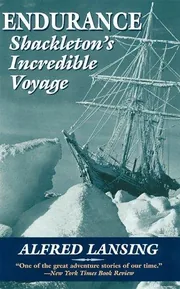
Endurance
by Alfred Lansing, Elena Grau · 1959
Suits older teens and adults who enjoy true adventure and history.
282 pages, about 4.5 to 6.5 hours.
A true survival story that reads like a tightly built thriller. 67% taste match
What it covers
Endurance is a work of narrative history by Alfred Lansing, first published in 1959. It recounts the Imperial Trans-Antarctic Expedition of 1914 to 1917, led by the polar explorer Sir Ernest Shackleton, whose aim was to cross Antarctica on foot, the last uncharted continent. The book sits within the history of discovery and exploration, and it also draws on the genres of travel writing and biography.
The story follows the ship Endurance, which left England in August 1914 with Shackleton and 27 men aboard. The vessel became trapped in an island of ice and was eventually crushed, leaving the crew to survive for more than a year on the ice-bound waters off Antarctica. The account opens with the order to abandon ship, given at 5 p.m. Readers interested in British polar exploration, scientific expeditions, and voyages in the early twentieth century will find the setting and period clearly drawn. The book runs to roughly 282 pages in its median edition, and it has appeared in 43 editions.
The order to abandon ship was given at 5 p.m.
Characters
Ernest Shackleton
Setting
Antarctica
Themes
BritishDiscovery and explorationEndurance (Navire)Endurance (Ship)TravelEndurance (Ship : A171)Scientific expeditionsExplorers
- Want to read 163
- Reading now 11
- Read 25
Most people shelving it are saving it for later.
Of 199 readers who put it on a shelf, 82% want to read it, 6% are reading it now, 13% have finished it and 0% stopped before the end.
By the numbers
- The median edition runs 282 pages. Counting about 275 words a page and an adult reading pace of 250 words a minute, that is about 5.2 hours of reading.
- Open Library tracks 43 editions from 28 publishers, the earliest dated 1959 and the latest 2018, across 2 languages.
- On reader demand it ranks in the top 7% of the classic books in our catalog (8,749 of them).
- Libraries shelve it under Dewey 919.8904 and Library of Congress class G--0850.00000000 1914 .S53 L36 1998.
 BookWard’s take
A true survival story that reads like a tightly built thriller
Alfred Lansing tells the story of Shackleton's Imperial Trans-Antarctic Expedition as narrative history, and it moves like a novel. The Endurance sails in August 1914, becomes trapped in ice, and is crushed, leaving 28 men to survive for over a year. The opening grabs from the first page, where the order to abandon ship comes at 5 p.m. The pace never slackens for long, with little sag in the middle despite the stillness of the ice. The tone stays restrained, letting hardship speak without gush. At 282 pages it is not a short book, but the length earns its keep. Story leads, ideas follow.
At 282 pages it is moderate, longer than BookWard's tight ideal but never padded for a story this large.
It keeps momentum through long stretches of waiting and sudden danger, close to BookWard's brisk preference.
The expedition is a well-known subject, but the survival story itself is unusual and vivid.
The writing is clear and direct, more plain than ornate, which keeps attention on events.
Events drive the book, though the crew's endurance gives it human weight.
Dire circumstances are met with resolve, so the book leans toward hope.
It follows a conventional chronological shape from departure to outcome.
The subject is grim, so humor is scarce and mostly incidental.
Danger, cold and the threat of death are present without being gratuitous.
The crew's ordeal carries real feeling, delivered with restraint.
See all 50 dialsEvery position, side by side with this book
Where it lines up
- EndingBookWard 8 · book 8
- SentimentBookWard 8 · book 8
- Shock for effectBookWard 9 · book 9
Where it pulls apart
- LengthBookWard 1 · book 4
- Familiar tropesBookWard 10 · book 8
- EraBookWard 7 · book 2
At 282 pages it is moderate, longer than BookWard's tight ideal but never padded for a story this large.
It opens at the moment of crisis, with the order to abandon ship, which suits BookWard's taste for an immediate pull.
The story is real, so it avoids invented tropes, though the heroic-explorer frame is a familiar one.
Events follow cause and effect from the ice closing in to the crew's decisions, so everything holds together.
It keeps momentum through long stretches of waiting and sudden danger, close to BookWard's brisk preference.
The expedition is a well-known subject, but the survival story itself is unusual and vivid.
Shackleton and his men come through in how they act under strain, with solid but not deep portraits.
The history resolves with the crew's fate settled, which BookWard values over an open close.
Lansing lets the facts carry the feeling rather than pushing the reader toward tears.
The ice, cold and loss are earned by events, not added for effect.
Built on the record of a real expedition, it is firmly grounded rather than anecdotal.
Lansing's narration is steady and recognizable, strong without drawing attention to itself.
This is story first, a chronicle of survival rather than an argument about ideas.
Events are shown through scenes of the men and the ice more than explained outright.
Even through the long months on the ice, tension and incident keep the middle from drooping.
The writing is clear and direct, more plain than ornate, which keeps attention on events.
Events drive the book, though the crew's endurance gives it human weight.
Dire circumstances are met with resolve, so the book leans toward hope.
It follows a conventional chronological shape from departure to outcome.
The subject is grim, so humor is scarce and mostly incidental.
The narrative history is accessible and needs no special background to follow.
Mostly Shackleton's expedition seen as a group, with a modest range of perspectives.
The account runs forward in time without much jumping about.
Everything is real and grounded, set on actual ice and sea.
Shackleton and 27 men make a sizable crew, though only some stand out.
The stakes are one expedition, yet the Antarctic setting gives it real grandeur.
Action on the ice dominates over inner reflection.
The book is narration-led, with spoken exchanges used sparingly.
Romance plays no part in this story of survival.
Antarctica and polar exploration are unfamiliar territory for most readers.
Set in 1914 to 1917, it looks back to the early twentieth century.
A survival story of this kind stays gripping long after its date.
Lansing narrates as a historian, reliable and straightforward.
Heroism and duty are presented clearly, with little moral murk.
The ice, sea and cold are rendered vividly, which adds to the sense of place.
This is narrative history at its most story-like, not an analytical study.
The author stays mostly in the background, though the telling has warmth.
It stands alone as a complete account.
Reversals come from the ice and the sea, giving some surprise to a known outcome.
It tests the reader with hardship but rewards with admiration, not discomfort.
Danger, cold and the threat of death are present without being gratuitous.
The crew's ordeal carries real feeling, delivered with restraint.
Any humor is dry and incidental to the hardship.
The threat is nature and hunger, with little direct violence on the page.
There is no sexual content.
The expedition's imperial setting appears, but politics is not a focus.
The language is plain and easy to read.
The narration lets events speak with little editorializing.
It looks back at a past expedition rather than ahead.
Courage and loyalty under pressure give it an idealistic streak.
Review written by BookWard, dial version 1, November 2026.
Who is Endurance right for?
Suits older teens and adults who enjoy true adventure and history. It deals with cold, hunger and the threat of death, though without graphic content.
The narrative history is accessible and needs no special background to follow.
Danger, cold and the threat of death are present without being gratuitous.
The crew's ordeal carries real feeling, delivered with restraint.
The threat is nature and hunger, with little direct violence on the page.
Book CompanionEndurance: ideas, characters, themes
Shackleton's expedition shows how leadership and endurance can carry a crew through months of impossible conditions on the ice.
- The expedition's aim. Shackleton planned to cross Antarctica on foot, the last uncharted continent, setting out from England in August 1914.
- Trapped in the ice. The Endurance became locked inside an island of ice, which shaped everything that followed.
- The ship is lost. The vessel was eventually crushed, and the account opens with the order to abandon ship at 5 p.m.
- A year of survival. The crew lived on the ice-bound seas for over a year, which is the heart of the story.
- All hands. Shackleton and all 27 of his men are part of the tale, which has come to define heroism.
Characters
Ernest Shackleton
Expedition leader
The polar explorer who planned the crossing of Antarctica and led the 27 men aboard.
The Endurance
The expedition ship
The vessel that sailed from England in 1914, was locked in ice, and was later crushed.
The crew
Shackleton's 27 men
The men who endured over a year on the ice-bound seas alongside their leader.
Themes
Surviving long hardship through persistence.
How a leader holds a group together under pressure.
Courage shown in sustained, practical effort.
The ice and sea as forces beyond human control.
The urge to reach the unknown and its costs.
Discussion questions
- What choices kept the crew together once the ship was lost?
- How does knowing the outcome change the tension of the story?
- What makes Shackleton's leadership stand out in the account?
- How does the setting shape the men's behavior?
- Does the book's idea of heroism hold up today?
Personalize your Book Companion
This is the general edition. In BookWard, the Companion is written for you: your reading profile, your notes, and spoiler-safe to the page you are on.
Buy, listen or borrow Endurance
Each link opens a search for this book on that store, in a new tab.
Read on a device
Borrow
Reviews and community
If you liked Endurance
A Cold War spy story told with a novelist's grip
UnbrokenLaura HillenbrandA true survival story that moves like a thriller
The Devil in the White CityErik LarsonTwo true stories braided together: a fair and a killer
In the Heart of the SeaNathaniel PhilbrickA tight, gripping history of the whaleship Essex and its survivors
Sources: Open Library.
Track Endurance and find your next favorite
Add it to your shelf, rate what you have read, and BookWard will recommend what fits you.
Free to start. No credit card needed.