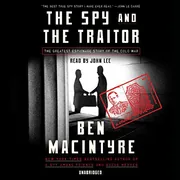
The Spy and the Traitor
by Ben Macintyre · 2018
Suits adult and older teen readers curious about the Cold War and spycraft.
384 pages, about 6 to 9 hours.
A Cold War spy story told with a novelist's grip. 72% taste match
What it covers
The Spy and the Traitor is a work of narrative history and biography by Ben Macintyre, first published in 2018. It belongs to the literature of the Cold War and tells the story of Oleg Gordievsky, a Soviet intelligence officer who came from a family of KGB agents and was shaped by the best institutions the Soviet Union had to offer.
The book follows Gordievsky from his first posting in 1968 through his rise to become the Soviet Union's senior figure in London. From 1973 he was secretly working for British intelligence, passing information to the West for close to ten years while the KGB's leadership grew fearful of a nuclear first strike. It also covers the CIA's efforts to identify Britain's well-placed source, and the role of Aldrich Ames in that search. The narrative reaches its crisis in 1985. Readers interested in espionage, the inner workings of Soviet intelligence, and the final decade of the Cold War will find its subject matter squarely in those areas. The paperback runs to roughly 384 pages and has appeared in 13 editions.
For the KGB's counterintelligence section, Directorate K, this was a routine bugging job.
Characters
Oleg Gordievsky
Setting
Soviet Union
Period
1985
Themes
Cold WarSpiesIntelligence serviceSoviet UnionBiographyHistoryAmes, aldrich hazen, 1941-Espionage, british
- Want to read 95
- Reading now 9
- Read 16
Most people shelving it are saving it for later.
Of 120 readers who put it on a shelf, 79% want to read it, 8% are reading it now, 13% have finished it and 0% stopped before the end.
By the numbers
- The median edition runs 384 pages. Counting about 275 words a page and an adult reading pace of 250 words a minute, that is about 7.0 hours of reading.
- Open Library tracks 13 editions from 12 publishers, the earliest dated 2018 and the latest 2023, across 3 languages.
- On reader demand it ranks in the top 8% of the recent books in our catalog (6,647 of them).
- Libraries shelve it under Dewey 327.120972092 and Library of Congress class UB-0271.00000000.S652.
 BookWard’s take
A Cold War spy story told with a novelist's grip
Ben Macintyre tells the story of Oleg Gordievsky, a KGB officer who spent roughly a decade secretly working for MI6, and he tells it like a thriller. The hook is the book's calling card: the double life is the story, so the tension starts early and rarely lets go. The pace stays brisk across 384 pages, and the middle never sags, because the cat-and-mouse keeps tightening. The research is strong too, since this is narrative history built on real events rather than anecdote. The ending lands well: the arc reaches a clear crisis in 1985 and resolves it. What gives way slightly is originality, since the spy-versus-spy frame is familiar, but the real-life irony of Aldrich Ames hunting Britain's source is stranger than fiction.
The narrative moves briskly from the 1968 posting through the 1973 recruitment to the crisis of 1985.
Espionage biography is well-trodden ground, but this particular double-agent story and its Ames twist feel fresh.
The writing is clear and polished rather than ornate, built to carry the plot.
Events drive the narrative, though Gordievsky's choices and loyalties give it a human center.
There is courage and a defection arc, but the Cold War setting and betrayals keep the mood guarded.
A conventional chronological build from first posting to crisis, with no formal experiments.
The material is serious, with only occasional dry irony.
Paranoia, betrayal and nuclear dread give it weight without graphic excess.
The stakes and personal cost carry real feeling while the telling stays controlled.
See all 50 dialsEvery position, side by side with this book
Where it lines up
- PaceBookWard 8 · book 8
- Character depthBookWard 8 · book 8
- EndingBookWard 8 · book 8
Where it pulls apart
- LengthBookWard 1 · book 4
- Familiar tropesBookWard 10 · book 7
- OriginalityBookWard 9 · book 6
The premise of a KGB officer secretly working for MI6 pulls the reader in from the start, matching BookWard's love of an instant hook.
Spy-story conventions are present in the genre, but the events are real and the Ames irony avoids stock setups.
The chain of events, from recruitment to the hunt for the source, follows a clear and traceable cause and effect.
The narrative moves briskly from the 1968 posting through the 1973 recruitment to the crisis of 1985.
Espionage biography is well-trodden ground, but this particular double-agent story and its Ames twist feel fresh.
Gordievsky is drawn with real texture, from his KGB family background to his growing contempt for Soviet communism.
The story builds to a defined crisis in 1985 and delivers a clear resolution rather than trailing off.
Macintyre keeps the tone measured and dry rather than sentimental, which suits BookWard's preference for restraint.
The drama comes from real events, including the Ames betrayal, so the darkness is earned rather than manufactured.
This is narrative history grounded in documented events and people, closer to rigorous than anecdotal.
Macintyre has a confident, polished storytelling voice that readers recognize across his espionage books.
The book is story-led: it follows a man and a plot rather than arguing an abstract thesis.
Context about the KGB and nuclear fears is woven into scenes more than delivered as lectures, though some explaining is needed.
The mutual hunt between agencies keeps tension rising, so the middle holds up well.
The writing is clear and polished rather than ornate, built to carry the plot.
Events drive the narrative, though Gordievsky's choices and loyalties give it a human center.
There is courage and a defection arc, but the Cold War setting and betrayals keep the mood guarded.
A conventional chronological build from first posting to crisis, with no formal experiments.
The material is serious, with only occasional dry irony.
Accessible, popular narrative history that rewards attention without needing specialist knowledge.
The story moves between Gordievsky, MI6 and the CIA, giving a few distinct vantage points.
The account runs largely in order from 1968 to the 1985 crisis.
Entirely grounded in documented Cold War events.
Several agencies and officers appear, so the cast is mid-sized rather than small.
The personal drama sits against nuclear-age tension between superpowers, giving it real geopolitical weight.
It balances operations and plots with Gordievsky's motives, tilting slightly toward action.
Scenes and exchanges appear, but narration carries most of the book.
Romance is not the focus of this espionage history.
The KGB, MI6 and Soviet life are unfamiliar worlds for most readers.
The events belong to the Cold War, from 1968 to 1985, well in the past.
Betrayal, loyalty and state paranoia keep the story relevant beyond its decade.
A historian narrates the documented record, so the narrator is reliable.
Gordievsky's treason against his state and the Ames betrayal raise questions about loyalty with no tidy answers.
Moscow, London and the tradecraft are rendered with enough detail to place the reader.
This leans strongly narrative, reading as a story rather than an analysis.
The book stays close to Gordievsky's experience rather than standing apart from it.
A standalone work.
The identity hunt and the Ames revelation supply real turns inside a true story.
It asks readers to weigh loyalty, ideology and betrayal rather than offering comfort.
Paranoia, betrayal and nuclear dread give it weight without graphic excess.
The stakes and personal cost carry real feeling while the telling stays controlled.
Any humor is understated and dry.
It is an espionage story of secrets and surveillance rather than bloodshed.
Sexual content is not a feature of the book.
Cold War ideology and state power are central to the story.
The language is plain, with Russian names and terms the main hurdle.
Macintyre tells it straight, with measured judgments rather than polemic.
It looks back at a closed chapter of the Cold War.
Gordievsky's turn comes from disillusion with communism, so the outlook leans realist more than idealist.
Review written by BookWard, dial version 1, November 2026.
Who is The Spy and the Traitor right for?
Suits adult and older teen readers curious about the Cold War and spycraft. It deals with betrayal and nuclear tension but is not graphic.
Accessible, popular narrative history that rewards attention without needing specialist knowledge.
Paranoia, betrayal and nuclear dread give it weight without graphic excess.
The stakes and personal cost carry real feeling while the telling stays controlled.
It is an espionage story of secrets and surveillance rather than bloodshed.
Book CompanionThe Spy and the Traitor: ideas, characters, themes
A senior KGB officer secretly serves British intelligence for years while rival Western agencies, and a traitor within them, close in on his secret.
- A KGB family and a divided mind. Gordievsky comes from two KGB agents and top Soviet institutions, yet comes to see his country's communism as criminal and philistine.
- Posted to London. His first posting is in 1968, and he eventually becomes the Soviet Union's top man in London.
- Working for MI6 from 1973. From 1973 he secretly works for British intelligence, helping expose Russian spies and foil plots.
- Soviet fear of a first strike. The KGB leadership grows paranoid about American nuclear first-strike capability, bringing the world closer to the brink.
- The Ames problem. MI6 withholds his name from the CIA, which becomes obsessed with identifying the source, and the officer assigned is Aldrich Ames, who spies for the Soviets.
Characters
Oleg Gordievsky
Soviet intelligence officer and secret MI6 source
Son of KGB agents, he rises to head the Soviet presence in London while secretly working for Britain.
Aldrich Ames
CIA officer and Soviet spy
Assigned to find Britain's top source, he is secretly spying for the Soviets himself.
Themes
What a person owes a state, an agency or a conscience when they pull in different directions.
Treason cuts through the story at several levels, from Gordievsky's defection to Ames's treachery.
Fear of attack drives Soviet leaders and Western agencies to misread one another.
Guarding a source's name shapes decisions and creates unintended consequences.
Gordievsky's rejection of communism raises how belief and disillusion shape choices.
Discussion questions
- Why does Gordievsky turn against a system his family served?
- Was MI6 right to keep his name from the CIA?
- How does Soviet fear of a first strike shape the story?
- What does the Ames connection add to the book's irony?
- Does Macintyre make you sympathize with a traitor, and should he?
Personalize your Book Companion
This is the general edition. In BookWard, the Companion is written for you: your reading profile, your notes, and spoiler-safe to the page you are on.
Buy, listen or borrow The Spy and the Traitor
Each link opens a search for this book on that store, in a new tab.
Read on a device
Borrow
Reviews and community
If you liked The Spy and the Traitor
A true survival story that reads like a tightly built thriller
Gabriel's MoonWilliam BoydA travel writer drifts into Cold War spying, with a childhood fire behind him
Into Thin AirJon KrakauerA first-person Everest disaster account that grips from page one
LongitudeDava SobelA short, sharp tale of one clockmaker against the establishment
Sources: Open Library.
Track The Spy and the Traitor and find your next favorite
Add it to your shelf, rate what you have read, and BookWard will recommend what fits you.
Free to start. No credit card needed.