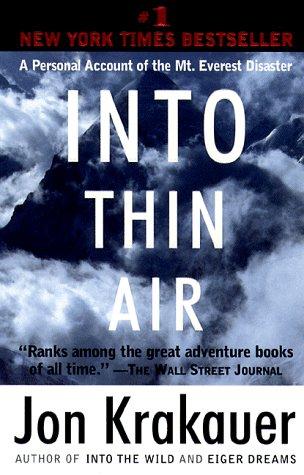
Into Thin Air
by Jon Krakauer
★ Top 10 book of 1997 · #6 on Best Books of 1997
Jon Krakauer reached Everest's summit on May 10, 1996, exhausted and short of oxygen, just before a storm closed in on the climbers behind him. His eyewitness report covers the deadliest season on the mountain and the pull it exerts on people.
Best for: Armchair adventurers drawn to true survival stories and the lure of Everest
Into Thin Air is #6 on BookWard's Best Books of 1997, out of 28 1997 books that cleared our data bar.
What Into Thin Air is about
Jon Krakauer, a journalist for the adventure magazine Outside, set out to report on the commercialization of Mount Everest and meant to climb only as far as base camp. But the mountain revived a childhood dream, and he asked his editor to delay publication by a year so he could train for a summit attempt. He joined an expedition led by Rob Hall of Adventure Consultants, while Scott Fischer, whose agency Mountain Madness was seen as a rival, led another group on the same summit day.
Krakauer reached the top on the afternoon of May 10, 1996, after being awake for fifty-seven hours. A storm then struck, killing eight climbers and stranding others. His account is sober and reflective, and it concludes that competition between guiding agencies sometimes compromised essential safety methods. It will appeal to readers of adventure writing and anyone curious about ambition, risk and what happens when the wildest places become a business.
Into Thin Air on the Best Books of 1997
Into Thin Air came out in 1997. Of the 28 books first published in 1997 that met BookWard's data bar, it ranks #6 on our Best Books of 1997 list.
Why it made the list: 466 readers have shelved it on Open Library; readers rate it 4.4 out of 5 (39 ratings); 25 are reading it right now. The list ranks each year’s books on how many readers have picked them up, how highly readers rate them, and how many are reading them right now.
It earns Reader favorite.
Nearby on the 1997 list
- The Adventures of Captain Underpants Dav Pilkey, #4
- The Power of Now Eckhart Tolle, #5
- The God of Small Things Arundhati Roy, #7
- Wizard and Glass Stephen King, #8
See all Best Books of 1997 Best books by year
More years: Best Books of 1996 Best Books of 1998.
The numbers behind it
- Readers: 384 want to read it, 25 are reading it now and 57 have read it, according to Open Library.
- Ratings: 4.4 out of 5 from 39 Open Library ratings.
| Signal | This book (0 to 100) | Weight |
|---|---|---|
| Reach | 64 | 55% |
| Reader love | 100 | 25% |
| Being read right now | 75 | 20% |
Questions about Into Thin Air
When was Into Thin Air published?
Into Thin Air by Jon Krakauer was first published in 1997.
Was Into Thin Air one of the best books of 1997?
Into Thin Air is #6 on BookWard's Best Books of 1997, out of 28 1997 books that cleared our data bar. 466 readers have shelved it on Open Library; readers rate it 4.4 out of 5 (39 ratings); 25 are reading it right now.
Why is Into Thin Air on the Best Books of 1997 list?
466 readers have shelved it on Open Library; readers rate it 4.4 out of 5 (39 ratings); 25 are reading it right now.
More of the best books of 1997
- Harry Potter and the Philosopher's Stone J. K. Rowling, #1
- Rich Dad, Poor Dad Robert T. Kiyosaki, #2
- Guns, Germs, and Steel Jared Diamond, #3
- The Adventures of Captain Underpants Dav Pilkey, #4
- The Power of Now Eckhart Tolle, #5
- The God of Small Things Arundhati Roy, #7
See the full Best Books of 1997, the Top 100, or new books on Rising.
How we know
This page uses public data: Open Library reader counts and ratings, and Wikipedia page views for recent years. The description is paraphrased from real source text. Rankings reflect reading interest, not quality or sales, and can be affected by data gaps. Lists update monthly.
Suits mature teens and adults who want a gripping true story.
Depends on the edition you pick.
A first-person Everest disaster account that grips from page one. 61% taste match
 BookWard’s take
A first-person Everest disaster account that grips from page one
Krakauer was on the mountain in May 1996, and that shows on every page. The book opens at the summit with the weather beginning to turn, which is about as strong a start as a disaster narrative can have, and the momentum never lets up because everything keeps moving toward the storm. It is nonfiction, so rigor matters, and his reporting is careful. He also wrestles openly with what he got wrong. He tells the story from inside it, which makes it a deeply personal account and gives him an unmistakable voice. Everest is unfamiliar territory for most readers, and he explains the altitude, the logistics and the commercial guiding trade in plain language. The outlook is bleak, and the book earns its darkness through the events it records, never through shock for effect.
A full-length narrative that stays on the single expedition, so it runs longer than BookWard likes but never feels padded.
Early chapters build the expedition steadily, and the push to the summit then moves fast, a touch under BookWard's preferred speed.
Everest accounts exist, but this one's mix of memoir, reportage and critique of commercial climbing feels fresh.
Clear, direct journalistic prose with the occasional vivid image, a little richer than BookWard's plain-leaning taste.
The events on the mountain drive things, though the author's inner turmoil shapes how they are told.
The tone is mournful, shadowed by loss and by Krakauer's own survivor's guilt.
It moves chronologically with some looking-back on the author's motives and the mountain's history.
Humor appears only in small moments of dry observation, since the subject is grave.
Eight deaths and the dying of climbers on the slopes make this heavy going.
The grief and guilt run deep, but are expressed through a reporter's controlled voice.
See all 50 dialsEvery position, side by side with this book
Where it lines up
- SentimentBookWard 8 · book 8
- Shock for effectBookWard 9 · book 9
- Sagging middleBookWard 8 · book 8
Where it pulls apart
- LengthBookWard 1 · book 5
- ExpositionBookWard 2 · book 6
- Familiar tropesBookWard 10 · book 8
A full-length narrative that stays on the single expedition, so it runs longer than BookWard likes but never feels padded.
It opens on the summit and the shifting sky, which lands very close to BookWard's taste for an immediate pull.
Disaster narratives could lean on heroics, but Krakauer mostly keeps to what happened and avoids the stock mountaineering clichés BookWard dislikes.
The account follows a clear chain of cause and effect, tying the outcome to guiding decisions and competition between agencies.
Early chapters build the expedition steadily, and the push to the summit then moves fast, a touch under BookWard's preferred speed.
Everest accounts exist, but this one's mix of memoir, reportage and critique of commercial climbing feels fresh.
The climbers come through as real people, though a large group means some get only brief sketches.
The disaster is resolved on the page, and the reckoning is honest about what stays unanswered.
Krakauer writes about loss plainly, which suits BookWard's liking for restraint over sentimentality.
Death comes from the mountain and the choices made on it, and the book never reaches for it as spectacle.
Journalistic reporting underpins the account, and Krakauer weighs his own memory against other testimony, close to BookWard's standard.
The first-person reporter's eye and candor give it a clearly recognizable stamp.
It is firmly story-led, though it also asks why people risk everything for a summit.
Altitude, gear and guiding practice get explained outright in places, more than BookWard prefers, though always in service of the narrative.
The climb builds toward the summit day with little drift, so tension holds throughout.
Clear, direct journalistic prose with the occasional vivid image, a little richer than BookWard's plain-leaning taste.
The events on the mountain drive things, though the author's inner turmoil shapes how they are told.
The tone is mournful, shadowed by loss and by Krakauer's own survivor's guilt.
It moves chronologically with some looking-back on the author's motives and the mountain's history.
Humor appears only in small moments of dry observation, since the subject is grave.
The writing is accessible, and the technical climbing detail is made easy to follow for newcomers.
Krakauer's own eyes dominate, though he relays what other climbers experienced.
It runs largely in order from Kathmandu to the summit and back, with brief pauses for backstory.
Everything is real, rooted in a documented 1996 expedition.
Several expedition teams, guides and clients crowd the pages, enough to take effort to track.
The stakes are huge for the people involved, but the narrative stays tightly on one mountain and one season.
Physical action and survival dominate, though his reflections on the experience weigh heavily too.
Some recalled exchanges appear, but narration and description carry most of the load.
This is a mountaineering account; romance has no role.
The Himalaya and the high-altitude world are unfamiliar to most readers, which adds to the draw.
It is set in 1996, now a generation past but still recent.
The questions about ambition, risk and commercialization keep it relevant long after publication.
Krakauer is a candid witness who openly questions his own memory, so reliability is high.
The book judges the commercial pressures and some decisions fairly clearly while admitting uncertainty about blame.
Cold, thin air, exhaustion and landscape are vividly rendered without overloading the narrative.
It reads as a narrative account first, with analysis woven in along the way.
He is a participant and says so, putting himself squarely inside the story.
A standalone account of a single expedition.
The path of the disaster is known, though the specific turns of events still catch the reader off guard.
It stays with hard questions of responsibility and survivor's guilt and refuses to comfort.
Eight deaths and the dying of climbers on the slopes make this heavy going.
The grief and guilt run deep, but are expressed through a reporter's controlled voice.
What humor appears is dry and passing rather than broad.
There is no human violence, but death and bodily suffering from cold and altitude are described plainly.
Sexual content does not figure here.
Politics sits at the edges, mainly in the business dynamics of guided expeditions.
The language is plain, with only some climbing and mountaineering terms to pick up.
Krakauer offers views on commercial guiding and the decisions made, so the narration is quite opinionated.
It looks back at one fixed season, with reflection on what it meant afterwards.
The mood is sobering, skeptical of hubris and commerce on the mountain.
Review written by BookWard, dial version 1, November 2026.
Who is Into Thin Air right for?
Suits mature teens and adults who want a gripping true story. It contains death, bodily suffering and grief, and some readers may find the loss of life hard to take.
The writing is accessible, and the technical climbing detail is made easy to follow for newcomers.
Eight deaths and the dying of climbers on the slopes make this heavy going.
The grief and guilt run deep, but are expressed through a reporter's controlled voice.
There is no human violence, but death and bodily suffering from cold and altitude are described plainly.
Book CompanionInto Thin Air: ideas, characters, themes
A journalist who joined a commercial Everest expedition in 1996 reconstructs the deadly storm and asks what drives people, and the industry around them, toward such risk.
- A reporter turned climber. Krakauer first meant to cover the commercialization of Everest for Outside, then trained to attempt the summit himself.
- Rival guiding agencies. Rob Hall's Adventure Consultants and Scott Fischer's Mountain Madness were competing teams on the mountain that day.
- The summit push. The narrative moves between events on the mountain and the unfolding tragedy during the climb to the top.
- Eight deaths. The 1996 disaster recorded eight deaths, including Krakauer's guide, Rob Hall.
- Competition and safety. Krakauer concludes that rivalry between agencies to get clients to the summit sometimes compromised safety practices.
Characters
Jon Krakauer
Narrator and journalist
An Outside magazine writer who joined an Everest expedition and survived the 1996 disaster.
Rob Hall
Expedition guide
Led Krakauer's expedition for Adventure Consultants and was among those killed.
Scott Fischer
Rival guide
Led a group that was also attempting the summit that day, for the agency Mountain Madness.
Themes
Why people accept danger, cost and loss for a single goal.
How paying clients and competition reshape a once-elite pursuit.
The weight of living when others did not.
The mountain and the weather do not bend to human plans.
How hard it is to reconstruct events in an oxygen-starved haze.
Discussion questions
- Why did Krakauer want to climb Everest after giving up serious climbing years before?
- How did competition between guiding agencies shape the decisions made on summit day?
- Can anyone be fairly blamed for what happened, or was it a chain of small choices?
- How does the author's presence as a participant strengthen or complicate the account?
- Does the book change how you see commercial adventure travel?
Personalize your Book Companion
This is the general edition. In BookWard, the Companion is written for you: your reading profile, your notes, and spoiler-safe to the page you are on.
Buy, listen or borrow Into Thin Air
Each link opens a search for this book on that store, in a new tab.
Read on a device
Borrow
Reviews and community
If you liked Into Thin Air
A tight, gripping history of the whaleship Essex and its survivors
Into the WildJon KrakauerA reported hunt for why a young man walked into Alaska
Down and Out in Paris and LondonGeorge OrwellOrwell's first book, and a clear-eyed look at poverty
The Hot ZoneRichard PrestonA viral outbreak told at thriller speed, with real horror
Find your own best books
Add what you have read, rate it, and BookWard will recommend what to read next.
Free to start. No credit card needed.