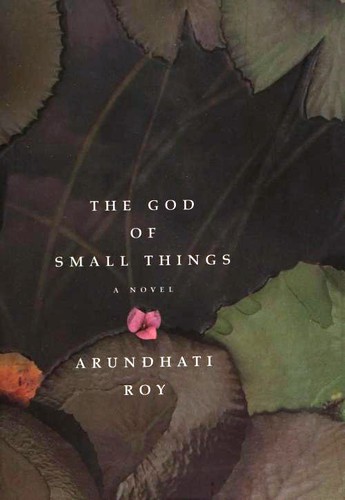
The God of Small Things
by Arundhati Roy
★ Top 10 book of 1997 · #7 on Best Books of 1997
Arundhati Roy's debut follows fraternal twins whose childhoods are wrecked by rigid rules about who may be loved. The novel looks at how small things shape lives, and turns its irony on caste discrimination in India.
Best for: Readers drawn to prize-winning debut fiction that examines caste, love, and childhood in India
The God of Small Things is #7 on BookWard's Best Books of 1997, out of 28 1997 books that cleared our data bar.
What The God of Small Things is about
In Ayemenem, in Kerala, India, the twins Rahel and Estha grow up in a household full of tension. Their mother, Ammu, has divorced their father and come home to her family, where she is not entirely welcome. The story moves between 1969, when the twins are children, and 1993, when they meet again as adults. In between lies a season of visits, a pickle factory, and a friendship and forbidden attachment that cross the lines of caste. Set against the political upheaval of the 1960s and the long shadow of British colonialism, the novel asks who is allowed to be loved, and how. Arundhati Roy's debut won the 1997 Booker Prize. Its prose is lyrical, sensory and melancholic, and it will suit readers who enjoy language as much as plot and are ready for a story about childhood and loss.
The God of Small Things on the Best Books of 1997
The God of Small Things came out in 1997. Of the 28 books first published in 1997 that met BookWard's data bar, it ranks #7 on our Best Books of 1997 list.
Why it made the list: 1,437 readers have shelved it on Open Library; readers rate it 3.8 out of 5 (78 ratings); 96 are reading it right now. The list ranks each year’s books on how many readers have picked them up, how highly readers rate them, and how many are reading them right now.
Nearby on the 1997 list
- The Power of Now Eckhart Tolle, #5
- Into Thin Air Jon Krakauer, #6
- Wizard and Glass Stephen King, #8
- Memoirs of a Geisha Arthur Golden, #9
See all Best Books of 1997 Best books by year
More years: Best Books of 1996 Best Books of 1998.
The numbers behind it
- Readers: 1,234 want to read it, 96 are reading it now and 106 have read it, according to Open Library.
- Ratings: 3.8 out of 5 from 78 Open Library ratings.
| Signal | This book (0 to 100) | Weight |
|---|---|---|
| Reach | 89 | 55% |
| Reader love | 25 | 25% |
| Being read right now | 89 | 20% |
Questions about The God of Small Things
When was The God of Small Things published?
The God of Small Things by Arundhati Roy was first published in 1997.
Was The God of Small Things one of the best books of 1997?
The God of Small Things is #7 on BookWard's Best Books of 1997, out of 28 1997 books that cleared our data bar. 1,437 readers have shelved it on Open Library; readers rate it 3.8 out of 5 (78 ratings); 96 are reading it right now.
Why is The God of Small Things on the Best Books of 1997 list?
1,437 readers have shelved it on Open Library; readers rate it 3.8 out of 5 (78 ratings); 96 are reading it right now.
More of the best books of 1997
- Harry Potter and the Philosopher's Stone J. K. Rowling, #1
- Rich Dad, Poor Dad Robert T. Kiyosaki, #2
- Guns, Germs, and Steel Jared Diamond, #3
- The Adventures of Captain Underpants Dav Pilkey, #4
- The Power of Now Eckhart Tolle, #5
- Into Thin Air Jon Krakauer, #6
See the full Best Books of 1997, the Top 100, or new books on Rising.
How we know
This page uses public data: Open Library reader counts and ratings, and Wikipedia page views for recent years. The description is paraphrased from real source text. Rankings reflect reading interest, not quality or sales, and can be affected by data gaps. Lists update monthly.
Best suited to mature teens and adults comfortable with demanding prose.
Depends on the edition you pick.
A Booker-winning family tragedy told in fractured time. 56% taste match
 BookWard’s take
A Booker-winning family tragedy told in fractured time
Arundhati Roy's 1997 debut follows the twins Estha and Rahel in 1960s Kerala and again in their thirties, circling the events that broke their family apart. The voice is unmistakably hers: the language is entirely her own, full of coined phrases, capitalized refrains and playful repetition. The prose is richly ornate, more so than I usually like, and the structure is boldly experimental, with time shifting constantly. It is also gentler in its pull than I tend to prefer, because the book unfolds by accretion rather than propulsion. But the internal logic is tightly built, with small images paying off, and the darkness feels earned because it serves the story. It is a character-driven, politically charged novel about caste, love and the rules that govern both.
A mid-length novel, substantial but not sprawling; BookWard prefers tighter books, though this one carries its weight.
The narrative moves in slow spirals through memory instead of racing forward, slower than BookWard's preference.
Few novels sound or move like this one, which is exactly what BookWard prizes.
Dense with invented compounds, wordplay and lyrical repetition, far more ornate than BookWard's usual taste.
The book is driven by the inner lives and bonds of its characters more than by plot mechanics.
Loss and punishment dominate, with only fragile moments of tenderness; bleaker than BookWard's hopeful lean.
Time breaks and loops between 1969 and 1993, far more experimental than BookWard typically picks.
Wit flickers in the wordplay, but the overall tone is serious and mournful.
Child abuse, a death and brutal social punishment make this a dark read.
Grief and longing run high, and the book hits hard.
See all 50 dialsEvery position, side by side with this book
Where it lines up
- Familiar tropesBookWard 10 · book 9
- Internal logicBookWard 10 · book 9
- OriginalityBookWard 9 · book 10
Where it pulls apart
- OpeningBookWard 10 · book 5
- LengthBookWard 1 · book 5
- PaceBookWard 8 · book 4
A mid-length novel, substantial but not sprawling; BookWard prefers tighter books, though this one carries its weight.
The opening lingers and circles rather than grabbing at once, which is slower than BookWard likes.
Its imagery, structure and treatment of caste and family avoid stock moves, which BookWard rewards.
Motifs and events interlock closely, with early details returning meaningfully, matching BookWard's taste for airtight construction.
The narrative moves in slow spirals through memory instead of racing forward, slower than BookWard's preference.
Few novels sound or move like this one, which is exactly what BookWard prizes.
Estha, Rahel and Ammu are drawn with deep interior life and contradiction, fitting BookWard's taste well.
The ending resolves the central events while leaving feeling to linger; reasonably close to BookWard's preference.
Tenderness is present but pointed, with feeling channeled through precise images rather than easy sentiment.
Its darkest events arise from the social order the book is examining, so the darkness feels earned.
This is a novel, so the rigor dial does not apply.
Roy's voice is unmistakable and unlike anyone else's, a top-of-the-scale match for BookWard.
Ideas about caste and love are carried inside a story with real narrative pull, so it leans story-led.
Meaning arrives through images and scenes rather than explanation, which suits BookWard's preference.
The structure's circling keeps tension building, though a few stretches linger in memory longer than needed.
Dense with invented compounds, wordplay and lyrical repetition, far more ornate than BookWard's usual taste.
The book is driven by the inner lives and bonds of its characters more than by plot mechanics.
Loss and punishment dominate, with only fragile moments of tenderness; bleaker than BookWard's hopeful lean.
Time breaks and loops between 1969 and 1993, far more experimental than BookWard typically picks.
Wit flickers in the wordplay, but the overall tone is serious and mournful.
The language and shifting time ask for attention and patience, more demanding than BookWard's norm.
The narration drifts close to several characters, though the twins remain the emotional center.
The story hops between childhood and adulthood constantly, about as shifting as a novel gets.
The world is grounded and realistic, even when the language turns dreamlike.
A single family and a few outsiders make for a contained, manageable cast.
Despite the political backdrop, the story stays close to one household and its secrets.
Feeling, memory and perception drive the book more than outward action does.
Speech is present but secondary to narration and imagery.
A forbidden love is central to the tragedy, though family and caste are equally important.
Kerala in the 1960s will be unfamiliar to many readers, which BookWard enjoys.
The main events happen decades ago, with a later reunion framing them.
Its themes of caste, love and loss keep it vital well past its 1997 publication.
The narration is trustworthy about events even as it plays with how and when they are revealed.
The book is clear about who is harmed and by what, though individual motives are tangled.
Sensory, vivid detail saturates nearly every page, richer than BookWard's usual taste.
This is fiction, so the nonfiction style dial does not apply.
This is fiction, so the nonfiction perspective dial does not apply.
A self-contained novel with no sequels.
The book reveals its events gradually, but they are anticipated rather than sprung as surprises.
It confronts caste, abuse and injustice directly, offering little comfort.
Child abuse, a death and brutal social punishment make this a dark read.
Grief and longing run high, and the book hits hard.
Humor is dry and ironic, edged with bitterness.
Violence is present and consequential, though not on every page.
A forbidden affair and an abusive incident appear, handled seriously rather than gratuitously.
Caste, Communism and colonial legacy are woven into the plot and shape every outcome.
Wordplay, invented phrasing and Malayalam-inflected speech make the language dense in places.
The narration carries a clear, angry moral intelligence rather than staying neutral.
The book keeps looking back at what happened and what it cost.
It is clear-eyed and unsparing about cruelty, with only glimmers of idealism.
Review written by BookWard, dial version 1, November 2026.
Who is The God of Small Things right for?
Best suited to mature teens and adults comfortable with demanding prose. It deals with child abuse, a child's death, caste violence and a sexual relationship, so it can be distressing.
The language and shifting time ask for attention and patience, more demanding than BookWard's norm.
Child abuse, a death and brutal social punishment make this a dark read.
Grief and longing run high, and the book hits hard.
Violence is present and consequential, though not on every page.
Book CompanionThe God of Small Things: ideas, characters, themes
A family's private tragedy is inseparable from the rigid social laws governing caste, class and who may love whom.
- Two timelines. The story moves between 1969, when the twins are seven, and 1993, when they reunite as adults.
- The Love Laws. The book frames its central conflict as rules about who should be loved, and how, and how much.
- Small things. Minor details and gestures shape lives and carry as much weight as large public events.
- Postcolonial backdrop. British colonial legacy and casteism in India sit at the center of the book's themes.
- A distinctive style. Roy's invented phrasing and repetition create a voice that defines the reading experience.
Characters
Estha (Esthappen)
One of the twins
A fraternal twin whose childhood experiences leave a deep mark on his adult life.
Rahel
One of the twins
The other twin, whose reunion with her brother in adulthood frames the story.
Ammu
The twins' mother
Divorced and returned to her family home, she becomes drawn into a forbidden relationship.
Velutha
A servant at the family pickle factory
An untouchable worker and close friend of the twins whose relationship with Ammu has grave consequences.
Baby Kochamma
The twins' grand-aunt
A member of the household whose humiliation and resentments shape events.
Themes
How rigid social hierarchy dictates who is valued, who is punished, and who may be loved.
Love that crosses social boundaries and the price those who attempt it pay.
How early experiences echo through adult lives and are revisited across time.
The lingering effects of British rule on family attitudes, language and aspiration.
How style and wordplay shape meaning and carry feeling.
Discussion questions
- How does moving between 1969 and 1993 change the way you understand the twins?
- What do the Love Laws reveal about the society the book portrays?
- Why might Roy have chosen such an ornate, playful style for such painful material?
- How do the book's small details accumulate into larger meaning?
- Who bears responsibility for what happens, and does the book assign blame clearly?
Personalize your Book Companion
This is the general edition. In BookWard, the Companion is written for you: your reading profile, your notes, and spoiler-safe to the page you are on.
Buy, listen or borrow The God of Small Things
Each link opens a search for this book on that store, in a new tab.
Read on a device
Borrow
Reviews and community
If you liked The God of Small Things
A short, devastating debut about beauty, shame, and who gets seen
Wuthering HeightsEmily BrontëA savage, original Gothic love story that still unsettles
BelovedToni MorrisonA haunted house, a scarred past, and prose that refuses to look away
AtonementIan McEwanOne girl's mistake, and a novel about what writing owes the truth
Find your own best books
Add what you have read, rate it, and BookWard will recommend what to read next.
Free to start. No credit card needed.