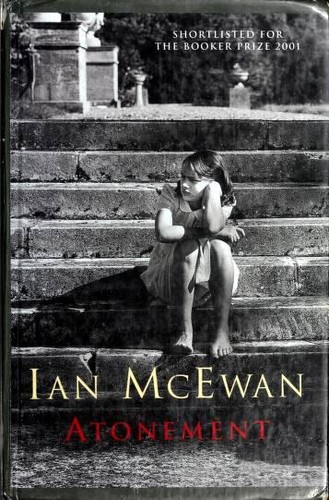
Atonement
by Ian McEwan
★ Top 10 book of 2001 · #8 on Best Books of 2001
A young girl from a wealthy family makes a half-innocent mistake that wrecks lives, and the story follows her adulthood in its shadow. Spanning 1935, wartime England and France, and the present, it also reflects on what writing means.
Best for: Readers who enjoy award-shortlisted, reflective novels that explore guilt and the craft of writing
Atonement is #8 on BookWard's Best Books of 2001, out of 35 2001 books that cleared our data bar.
What Atonement is about
On a hot summer day in 1935, thirteen-year-old Briony Tallis, a girl who loves to write, is at her family's country house with her older sister Cecilia and Robbie Turner, the housekeeper's son whose schooling the family paid for. Visiting cousins and a friend of her brother's bring new tension to the house, and a misdelivered note leaves Briony holding information she is too young to understand. She draws a conclusion that will shape many lives.
McEwan follows the fallout across three periods: that fateful summer, wartime England and France, and the present day. Beneath the story sits a question about what a writer owes the people she writes about, and how far imagination can go toward repairing real harm. Readers who like moral weight in their fiction will find a lot to turn over here.
Atonement on the Best Books of 2001
Atonement came out in 2001. Of the 35 books first published in 2001 that met BookWard's data bar, it ranks #8 on our Best Books of 2001 list.
Why it made the list: 715 readers have shelved it on Open Library; readers rate it 3.7 out of 5 (49 ratings); 24 are reading it right now. The list ranks each year’s books on how many readers have picked them up, how highly readers rate them, and how many are reading them right now.
Nearby on the 2001 list
- Unbroken Laura Hillenbrand, #6
- Deception Point Dan Brown, #7
- Baby Einstein Julie Aigner-Clark, #9
- Violets Are Blue James Patterson, #10
See all Best Books of 2001 Best books by year
More years: Best Books of 2000 Best Books of 2002.
The numbers behind it
- Readers: 617 want to read it, 24 are reading it now and 74 have read it, according to Open Library.
- Ratings: 3.7 out of 5 from 49 Open Library ratings.
| Signal | This book (0 to 100) | Weight |
|---|---|---|
| Reach | 89 | 55% |
| Reader love | 29 | 25% |
| Being read right now | 80 | 20% |
Questions about Atonement
When was Atonement published?
Atonement by Ian McEwan was first published in 2001.
Was Atonement one of the best books of 2001?
Atonement is #8 on BookWard's Best Books of 2001, out of 35 2001 books that cleared our data bar. 715 readers have shelved it on Open Library; readers rate it 3.7 out of 5 (49 ratings); 24 are reading it right now.
Why is Atonement on the Best Books of 2001 list?
715 readers have shelved it on Open Library; readers rate it 3.7 out of 5 (49 ratings); 24 are reading it right now.
More of the best books of 2001
- American Gods Neil Gaiman, #1
- Eat That Frog! 21 Great Ways to Stop Procrastinating and Get More Done in Less Time Brian Tracy, #2
- Crucial Conversations Kerry Patterson, #3
- Point Blanc Anthony Horowitz, #4
- Getting Things Done David Allen, #5
- Unbroken Laura Hillenbrand, #6
See the full Best Books of 2001, the Top 100, or new books on Rising.
How we know
This page uses public data: Open Library reader counts and ratings, and Wikipedia page views for recent years. The description is paraphrased from real source text. Rankings reflect reading interest, not quality or sales, and can be affected by data gaps. Lists update monthly.
Best suited to adult and mature teen readers.
Depends on the edition you pick.
One girl's mistake, and a novel about what writing owes the truth. 55% taste match
 BookWard’s take
One girl's mistake, and a novel about what writing owes the truth
Atonement opens on a hot summer day in 1935, when a thirteen-year-old with a gift for storytelling is handed a piece of information she misreads. The consequences run through three time periods, and the book is as much about the act of writing as about the harm done. What impresses most is how tightly the whole thing is built: every misunderstanding feels inevitable, as if it could not have gone any other way. The characters have real depth, especially in the way Briony thinks, and the voice is unmistakably McEwan's. The prose runs more ornate than I usually like, and the opening takes a patient, scene-setting approach rather than hooking you at once. It was shortlisted for the 2001 Booker Prize, and the ending is the part readers argue about longest.
A medium-length novel that takes room for three time periods; not tight, not sprawling, and it uses the space deliberately.
The first section moves slowly, dwelling on one day, before the story speeds up; steadier than BookWard's preferred pace.
A story about a mistake that also reflects on storytelling itself feels distinctive and layered beyond its romance and war surface.
Elaborate, finely worked sentences and heavy interiority put it on the ornate side, richer than BookWard's usual taste.
What happens flows from who Briony, Cecilia and Robbie are, so it is firmly character-led.
Regret and irreversible damage dominate, with little consolation, which is bleaker than BookWard's gently hopeful lean.
Three time periods and a final reframing make the structure more inventive than a conventional chronicle.
A serious, sober book with very little room for comedy.
Wartime and the fallout of a false accusation bring real darkness, though not relentlessly.
Regret, longing and guilt run deep and carry real emotional force.
See all 50 dialsEvery position, side by side with this book
Where it lines up
- Authorial voiceBookWard 9 · book 9
- Internal logicBookWard 10 · book 9
- OriginalityBookWard 9 · book 8
Where it pulls apart
- OpeningBookWard 10 · book 4
- LengthBookWard 1 · book 5
- PaceBookWard 8 · book 4
A medium-length novel that takes room for three time periods; not tight, not sprawling, and it uses the space deliberately.
It opens with a slow, atmospheric country-house day rather than a grabber, which sits against BookWard's wish to be hooked at once.
The country-house setting is familiar, but the way the story turns on a child's misreading is handled with real freshness.
The central misunderstanding is built so every step follows from the last, which suits BookWard's love of airtight cause and effect.
The first section moves slowly, dwelling on one day, before the story speeds up; steadier than BookWard's preferred pace.
A story about a mistake that also reflects on storytelling itself feels distinctive and layered beyond its romance and war surface.
Briony's mind is drawn with close, patient attention, which is exactly the depth BookWard rewards.
It resolves the plot yet reframes what came before, leaving some readers unsettled; less tidy than BookWard's taste for closure.
It draws on longing and regret, with feeling that is earned by the story and not milked, though it leans emotive at moments.
The harm in the story comes from character and consequence, not shock for its own sake, so the darkness feels earned.
Not nonfiction, so this dial does not apply.
McEwan's controlled, observant voice is unmistakable, matching BookWard's appetite for a distinctive author.
Story carries the weight, but the book is also an extended reflection on writing, so ideas matter more than usual.
Most of it is shown through scene and interior thought, in line with BookWard's preference for showing.
The long opening and the later sections hold attention differently, but nothing drifts without purpose.
Elaborate, finely worked sentences and heavy interiority put it on the ornate side, richer than BookWard's usual taste.
What happens flows from who Briony, Cecilia and Robbie are, so it is firmly character-led.
Regret and irreversible damage dominate, with little consolation, which is bleaker than BookWard's gently hopeful lean.
Three time periods and a final reframing make the structure more inventive than a conventional chronicle.
A serious, sober book with very little room for comedy.
The prose and the shifting frame ask for attention, though the story itself stays readable.
The narration moves between several characters' minds, giving the story more than one angle.
It jumps across 1935, wartime England and France, and the present day, so time is not linear.
Entirely grounded in realistic English and French settings.
A family household plus a handful of visitors keeps the cast modest and easy to track.
The war gives it wider reach, but the heart of the book is a family and one fateful summer.
Much of the drama happens inside the characters' heads, in perception and misperception.
Conversation matters, but it shares the page with long stretches of narration and thought.
A love story between Cecilia and Robbie sits at the heart of what goes wrong.
Mostly recognizable English settings, with the wartime France sections adding some unfamiliarity.
Its three periods run from 1935 through the Second World War to the present day, so most of the story looks to the past.
Named to Time's list of 100 greatest English-language novels since 1923, it has held its place.
The book's frame invites questions about who is telling the story and how far to trust it.
Guilt and blame are tangled; Briony's act is neither simply innocent nor simply cruel.
The setting, the heat of the summer and the household are described in rich, sensory detail.
A standalone novel.
Its biggest surprises arrive through the structure and what the reader learns about the telling.
Emotionally uncomfortable, asking readers to sit with a damaging mistake and its lasting cost.
Wartime and the fallout of a false accusation bring real darkness, though not relentlessly.
Regret, longing and guilt run deep and carry real emotional force.
Wit is minimal; any humor is dry and incidental.
Wartime brings some harrowing scenes, but they are not the book's focus.
An explicit crude phrase and a scene of sexual violence are present, but not dwelt on.
Class and war are the backdrop, not the argument.
The language is literary and layered but not dialect-heavy.
The narration comments and reflects, but mostly stays measured.
Preoccupied with the past and how it is remembered.
A sober, disillusioned view of what people can undo or repair.
Review written by BookWard, dial version 1, November 2026.
Who is Atonement right for?
Best suited to adult and mature teen readers. It contains a crude phrase in a letter, a sexual assault element, and wartime suffering.
The prose and the shifting frame ask for attention, though the story itself stays readable.
Wartime and the fallout of a false accusation bring real darkness, though not relentlessly.
Regret, longing and guilt run deep and carry real emotional force.
Wartime brings some harrowing scenes, but they are not the book's focus.
Book CompanionAtonement: ideas, characters, themes
A young writer's half-innocent mistake ruins lives, and the book asks what writing can and cannot do to make amends.
- One day, three periods. The story is set in 1935 England, wartime England and France, and present-day England.
- A gifted child. Briony Tallis is thirteen and already driven to write, which shapes how she reads the world.
- The misread letter. Robbie's accidentally wrong draft sets Briony's suspicions in motion.
- Writing about writing. The novel reflects on the nature of writing as much as on the events it tells.
- Recognition. It was shortlisted for the 2001 Booker Prize and later adapted into an award-winning film.
Characters
Briony Tallis
Young writer at the center
A thirteen-year-old with a talent for writing, whose mistake drives the story.
Cecilia Tallis
Briony's older sister
A Cambridge graduate whose relationship with Robbie is central to events.
Robbie Turner
Housekeeper's son
Cecilia's childhood friend, whose university education Jack Tallis funded.
Lola
Visiting cousin
A fifteen-year-old who comes to stay amid her parents' divorce.
Themes
How a mistake can shape a whole life.
What writing can reveal, distort or try to repair.
How social position shapes who is believed.
How limited perspective turns innocent acts into harm.
Discussion questions
- Is Briony's mistake truly innocent, or half-innocent as the book frames it?
- What does the novel suggest writing can do to atone for harm?
- How does the shift between time periods change how you judge Briony?
- Why might McEwan make the book a reflection on its own telling?
- How much does class shape what happens to Robbie?
Personalize your Book Companion
This is the general edition. In BookWard, the Companion is written for you: your reading profile, your notes, and spoiler-safe to the page you are on.
Buy, listen or borrow Atonement
Each link opens a search for this book on that store, in a new tab.
Read on a device
Borrow
Reviews and community
If you liked Atonement
A murder case retold through a woman who may not remember
FlashlightSusan ChoiA family wrecked by one night on a breakwater
The God of Small ThingsArundhati RoyA Booker-winning family tragedy told in fractured time
Snow Falling on CedarsDavid GutersonA courtroom drama where snow and memory press on an island
Find your own best books
Add what you have read, rate it, and BookWard will recommend what to read next.
Free to start. No credit card needed.