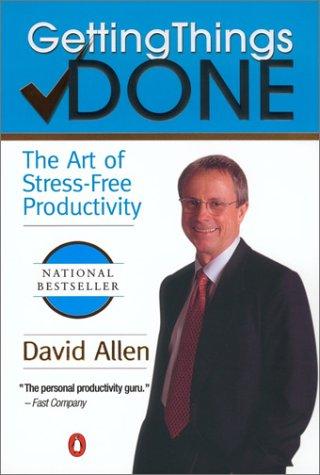
Getting Things Done
by David Allen
★ Top 5 book of 2001 · #5 on Best Books of 2001
A veteran coach and management consultant presents his methods for working without stress. His central idea is that we get more done when we can relax, which requires a clear mind and organized thoughts.
Best for: Busy people wanting a calmer, more organized approach to productivity and creativity
Getting Things Done is #5 on BookWard's Best Books of 2001, out of 35 2001 books that cleared our data bar.
What Getting Things Done is about
Allen's starting point is a simple observation: the more you try to hold in your head, the less you tend to finish. His system asks you to get everything out of your mind and into a trusted external record, whether tasks, projects, worries or loose ideas. Each item is then broken into concrete actions with clear time limits, so your attention goes to doing the work rather than trying to remember it.
Behind the method is his belief that productivity rises with our ability to relax. A veteran coach and management consultant, Allen writes in a practical, encouraging tone. The book first appeared in 2001, and a 2015 revision updated it for the changes in technology since. It suits anyone who feels buried under commitments and wants a calmer, clearer way to organize their days.
Getting Things Done on the Best Books of 2001
Getting Things Done came out in 2001. Of the 35 books first published in 2001 that met BookWard's data bar, it ranks #5 on our Best Books of 2001 list.
Why it made the list: 513 readers have shelved it on Open Library; readers rate it 3.8 out of 5 (56 ratings); 30 are reading it right now. The list ranks each year’s books on how many readers have picked them up, how highly readers rate them, and how many are reading them right now.
Nearby on the 2001 list
- Crucial Conversations Kerry Patterson, #3
- Point Blanc Anthony Horowitz, #4
- Unbroken Laura Hillenbrand, #6
- Deception Point Dan Brown, #7
See all Best Books of 2001 Best books by year
More years: Best Books of 2000 Best Books of 2002.
The numbers behind it
- Readers: 409 want to read it, 30 are reading it now and 74 have read it, according to Open Library.
- Ratings: 3.8 out of 5 from 56 Open Library ratings.
| Signal | This book (0 to 100) | Weight |
|---|---|---|
| Reach | 83 | 55% |
| Reader love | 40 | 25% |
| Being read right now | 86 | 20% |
Questions about Getting Things Done
When was Getting Things Done published?
Getting Things Done by David Allen was first published in 2001.
Was Getting Things Done one of the best books of 2001?
Getting Things Done is #5 on BookWard's Best Books of 2001, out of 35 2001 books that cleared our data bar. 513 readers have shelved it on Open Library; readers rate it 3.8 out of 5 (56 ratings); 30 are reading it right now.
Why is Getting Things Done on the Best Books of 2001 list?
513 readers have shelved it on Open Library; readers rate it 3.8 out of 5 (56 ratings); 30 are reading it right now.
More of the best books of 2001
- American Gods Neil Gaiman, #1
- Eat That Frog! 21 Great Ways to Stop Procrastinating and Get More Done in Less Time Brian Tracy, #2
- Crucial Conversations Kerry Patterson, #3
- Point Blanc Anthony Horowitz, #4
- Unbroken Laura Hillenbrand, #6
- Deception Point Dan Brown, #7
See the full Best Books of 2001, the Top 100, or new books on Rising.
How we know
This page uses public data: Open Library reader counts and ratings, and Wikipedia page views for recent years. The description is paraphrased from real source text. Rankings reflect reading interest, not quality or sales, and can be affected by data gaps. Lists update monthly.
It suits working adults and older students looking to organize their time and commitments.
Depends on the edition you pick.
A practical system for getting your head clear and your work moving. 39% taste match
 BookWard’s take
A practical system for getting your head clear and your work moving
David Allen's premise is that the more you try to hold in your mind, the less actually gets done. The fix is to capture every task and commitment outside your head, then break each into a concrete next action. It is a method rather than a study, so expect guidance drawn from experience more than from evidence. The book is led by ideas and leans heavily on direct explanation, telling you outright what a scene-driven reader would rather see played out, which puts it well away from what I usually look for on both counts. Where it does connect is in its originality and its voice: the capture-and-clarify approach is distinctive, and Allen's coaching tone is entirely his own. It also holds up over time, since the 2015 revision updated the tools while keeping the core method intact.
A full-length guide that walks through the whole system in detail, longer than BookWard's tight-and-short preference.
It moves at a steady instructional clip, neither racing nor dragging, a little slower than BookWard's taste.
The external-capture and next-action approach was fresh when published, which BookWard values.
The prose is plain and functional, kept clear so the method comes first.
It promises relief from overwhelm and a clearer mind, which lands on the hopeful side that BookWard enjoys.
It follows a conventional how-to layout, moving from principles to practice.
The tone is earnest and instructional, with little aimed at laughs.
Gentle throughout, with no dark content.
Calm and practical, aiming to reduce stress rather than stir it.
See all 50 dialsEvery position, side by side with this book
Where it lines up
- SentimentBookWard 8 · book 9
- Internal logicBookWard 10 · book 8
- OriginalityBookWard 9 · book 7
Where it pulls apart
- LengthBookWard 1 · book 6
- ExpositionBookWard 2 · book 9
- OpeningBookWard 10 · book 6
A full-length guide that walks through the whole system in detail, longer than BookWard's tight-and-short preference.
Productivity advice is a crowded genre, but the capture-everything framing is its own thing, so it sits mid-scale.
The method builds step by step from capture to review, and that internal consistency suits BookWard's liking for airtight logic.
It moves at a steady instructional clip, neither racing nor dragging, a little slower than BookWard's taste.
The external-capture and next-action approach was fresh when published, which BookWard values.
Plainly practical and unsentimental, which fits BookWard's preference for restraint.
It rests on coaching experience and a defined method rather than formal evidence, so it is more practical than rigorous.
Allen's coaching tone is recognizable and personal, a good fit with BookWard's appetite for distinctive voices.
This is an idea-led book from start to finish, well away from BookWard's story-first lean.
It explains its method outright rather than dramatizing it, the opposite of BookWard's preference for showing in scene.
The prose is plain and functional, kept clear so the method comes first.
It promises relief from overwhelm and a clearer mind, which lands on the hopeful side that BookWard enjoys.
It follows a conventional how-to layout, moving from principles to practice.
The tone is earnest and instructional, with little aimed at laughs.
Accessible and clearly written, though absorbing the full system takes some effort.
A single authorial perspective guides the reader throughout.
The method is laid out in a straightforward sequence, with no shifting timeline.
Entirely grounded in everyday work and home life.
There is no cast beyond Allen and the reader.
The focus is on one person's tasks and commitments, an intimate scale.
It concerns the thoughts crowding your mind, but pushes toward concrete outward action.
Dialogue plays essentially no part in the book.
The setting is ordinary working and domestic life, entirely familiar.
The 2015 revision brings the tools up to date, keeping it close to the present day.
The core idea of getting commitments out of your head outlasts any particular technology.
A direct, straightforward author voice with nothing unreliable about it.
The advice is prescriptive and clear, with little moral ambiguity.
Light on scenery, it describes processes and categories rather than places.
It reads as a structured method rather than a narrative, leaning analytical over story-driven.
Allen draws on his coaching practice, giving it a personal, advisory feel rather than detachment.
A standalone book, though it spawned a wider GTD following.
A how-to has no plot, so there are no twists.
It asks you to change your habits, which is a gentle challenge.
Gentle throughout, with no dark content.
Calm and practical, aiming to reduce stress rather than stir it.
Not political in any way.
Written in plain, clear language.
Allen is openly opinionated about how work should be managed.
It aims at getting you ready for what comes next, so it faces forward.
It is optimistic that a clear mind and a trusted system bring better focus.
Review written by BookWard, dial version 1, November 2026.
Who is Getting Things Done right for?
It suits working adults and older students looking to organize their time and commitments. Nothing in it is sensitive.
Accessible and clearly written, though absorbing the full system takes some effort.
Gentle throughout, with no dark content.
Calm and practical, aiming to reduce stress rather than stir it.
Book CompanionGetting Things Done: ideas, characters, themes
Your mind is poor at holding commitments, so capture everything outside it and turn each item into a clear next action.
- Mind like water. Clearing your mind of open loops frees attention for the task in front of you.
- Capture everything. Move tasks, ideas and commitments into a trusted external record rather than relying on memory.
- Clarify and organize. Break items into actionable work with a defined next step.
- Review regularly. A routine check keeps the system current and trustworthy.
- Engage with confidence. With a clear system, you can choose what to do next without second-guessing.
Themes
A less cluttered mind makes room for focus and creativity.
Feeling in control of commitments reduces overwhelm.
A system works only if you trust it enough to stop holding things in your head.
Turning vague goals into concrete next steps.
Discussion questions
- Which open loops weigh on your mind right now, and what would capturing them change?
- Why might writing things down relieve stress even before you act on them?
- Where does a trusted system tend to break down in practice?
- How do you tell a project from a single next action?
- Which parts of the method would you adopt, and which would you skip?
Personalize your Book Companion
This is the general edition. In BookWard, the Companion is written for you: your reading profile, your notes, and spoiler-safe to the page you are on.
Buy, listen or borrow Getting Things Done
Each link opens a search for this book on that store, in a new tab.
Read on a device
Borrow
Reviews and community
If you liked Getting Things Done
A former FBI agent's field guide to reading body language
Get Better at AnythingScott YoungA clear framework for why some learning sticks and some stalls
The Lean StartupEric RiesA business method built on testing ideas against real customers early
Emotional IntelligenceDaniel GolemanGoleman's case that emotional skill can outweigh IQ, and can be taught
Find your own best books
Add what you have read, rate it, and BookWard will recommend what to read next.
Free to start. No credit card needed.