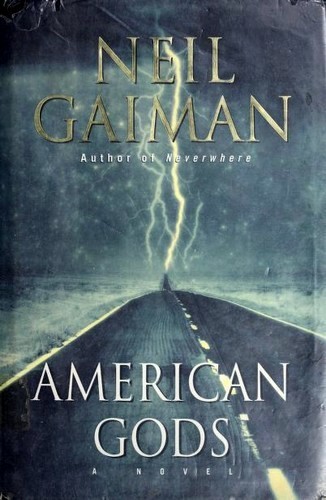
American Gods
by Neil Gaiman
★ Most-read book of 2001 · #1 on Best Books of 2001
Neil Gaiman's fantasy novel mixes Americana with strands of ancient and modern mythology into one story. Everything revolves around Shadow, a mysterious, taciturn figure, making it a good pick for readers curious about mythology old and new.
Best for: Fantasy readers who enjoy Americana mixed with ancient and modern mythology.
American Gods is #1 on BookWard's Best Books of 2001, out of 35 2001 books that cleared our data bar.
What American Gods is about
Shadow Moon walks out of prison early after learning his wife Laura has died in a car accident, and that she was having an affair with his best friend. With nothing left to go home to, he takes a job as bodyguard to a charming con man called Mr. Wednesday and travels across the United States with him.
Wednesday turns out to be far more than a swindler. He is recruiting Old Gods, whose powers have faded, to stand against the New Gods who embody technology, media and pop culture. Along the way Shadow runs into a leprechaun, a magical coin and a stretch of hiding in a quiet Wisconsin town under a false name. Gaiman mixes Americana with ancient and modern myth, and the tone is dark, atmospheric and full of questions about belief, immigration, grief and what people worship now.
American Gods on the Best Books of 2001
American Gods came out in 2001. Of the 35 books first published in 2001 that met BookWard's data bar, it ranks #1 on our Best Books of 2001 list.
Why it made the list: 862 readers have shelved it on Open Library; readers rate it 4.2 out of 5 (62 ratings); 31 are reading it right now. The list ranks each year’s books on how many readers have picked them up, how highly readers rate them, and how many are reading them right now.
It earns Most-read of 2001 and reader favorite and being read right now.
Nearby on the 2001 list
- Eat That Frog! 21 Great Ways to Stop Procrastinating and Get More Done in Less Time Brian Tracy, #2
- Crucial Conversations Kerry Patterson, #3
See all Best Books of 2001 Best books by year
More years: Best Books of 2000 Best Books of 2002.
The numbers behind it
- Readers: 687 want to read it, 31 are reading it now and 144 have read it, according to Open Library.
- Ratings: 4.2 out of 5 from 62 Open Library ratings.
| Signal | This book (0 to 100) | Weight |
|---|---|---|
| Reach | 97 | 55% |
| Reader love | 97 | 25% |
| Being read right now | 91 | 20% |
Questions about American Gods
When was American Gods published?
American Gods by Neil Gaiman was first published in 2001.
Was American Gods one of the best books of 2001?
American Gods is #1 on BookWard's Best Books of 2001, out of 35 2001 books that cleared our data bar. 862 readers have shelved it on Open Library; readers rate it 4.2 out of 5 (62 ratings); 31 are reading it right now.
Why is American Gods on the Best Books of 2001 list?
862 readers have shelved it on Open Library; readers rate it 4.2 out of 5 (62 ratings); 31 are reading it right now.
More of the best books of 2001
- Eat That Frog! 21 Great Ways to Stop Procrastinating and Get More Done in Less Time Brian Tracy, #2
- Crucial Conversations Kerry Patterson, #3
- Point Blanc Anthony Horowitz, #4
- Getting Things Done David Allen, #5
- Unbroken Laura Hillenbrand, #6
- Deception Point Dan Brown, #7
See the full Best Books of 2001, the Top 100, or new books on Rising.
How we know
This page uses public data: Open Library reader counts and ratings, and Wikipedia page views for recent years. The description is paraphrased from real source text. Rankings reflect reading interest, not quality or sales, and can be affected by data gaps. Lists update monthly.
Best for adult and older teen readers.
Depends on the edition you pick.
Old gods, new gods, and one quiet man crossing America. 66% taste match
 BookWard’s take
Old gods, new gods, and one quiet man crossing America
Shadow Moon walks out of prison early to find his life already gone, and within pages he is working for the con man Mr. Wednesday. That opening hooks hard: grief, a job offer and a road trip arrive almost at once. The road-trip structure keeps things moving at a brisk clip, though the book is long and sprawling. Where it earns its place is originality, a blend of Americana and ancient and modern mythology that steers clear of the usual fantasy furniture. Gaiman's voice is easy to recognise, dry and storyteller-ish, and the settings of motels, roadside attractions and small towns feel both familiar and strange. It is driven by story and character more than by argument, even though ideas fill every chapter. It won the 2002 Hugo and Nebula awards.
A long novel with a wide cast and many stops along the road, well past the tight shape BookWard prefers.
The road-trip structure keeps things moving, but the many side encounters slow it below BookWard's fast pace.
Mixing Americana with ancient and modern mythology is a distinctive premise that BookWard rewards.
Clear, lightly stylised prose with occasional lyrical passages, a little richer than BookWard's plain preference.
Shadow's loss anchors the story, but the war between old and new gods supplies the plot's push.
Loss and fading gods weigh heavily, yet the book keeps a thread of endurance and belief running through it.
Mostly a straightforward journey, with the occasional interlude stepping aside from Shadow's story.
Dry humor threads through a story that is otherwise serious about grief and belief.
Death, grief and violence are present, but the book is not unrelentingly bleak.
Shadow's loss gives the book real feeling, kept under a calm surface.
See all 50 dialsEvery position, side by side with this book
Where it lines up
- OriginalityBookWard 9 · book 9
- Authorial voiceBookWard 9 · book 9
- Character depthBookWard 8 · book 7
Where it pulls apart
- LengthBookWard 1 · book 8
- Internal logicBookWard 10 · book 6
- OpeningBookWard 10 · book 8
A long novel with a wide cast and many stops along the road, well past the tight shape BookWard prefers.
A convict is freed early because his wife has died, then hired by a stranger, so the story is moving within pages.
Gods drawn from old and new worship, set in ordinary America, feel fresh rather than recycled fantasy.
The rule that gods live on belief gives the world a firm backbone, though the magic bends when the story needs it.
The road-trip structure keeps things moving, but the many side encounters slow it below BookWard's fast pace.
Mixing Americana with ancient and modern mythology is a distinctive premise that BookWard rewards.
Shadow is taciturn and carefully drawn, but many of the gods are sketched quickly rather than deeply.
The central conflict is brought to a conclusion, though it leaves some threads for the reader to ponder.
Grief runs through the book but is handled with dry reserve rather than easy sentiment.
The darker turns come out of the mythology and the plot, not from effect for its own sake.
Not applicable to a novel.
Gaiman's dry, storytelling narration is instantly recognisable, which BookWard values highly.
It is driven by its plot and characters, with the ideas about belief carried inside the story.
Much of the mythology is revealed through conversations and encounters, with some explaining along the way.
The road-trip middle holds interest through its encounters, though a book this long has its slower stretches.
Clear, lightly stylised prose with occasional lyrical passages, a little richer than BookWard's plain preference.
Shadow's loss anchors the story, but the war between old and new gods supplies the plot's push.
Loss and fading gods weigh heavily, yet the book keeps a thread of endurance and belief running through it.
Mostly a straightforward journey, with the occasional interlude stepping aside from Shadow's story.
Dry humor threads through a story that is otherwise serious about grief and belief.
Accessible to read, though keeping track of the many mythological figures takes some attention.
Shadow carries the story, with some interludes that step outside his perspective.
The story moves forward in time, with the gods' pasts told in occasional interludes.
Gods walk the earth and magic is real, though the surface setting is recognisably contemporary America.
A large roster of gods and humans from many pantheons appears across the book.
The story is built around a coming war between gods, yet it stays close to one man on the road.
Travel and encounters drive events, but Shadow's grief and quiet reflection stay close behind.
Conversations carry much of the mythology and character, so talk is a major part of the book.
Shadow's marriage matters to the plot, but romance is not the book's centre.
The America on the page is recognisable, but the hidden world of gods beneath it is unfamiliar.
Set in a recognisably contemporary America as of its 2001 publication.
Its myths are old, and the question of what people worship still resonates after its 2001 publication.
The narration is a straightforward third person that stays close to Shadow and does not mislead.
The old and new gods are neither clearly good nor evil, which leaves the moral picture uncertain.
The roadside attractions and small towns of America are drawn in memorable, evocative detail.
Not applicable to a novel.
Not applicable to a novel.
Reads as a self-contained novel, even though it has since been adapted for television.
Wednesday's schemes and the identities of those Shadow meets keep reshaping what the reader thinks is going on.
It asks pointed questions about belief and what America worships, without being punishing to read.
Death, grief and violence are present, but the book is not unrelentingly bleak.
Shadow's loss gives the book real feeling, kept under a calm surface.
The humor is wry and understated rather than broad.
Fights and killings occur, often tied to the clash of gods, and are not played down.
Sex appears in the story and in its mythology, at a moderate level.
Questions about immigration and what America worships run beneath the story rather than driving it.
The language is plain and readable; only the mythological names add density.
The narrator has a recognisable personality and offers wry observations on America and belief.
It looks back at old gods fading but also asks what America worships now.
The book neither mocks nor fully endorses belief, landing somewhere between cynical and hopeful.
Review written by BookWard, dial version 1, November 2026.
Who is American Gods right for?
Best for adult and older teen readers. It contains violence, death and sexual content.
Accessible to read, though keeping track of the many mythological figures takes some attention.
Death, grief and violence are present, but the book is not unrelentingly bleak.
Shadow's loss gives the book real feeling, kept under a calm surface.
Fights and killings occur, often tied to the clash of gods, and are not played down.
Book CompanionAmerican Gods: ideas, characters, themes
Gods exist because people believe in them, and when belief shifts, old gods fade while new ones rise to take their place.
- A grief-struck start. Shadow leaves prison early after his wife's death, and the loss follows him through the whole journey.
- A mysterious employer. With nowhere to go, Shadow takes a job as bodyguard to the con man Mr. Wednesday.
- Old gods against new. Wednesday is recruiting fading gods to face off against new gods of technology, media and modern life.
- America as the setting. The story crosses the United States, treating its roadside oddities and small towns as part of the mythology.
- Many pantheons at once. Figures from Slavic, Egyptian, Norse and other traditions share the page with newer forces.
Characters
Shadow Moon
Protagonist
A taciturn ex-convict who becomes Wednesday's bodyguard after his wife's death.
Mr. Wednesday
Shadow's employer
A mysterious con man who turns out to be an incarnation of Odin, recruiting the Old Gods.
Laura
Shadow's wife
She dies in a car accident at the start but returns as a revenant.
Mad Sweeney
Leprechaun
A leprechaun who gives Shadow a magical gold coin after Shadow beats him in a fight.
Themes
Gods gain and lose strength according to how many people worship them.
Traditional faiths clash with modern worship of technology, media and pop culture.
Shadow's mourning for his wife shapes how he moves through the story.
Gods arrive in America with the people who carry their stories, and they change there.
The book asks what a modern nation holds sacred.
Discussion questions
- What does Shadow's quiet, passive nature add to the story?
- Do the old gods or the new gods feel more sympathetic, and why?
- How does the book treat America as a place made of arrivals?
- What do the road-trip structure and its detours gain or lose for the story?
- Does the idea that belief creates gods feel persuasive by the end?
Personalize your Book Companion
This is the general edition. In BookWard, the Companion is written for you: your reading profile, your notes, and spoiler-safe to the page you are on.
Buy, listen or borrow American Gods
Each link opens a search for this book on that store, in a new tab.
Read on a device
Borrow
Reviews and community
If you liked American Gods
A time-travel romance that argues with Britain's past and present
Cursed DaughtersOyinkan BraithwaiteA Lagos family curse, a reincarnation belief, and a girl fighting her fate
EndlingMaria RevaSnails, romance tours and a road trip into invasion
Exit PartyEmily St. John MandelA party, a vanished host, and an America that has come apart
Find your own best books
Add what you have read, rate it, and BookWard will recommend what to read next.
Free to start. No credit card needed.