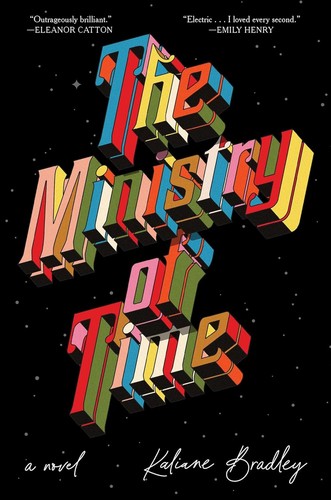
The Ministry of Time
by Kaliane Bradley
★ Top 25 book of 2024 · #23 on Best Books of 2024
Kaliane Bradley's debut imagines a government Ministry of Time, where a civil servant looks after one of the first time travellers, called "expats". It blends science fiction with romance and first appeared through Hodder & Stoughton.
Best for: Sci-fi readers who enjoy romance and time travel in a debut novel
The Ministry of Time is #23 on BookWard's Best Books of 2024, out of 34 2024 books that cleared our data bar.
What The Ministry of Time is about
The British government discovers a door through time and sets up the Ministry of Time to use it. Its project is to rescue people from history who were about to die, and to settle them in the present as "expats". Each is paired with a "bridge", a civil servant who explains modern life. Our narrator, the daughter of a British father and a Cambodian immigrant mother, is bridge to Graham Gore, an explorer who would otherwise have perished on Franklin's lost expedition.
Their daily conversations take in race, empire, gender, religion and sexuality, and the two grow close. Meanwhile the Ministry's tidy arrangements come under strain from danger and betrayal. Kaliane Bradley's debut mixes science fiction and romance, with a witty, tender voice. It will suit readers who like their time travel full of feeling and ideas.
The Ministry of Time on the Best Books of 2024
The Ministry of Time came out in 2024. Of the 34 books first published in 2024 that met BookWard's data bar, it ranks #23 on our Best Books of 2024 list.
Why it made the list: 300 readers have shelved it on Open Library; its Wikipedia page averaged 8,990 views a month recently. The list ranks each year’s books on how many readers have picked them up, how highly readers rate them, and how many are reading them right now.
Nearby on the 2024 list
- Wrath of the Triple Goddess Rick Riordan, #21
- Mania Lionel Shriver, #22
- You Are Here David Nicholls, #24
See all Best Books of 2024 Best books by year
More years: Best Books of 2023 Best Books of 2025.
The numbers behind it
- Readers: 41 want to read it, 0 are reading it now and 11 have read it, according to Open Library.
- Wikipedia: its article averaged 8,990 views a month recently.
| Signal | This book (0 to 100) | Weight |
|---|---|---|
| Reach | 76 | 45% |
| Reader love | 15 | 20% |
| Being read right now | 47 | 15% |
| Attention | 85 | 20% |
Questions about The Ministry of Time
When was The Ministry of Time published?
The Ministry of Time by Kaliane Bradley was first published in 2024.
Was The Ministry of Time one of the best books of 2024?
The Ministry of Time is #23 on BookWard's Best Books of 2024, out of 34 2024 books that cleared our data bar. 300 readers have shelved it on Open Library; its Wikipedia page averaged 8,990 views a month recently.
Why is The Ministry of Time on the Best Books of 2024 list?
300 readers have shelved it on Open Library; its Wikipedia page averaged 8,990 views a month recently.
More of the best books of 2024
- Wind and Truth Brandon Sanderson, #1
- The Let Them Theory Mel Robbins, #2
- The Tainted Cup Robert Jackson Bennett, #3
- Lights Out Navessa Allen, #4
- The Women Kristin Hannah, #5
- Funny Story Emily Henry, #6
See the full Best Books of 2024, the Top 100, or new books on Rising.
How we know
This page uses public data: Open Library reader counts and ratings, and Wikipedia page views for recent years. The description is paraphrased from real source text. Rankings reflect reading interest, not quality or sales, and can be affected by data gaps. Lists update monthly.
Best suited to adult and older teen readers comfortable with political themes and a developing romance.
Depends on the edition you pick.
A time-travel romance that argues with Britain's past and present. 66% taste match
 BookWard’s take
A time-travel romance that argues with Britain's past and present
Kaliane Bradley's debut sets a bureaucratic premise against a love story, and it holds both. A Ministry rescues people who would have died in their own eras, and an unnamed narrator is assigned to teach one of them, the explorer Graham Gore, how modern life works. The originality is where it shines: the 'expat' and 'bridge' framing is fresh and gives every conversation about race, empire and gender a natural reason to exist. The hook is quick, the premise landing within the first pages. The voice is distinctive, wry and self-aware, with dialogue doing much of the work. Where it asks more of you is on moral clarity, since the Ministry is never simply good or bad. If you like ideas carried by character rather than lectured, this will suit you closely.
Scenes of learning and conversation move briskly and the plot gathers urgency as threats appear, close to BookWard's preference for speed.
Pairing historical figures with a modern bureaucratic placement scheme is a fresh angle that BookWard would reward.
The writing is polished and playful without turning ornate, a touch richer than BookWard's plainer preference.
Relationships and the narrator's inner life matter as much as the spy plot, tilting it toward character.
There is real warmth in the friendships and romance alongside loss, leaving it mildly hopeful overall.
A broadly linear account of the narrator's assignment, with the time-travel conceit rather than form doing the inventive work.
Wry humor runs through the culture-clash scenes without turning the book into a comedy.
Deaths and threats give it some edge, though it never turns relentlessly grim.
Friendship, loss and romance carry real feeling without tipping into melodrama.
See all 50 dialsEvery position, side by side with this book
Where it lines up
- Character depthBookWard 8 · book 8
- Authorial voiceBookWard 9 · book 9
- PaceBookWard 8 · book 7
Where it pulls apart
- LengthBookWard 1 · book 5
- Internal logicBookWard 10 · book 6
- Familiar tropesBookWard 10 · book 7
The Ministry, the expats and the narrator's role are set up quickly, which suits BookWard's liking for books that grab you early.
Time travel and workplace romance are familiar ground, but the expat and bridge framing keeps it from feeling stock, a decent if not perfect match.
The time door and the Ministry's rules mostly hang together, with the rescue-the-doomed logic giving the setup a firm spine.
Scenes of learning and conversation move briskly and the plot gathers urgency as threats appear, close to BookWard's preference for speed.
Pairing historical figures with a modern bureaucratic placement scheme is a fresh angle that BookWard would reward.
The narrator and Gore are drawn through sustained conversation and friction, and the supporting expats have distinct histories.
The plot threads of the spies and the mole drive toward a resolution, though the emotional note is less tidily closed than BookWard prefers.
The romance is warm but undercut by wit and the narrator's guardedness, so it lands in the middle rather than syrupy.
Deaths and attacks arrive within a plot that gives them consequences, which fits BookWard's wish for darkness that is earned.
This is fiction, so the dial does not apply.
The narrator's dry, observant, self-deprecating voice is the book's signature and a strong match for BookWard.
Ideas about empire, race and belonging run through a story that still moves, so it balances rather than leaning either way.
Much is conveyed through conversations between narrator and expats, though the premise itself needs some explaining.
The middle keeps its momentum through new threats and shifting relationships, close to what BookWard wants.
The writing is polished and playful without turning ornate, a touch richer than BookWard's plainer preference.
Relationships and the narrator's inner life matter as much as the spy plot, tilting it toward character.
There is real warmth in the friendships and romance alongside loss, leaving it mildly hopeful overall.
A broadly linear account of the narrator's assignment, with the time-travel conceit rather than form doing the inventive work.
Wry humor runs through the culture-clash scenes without turning the book into a comedy.
It reads easily and quickly, with the ideas lightly carried, so it asks little of you.
The story stays close to the narrator's single perspective, which gives it intimacy but a narrower lens than BookWard's taste.
Characters are pulled from several centuries into the present, though the telling itself keeps to the main thread of the present day.
One speculative device, a time door, sits inside an otherwise recognisable modern bureaucracy.
A handful of expats, bridges and Ministry figures make a manageable ensemble rather than a crowd.
The stakes are personal and institutional rather than world-ending, keeping the focus on a few relationships.
Much of the book is conversation and the narrator's reflection, with action arriving in bursts.
Exchanges between narrator and expats carry much of the book's charm and argument.
The relationship with Gore is a major thread, though the spy plot keeps it from being the only engine.
A near-present Britain with a secret Ministry is familiar territory made strange by its arrivals from the past.
The main action is set in the contemporary United Kingdom, with history entering through the expats.
Its themes of belonging and history will last, though the satire of current Britain is tied to its moment.
The narrator tells her story with candor and humor, with no strong sense that she misleads the reader.
The Ministry's choices and the expats' fate are treated as morally tangled rather than clear-cut.
Scene-setting is present and vivid at moments but secondary to dialogue and voice.
This is fiction, so the dial does not apply.
This is fiction, so the dial does not apply.
It reads as a self-contained novel.
Spies, a mole and sudden deaths keep the plot turning, a good fit for BookWard's liking for surprise.
It raises uncomfortable questions about empire and identity but wraps them in an approachable story.
Deaths and threats give it some edge, though it never turns relentlessly grim.
Friendship, loss and romance carry real feeling without tipping into melodrama.
The humor is more wry and observational than broad.
There are shootings, attacks and battlefield backstories, but they are not the focus.
A romance develops with intimacy on the page, though it is not the book's main draw.
Race, imperialism and gender are woven openly into the conversations and the Ministry's setup.
The language is accessible, with period speech from the expats adding flavor rather than difficulty.
The narrator offers sharp, pointed views on her world and the people in it.
It looks at the past through a present-day lens, but the stakes include what the future holds.
Hope and affection sit alongside a skeptical view of institutions, landing on the cynical side of the middle.
Review written by BookWard, dial version 1, November 2026.
Who is The Ministry of Time right for?
Best suited to adult and older teen readers comfortable with political themes and a developing romance. It includes deaths, shootings and discussions of racism and empire.
It reads easily and quickly, with the ideas lightly carried, so it asks little of you.
Deaths and threats give it some edge, though it never turns relentlessly grim.
Friendship, loss and romance carry real feeling without tipping into melodrama.
There are shootings, attacks and battlefield backstories, but they are not the focus.
Book CompanionThe Ministry of Time: ideas, characters, themes
Rescuing people from the moment of their deaths and teaching them the modern world becomes a way to question what the present has inherited and what it owes.
- The Ministry's premise. The UK government finds a time door and rescues people who would have died in their own eras, calling them expats.
- Bridges and expats. Each expat is paired with a bridge, an employee who teaches them how the modern world works.
- The narrator and Gore. The unnamed narrator is assigned to Graham Gore, an explorer who would have died on Franklin's lost expedition.
- Conversations across eras. Their discussions cover changing views on race, imperialism, gender, religion and sexuality.
- Threats from the future. Spies from the future attack, and a mole leaking information puts the bridges and expats at risk.
Characters
The narrator
Bridge to Graham Gore
Daughter of a British father and a Cambodian immigrant mother, she works in the Ministry and teaches Gore about the present.
Graham Gore
Expat and explorer
An explorer who would have died on Franklin's lost expedition and is brought into the present.
Maggie Kemble
Expat
Extracted from the Great Plague of London in 1665, she becomes a good friend to the narrator.
Arthur Reginald-Smyth
Expat
A captain extracted from the Battle of the Somme in 1916.
Adela
Vice Secretary of the Ministry
She becomes the narrator's new handler after Quentin is killed.
Themes
What it takes to feel at home in a time or place that is not your own.
How Britain's imperial past shapes the present and the people in it.
The narrator's mixed heritage frames how she reads both the expats and the institution.
The Ministry's choices about who to save and how to use them.
Intimacy forming under pressure and surveillance.
Discussion questions
- Is the Ministry's choice to rescue only people who would have died ethical, and who benefits?
- How does the narrator's background shape the way she teaches Gore about Britain?
- Which of the expats' reactions to the modern world surprised you most?
- What does the book suggest about how the past should be remembered?
- Did the romance feel earned given the circumstances in which it develops?
Personalize your Book Companion
This is the general edition. In BookWard, the Companion is written for you: your reading profile, your notes, and spoiler-safe to the page you are on.
Buy, listen or borrow The Ministry of Time
Each link opens a search for this book on that store, in a new tab.
Read on a device
Borrow
Reviews and community
If you liked The Ministry of Time
A Lagos family curse, a reincarnation belief, and a girl fighting her fate
Stag DanceTorrey PetersA lumberjack novel and three stories on gender and desire
EndlingMaria RevaSnails, romance tours and a road trip into invasion
IcarusKayla AncrumA heist, a gilded cage, and a myth retold with a queer love story
Find your own best books
Add what you have read, rate it, and BookWard will recommend what to read next.
Free to start. No credit card needed.