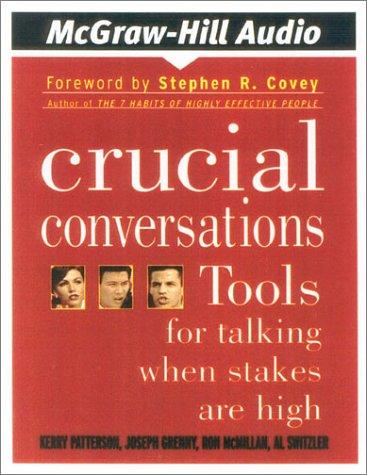
Crucial Conversations
by Kerry Patterson
★ Top 5 book of 2001 · #3 on Best Books of 2001
This guide helps readers stay calm and get results when stakes are high, opinions differ, and emotions run strong. It offers tools for speaking up, making conversations safe, and listening when others explode or shut down, at work or at home.
Best for: Anyone facing tense, high-stakes talks at work or at home.
Crucial Conversations is #3 on BookWard's Best Books of 2001, out of 35 2001 books that cleared our data bar.
What Crucial Conversations is about
Some conversations carry real weight: stakes are high, opinions clash, and feelings run strong. Crucial Conversations looks at what happens in those moments, whether with a boss, a neighbour or a spouse, and why they can shape your career, your happiness and your future. The book's point is that you have three choices: dodge the talk, handle it badly, or learn to communicate at your best when it matters most.
It aims to teach the third path. Readers learn how to make it safe to discuss almost anything, how to be persuasive without being abrasive, and how to keep listening when the other person erupts or goes silent. It also promises a six-minute technique for preparing before a high-impact exchange. A New York Times bestseller, it teaches readers how to handle high-stakes, emotionally charged conversations, whether at work or at home.
Crucial Conversations on the Best Books of 2001
Crucial Conversations came out in 2001. Of the 35 books first published in 2001 that met BookWard's data bar, it ranks #3 on our Best Books of 2001 list.
Why it made the list: 740 readers have shelved it on Open Library; readers rate it 4 out of 5 (30 ratings); 61 are reading it right now. The list ranks each year’s books on how many readers have picked them up, how highly readers rate them, and how many are reading them right now.
It earns Being read right now.
Nearby on the 2001 list
- American Gods Neil Gaiman, #1
- Eat That Frog! 21 Great Ways to Stop Procrastinating and Get More Done in Less Time Brian Tracy, #2
- Point Blanc Anthony Horowitz, #4
- Getting Things Done David Allen, #5
See all Best Books of 2001 Best books by year
More years: Best Books of 2000 Best Books of 2002.
The numbers behind it
- Readers: 648 want to read it, 61 are reading it now and 31 have read it, according to Open Library.
- Ratings: 4 out of 5 from 30 Open Library ratings.
| Signal | This book (0 to 100) | Weight |
|---|---|---|
| Reach | 91 | 55% |
| Reader love | 69 | 25% |
| Being read right now | 94 | 20% |
Questions about Crucial Conversations
When was Crucial Conversations published?
Crucial Conversations by Kerry Patterson was first published in 2001.
Was Crucial Conversations one of the best books of 2001?
Crucial Conversations is #3 on BookWard's Best Books of 2001, out of 35 2001 books that cleared our data bar. 740 readers have shelved it on Open Library; readers rate it 4 out of 5 (30 ratings); 61 are reading it right now.
Why is Crucial Conversations on the Best Books of 2001 list?
740 readers have shelved it on Open Library; readers rate it 4 out of 5 (30 ratings); 61 are reading it right now.
More of the best books of 2001
- American Gods Neil Gaiman, #1
- Eat That Frog! 21 Great Ways to Stop Procrastinating and Get More Done in Less Time Brian Tracy, #2
- Point Blanc Anthony Horowitz, #4
- Getting Things Done David Allen, #5
- Unbroken Laura Hillenbrand, #6
- Deception Point Dan Brown, #7
See the full Best Books of 2001, the Top 100, or new books on Rising.
How we know
This page uses public data: Open Library reader counts and ratings, and Wikipedia page views for recent years. The description is paraphrased from real source text. Rankings reflect reading interest, not quality or sales, and can be affected by data gaps. Lists update monthly.
It suits adult readers and older teens dealing with work, family or relationship tensions.
Depends on the edition you pick.
A practical playbook for talking when stakes and emotions are high. 43% taste match
 BookWard’s take
A practical playbook for talking when stakes and emotions are high
Crucial Conversations is a self-help manual built around one promise: you can stay calm and still say what matters when opinions clash and feelings run hot. It is driven by ideas rather than stories, and the advice is laid out plainly instead of being dramatized, which sets it far from the kind of book that shows things in scene. It does earn its keep in other ways. The hook is strong, since the premise is clear from page one, and the framework is a specific toolkit rather than vague encouragement. The rigor is moderate: it leans on worked examples more than hard proof. The outlook is hopeful throughout, and it reads easily. Useful, but a poor match for a reader who values craft.
The core idea of making talk safe is a sharp framing, but it sits within a crowded genre, so it only partly fits BookWard's taste for the new.
Plain, conversational sentences built for clarity, a bit plainer than BookWard's slightly richer taste.
There is no plot to drive; the book runs on its method rather than on people, so it falls on the plot side.
It insists that hard talks can end well and can be learned, an optimistic outlook that agrees with BookWard.
A conventional how-to layout of principles, examples and practice, with nothing experimental.
The tone is earnest and instructive, with only light touches of humor.
Conflict is everyday and workplace-scale, with nothing grim to dwell on.
It tackles strong feelings as something to manage, but the book itself stays measured.
See all 50 dialsEvery position, side by side with this book
Where it lines up
- Shock for effectBookWard 9 · book 9
- EndingBookWard 8 · book 7
- OpeningBookWard 10 · book 8
Where it pulls apart
- ExpositionBookWard 2 · book 9
- Familiar tropesBookWard 10 · book 6
- Internal logicBookWard 10 · book 6
Self-help conventions are present, but the specific toolkit gives it more shape than generic advice, a partial fit for BookWard.
The method follows a clear step-by-step structure, though it asks for trust more than it proves its claims, short of BookWard's airtight ideal.
The core idea of making talk safe is a sharp framing, but it sits within a crowded genre, so it only partly fits BookWard's taste for the new.
People appear as illustrative examples rather than drawn characters, which is a weak fit for BookWard's appetite for deep characters.
The tone is encouraging and earnest, warmer than the restraint BookWard prefers.
There is no darkness to earn or abuse; the stakes are everyday workplace and home conflict, which BookWard has no complaint about.
It draws on research and long-running observation, but leans on anecdote and example more than BookWard's rigorous standard.
The authors write in a clear, friendly house style that is useful but not especially distinctive.
Each chapter delivers a concept or tool, so the book is idea-led, the opposite of BookWard's story-led leaning.
It explains its framework directly rather than dramatizing it, far from BookWard's preference for showing in scene.
Plain, conversational sentences built for clarity, a bit plainer than BookWard's slightly richer taste.
There is no plot to drive; the book runs on its method rather than on people, so it falls on the plot side.
It insists that hard talks can end well and can be learned, an optimistic outlook that agrees with BookWard.
A conventional how-to layout of principles, examples and practice, with nothing experimental.
The tone is earnest and instructive, with only light touches of humor.
Easy to read and designed to be picked up and applied, much easier than BookWard's moderate effort level.
It speaks in a single teaching voice, with occasional example speakers rather than varied viewpoints.
It moves forward through its method in a straight line, with no shifting time.
Entirely grounded in real conversations at work and at home.
The people in it are brief illustrative figures, so the cast stays small and unremembered.
It focuses on personal exchanges between a few people, an intimate scale.
It balances managing your own feelings with choosing outward words and actions, landing in the middle.
Sample exchanges are used often to show good and bad approaches, which fits BookWard's liking for talk.
Romance is not a concern; spouses appear only as one setting for hard talks.
Offices, homes and neighborhoods are completely familiar settings, less novel than BookWard likes.
Written for contemporary working life, so it reads as present day, though first published in 2001.
The central skill of handling hard talks does not date, though the examples and style are of their era.
The authors speak plainly and directly, so there is no unreliability to speak of.
It advises toward mutual respect and open dialogue with little moral gray area, clearer than BookWard's taste.
Description is sparse and functional, there to set up an example rather than paint a scene.
Mostly an analytical toolkit, but with enough anecdote to feel narrative in places.
The authors keep a fairly detached teaching distance, with occasional personal-sounding stories.
It stands alone as a single book, though the authors have written related titles.
Nothing surprises in a how-to book; the pleasure is in practical clarity.
It asks you to examine your own habits, but it is mostly encouraging rather than confrontational.
Conflict is everyday and workplace-scale, with nothing grim to dwell on.
It tackles strong feelings as something to manage, but the book itself stays measured.
Humor, when it appears, is gentle and mild rather than dry or broad.
No violence appears beyond the metaphor of conversations going badly.
No sexual content.
It stays out of politics, focusing on relationships and workplace dynamics.
Plain business-friendly language, easy to follow.
The authors openly push a point of view about how people should talk, so the narration is opinionated.
It is about doing better in future conversations, looking forward more than back.
It believes people can learn to communicate well and resolve conflict, a clearly idealistic view.
Review written by BookWard, dial version 1, November 2026.
Who is Crucial Conversations right for?
It suits adult readers and older teens dealing with work, family or relationship tensions. It contains no graphic content, though some of its examples involve conflict with spouses, colleagues and bosses.
Easy to read and designed to be picked up and applied, much easier than BookWard's moderate effort level.
Conflict is everyday and workplace-scale, with nothing grim to dwell on.
It tackles strong feelings as something to manage, but the book itself stays measured.
No violence appears beyond the metaphor of conversations going badly.
Book CompanionCrucial Conversations: ideas, characters, themes
High-stakes conversations go better when you keep the dialogue safe, stay in control of your emotions, and aim for shared meaning.
- Recognize what is at stake. A conversation becomes crucial when stakes are high, opinions differ and emotions run strong, and noticing that moment is the first skill.
- Avoid the two bad choices. The book sets out that avoiding a hard talk or handling it badly both carry consequences, which is the case for learning a better way.
- Make it safe to talk. People stop listening when they feel unsafe, so creating a sense of safety is what lets almost anything be discussed.
- Be persuasive, not abrasive. You can state your view with confidence and still respect the other person, rather than steamrolling them.
- Turn talk into action. A good conversation ends in clear results, not just relief, so the final step is converting what was said into follow-through.
Themes
How the words we choose shape what happens between people.
Keeping your cool when feelings run strong.
Creating conditions in which hard things can be said openly.
Making your case without being abrasive.
Linking honest talk to real outcomes at work and at home.
Discussion questions
- Which conversation in your life are you currently avoiding, and what is it costing you?
- When have you handled a hard talk badly, and what would you change?
- What makes a conversation feel safe or unsafe to you?
- How do you respond when others blow up or go silent?
- Which skill in the book would be easiest to try this week, and which hardest?
Personalize your Book Companion
This is the general edition. In BookWard, the Companion is written for you: your reading profile, your notes, and spoiler-safe to the page you are on.
Buy, listen or borrow Crucial Conversations
Each link opens a search for this book on that store, in a new tab.
Read on a device
Borrow
Reviews and community
If you liked Crucial Conversations
One big idea, two mindsets, applied to work, love and parenting
Nonviolent CommunicationMarshall B. RosenbergA practical, repeatable method for speaking honestly without starting a fight
Get Better at AnythingScott YoungA clear framework for why some learning sticks and some stalls
How to Talk to AnyoneLeil Lowndes92 named conversation techniques, built to be used at your next party
Find your own best books
Add what you have read, rate it, and BookWard will recommend what to read next.
Free to start. No credit card needed.