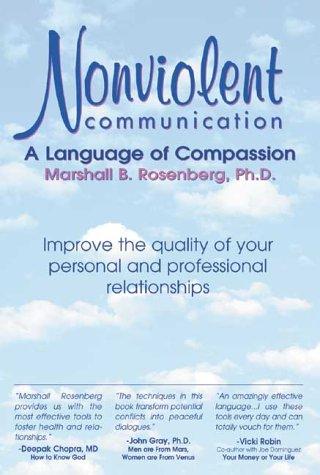
Nonviolent Communication
by Marshall B. Rosenberg
★ Top 10 book of 1999 · #9 on Best Books of 1999
Using stories, examples and sample dialogues, this book shows how compassionate communication can resolve differences at home, at work and in politics. It teaches readers to name feelings and needs, express anger, use empathy, and connect compassionately with themselves.
Best for: Anyone wanting calmer, more honest conversations with family, colleagues and friends
Nonviolent Communication is #9 on BookWard's Best Books of 1999, out of 52 1999 books that cleared our data bar.
What Nonviolent Communication is about
Most of us have said something in anger we wished we could take back, or kept quiet about what we really needed. Marshall Rosenberg offers a way of speaking and listening that aims to build connection instead of hostility.
Through stories, examples and sample dialogues, the book shows how to express anger fully, practice empathy and break the habits of thought that lead to anger and depression. The skills apply at home, at work and in political disagreements. The newer edition also adds guidance on treating yourself with compassion. It will help parents, partners, colleagues and anyone who wants difficult conversations to go better.
Nonviolent Communication on the Best Books of 1999
Nonviolent Communication came out in 1999. Of the 52 books first published in 1999 that met BookWard's data bar, it ranks #9 on our Best Books of 1999 list.
Why it made the list: 429 readers have shelved it on Open Library; readers rate it 4.4 out of 5 (21 ratings); 31 are reading it right now. The list ranks each year’s books on how many readers have picked them up, how highly readers rate them, and how many are reading them right now.
Nearby on the 1999 list
- The Monk Who Sold His Ferrari Robin S. Sharma, #7
- Speak Laurie Halse Anderson, #8
- The Pragmatic Programmer Andy Hunt, #10
- A Walk to Remember Nicholas Sparks, #11
See all Best Books of 1999 Best books by year
More years: Best Books of 1998 Best Books of 2000.
The numbers behind it
- Readers: 366 want to read it, 31 are reading it now and 32 have read it, according to Open Library.
- Ratings: 4.4 out of 5 from 21 Open Library ratings.
| Signal | This book (0 to 100) | Weight |
|---|---|---|
| Reach | 71 | 55% |
| Reader love | 90 | 25% |
| Being read right now | 81 | 20% |
Questions about Nonviolent Communication
When was Nonviolent Communication published?
Nonviolent Communication by Marshall B. Rosenberg was first published in 1999.
Was Nonviolent Communication one of the best books of 1999?
Nonviolent Communication is #9 on BookWard's Best Books of 1999, out of 52 1999 books that cleared our data bar. 429 readers have shelved it on Open Library; readers rate it 4.4 out of 5 (21 ratings); 31 are reading it right now.
Why is Nonviolent Communication on the Best Books of 1999 list?
429 readers have shelved it on Open Library; readers rate it 4.4 out of 5 (21 ratings); 31 are reading it right now.
More of the best books of 1999
- Harry Potter and the Prisoner of Azkaban J. K. Rowling, #1
- Wings of Fire A. P. J. Abdul Kalam, #2
- The Perks of Being a Wallflower Stephen Chbosky, #3
- On Writing Stephen King, #4
- The Bad Beginning Lemony Snicket, #5
- The Coldest Winter Ever Sister Souljah, #6
See the full Best Books of 1999, the Top 100, or new books on Rising.
How we know
This page uses public data: Open Library reader counts and ratings, and Wikipedia page views for recent years. The description is paraphrased from real source text. Rankings reflect reading interest, not quality or sales, and can be affected by data gaps. Lists update monthly.
Suits adults and mature teens interested in improving relationships at home and work.
Depends on the edition you pick.
A practical, repeatable method for speaking honestly without starting a fight. 38% taste match
 BookWard’s take
A practical, repeatable method for speaking honestly without starting a fight
Rosenberg's book is a how-to disguised as a philosophy, and it works because the method is simple enough to try the same day. It is firmly idea-led rather than story-driven, which is a bit against my usual grain, and the ideas are explained outright rather than dramatized. The familiar self-help conventions are everywhere, yet the four-part framework of observations, feelings, needs and requests is a distinctive tool. The rigor is anecdotal rather than evidence-driven, so expect conviction over data. Where it earns its place is in how easy it is to read, the clear authorial voice, and the sample dialogues that show the method in use. It is a book you practice more than finish.
A focused guide that stays on one method rather than sprawling, though the repeated examples add some bulk.
Rosenberg's separation of observation from evaluation and needs from strategies is a distinctive take on a crowded subject.
The writing is plain and instructional, chosen for clarity over style.
There is no plot; the focus is on the inner habits of the person trying to communicate differently.
Its whole premise is that conflict can be softened and connection built, which is strongly hopeful.
The tone is sincere and earnest, with little humor.
The content is gentle, though some examples touch on anger and conflict.
Feelings are the subject, handled thoughtfully rather than dramatically.
See all 50 dialsEvery position, side by side with this book
Where it lines up
- PaceBookWard 8 · book 6
- Authorial voiceBookWard 9 · book 7
- LengthBookWard 1 · book 4
Where it pulls apart
- Familiar tropesBookWard 10 · book 4
- ExpositionBookWard 2 · book 9
- OpeningBookWard 10 · book 6
A focused guide that stays on one method rather than sprawling, though the repeated examples add some bulk.
The self-help frame is familiar, but the four-step framework gives it a recognizable shape of its own.
The method builds step by step from observation to request, so each part follows cleanly from the last.
Rosenberg's separation of observation from evaluation and needs from strategies is a distinctive take on a crowded subject.
People appear as illustrations of the method, so they are types rather than fully drawn characters.
It is openly warm and compassion-driven, which leans sentimental compared with BookWard's restrained taste.
It relies on anecdotes and sample dialogues rather than research, which is thinner than BookWard prefers.
Rosenberg's earnest, teacherly voice is unmistakable and consistent throughout.
The book is built around a framework, with stories serving the method rather than driving it.
Concepts are named, defined and explained directly, with dialogues used to confirm rather than discover them.
The structure holds steady, though repeated applications across home, work and politics can feel cyclical.
The writing is plain and instructional, chosen for clarity over style.
There is no plot; the focus is on the inner habits of the person trying to communicate differently.
Its whole premise is that conflict can be softened and connection built, which is strongly hopeful.
The tone is sincere and earnest, with little humor.
Short sections, clear terms and ready examples make it easy to follow.
It speaks from the author's teaching perspective, with other voices appearing only in examples.
It moves in a straightforward teaching order with no shifting time frames.
Entirely grounded in everyday conversations at home and work.
Only brief illustrative speakers appear, so the cast stays small.
Most of the focus is on personal and workplace exchanges, though it nods to wider political differences.
The core work is noticing your own feelings and needs before speaking.
Sample dialogues are a main teaching device, showing the method in real exchanges.
Romantic relationships appear only as one setting among many for the method.
Everyday family and workplace settings are immediately recognizable.
Its concerns are timeless, but its 1999 vocabulary reads as late twentieth century self-help.
Conflict and the wish to be heard do not date, so the method keeps its relevance.
The author speaks plainly as a teacher, with no gap between voice and intent.
The book is clear about what compassionate communication is and why it matters.
Description is minimal, as scenes serve only to illustrate a point.
It is a framework-driven guide, mixing anecdote with explanation but leaning toward teaching.
Rosenberg draws on his own experience and invites readers to apply it personally.
A self-contained guide that needs nothing beyond itself.
A method book with no plot, so there are no surprises to speak of.
It asks readers to rethink habits of blame and judgment, which is quietly confronting.
The content is gentle, though some examples touch on anger and conflict.
Feelings are the subject, handled thoughtfully rather than dramatically.
Violence is discussed as a pattern of language and thought, not shown on the page.
Sexual content does not figure in the book.
It applies the method to political differences but stays focused on communication.
The language is plain and accessible throughout.
Rosenberg is openly persuasive and committed to his approach, which gives it a strong point of view.
It points toward better ways of relating, aimed at changing future conversations.
It believes deeply that compassion can reshape how people treat one another.
Review written by BookWard, dial version 1, November 2026.
Who is Nonviolent Communication right for?
Suits adults and mature teens interested in improving relationships at home and work. Examples touch on anger, conflict and depression but are handled gently.
Short sections, clear terms and ready examples make it easy to follow.
The content is gentle, though some examples touch on anger and conflict.
Feelings are the subject, handled thoughtfully rather than dramatically.
Violence is discussed as a pattern of language and thought, not shown on the page.
Book CompanionNonviolent Communication: ideas, characters, themes
Conflict softens when we separate what we observe from what we judge, and speak from our feelings and needs rather than blame.
- Observation without evaluation. The method starts by describing what actually happened, stripped of judgment, so the other person is not put on the defensive.
- Naming feelings. Rosenberg encourages identifying your real feelings instead of hiding behind thoughts and accusations.
- Connecting to needs. Feelings are traced back to underlying needs, which shifts the conversation from fault to what each person is seeking.
- Making clear requests. A request is stated plainly and positively, giving the other person a real choice rather than a demand.
- Empathic listening and self-compassion. The same approach is used to hear others without taking offense and, in the newer edition, to connect compassionately with yourself.
Themes
Responding to others and yourself with care rather than judgment.
Saying what is true for you in a way that does not provoke attack.
Seeing emotions as signals of what a person values or lacks.
Listening for the feelings and needs behind someone else's words.
Expressing it fully while tracing it to an unmet need.
Discussion questions
- Where in your own life do you tend to mix observation with evaluation?
- Which of the four steps feels hardest to practice, and why?
- Can a method this structured ever feel natural in a heated moment?
- How might the approach change a disagreement at work versus at home?
- Is expressing anger fully compatible with staying compassionate?
Personalize your Book Companion
This is the general edition. In BookWard, the Companion is written for you: your reading profile, your notes, and spoiler-safe to the page you are on.
Buy, listen or borrow Nonviolent Communication
Each link opens a search for this book on that store, in a new tab.
Read on a device
Borrow
Reviews and community
If you liked Nonviolent Communication
A calm, practical guide to living in the present moment
Crucial ConversationsKerry PattersonA practical playbook for talking when stakes and emotions are high
The 7 Habits of Highly Effective PeopleStephen R. CoveySeven habits, laid out plainly, with ideas ahead of story
MindsetCarol S. DweckOne big idea, two mindsets, applied to work, love and parenting
Find your own best books
Add what you have read, rate it, and BookWard will recommend what to read next.
Free to start. No credit card needed.