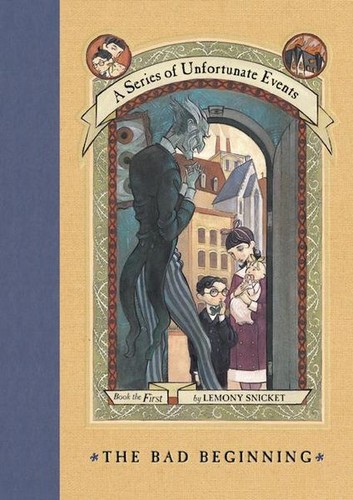
The Bad Beginning
by Lemony Snicket
★ Top 5 book of 1999 · #5 on Best Books of 1999
After their parents die suddenly, the three Baudelaire children have only each other and their wits to rely on. Their newly appointed guardian, a distant relative, will stop at nothing to get hold of their fortune.
Best for: Readers who like stories of orphaned siblings relying on cleverness against a scheming guardian
The Bad Beginning is #5 on BookWard's Best Books of 1999, out of 52 1999 books that cleared our data bar.
What The Bad Beginning is about
The Baudelaire children are sitting on Briny Beach when the banker Mr. Poe tells them their parents have died in a fire that destroyed the family home. Violet, fourteen and a gifted inventor, Klaus, twelve and devoted to books, and baby Sunny, who has four sharp teeth and a habit of using them, are sent to live with a distant relative none of them has heard of: Count Olaf.
Olaf's house is filthy, decorated with eyes, and has a tower the children must stay out of. He is bad-tempered, and he is clearly interested in the family fortune. Their only comfort is a kind neighbor, Justice Strauss. When Olaf pulls them into a theatrical scheme, the three must rely on cleverness and on one another.
The tone is wry and gloomy in a funny way, with a narrator who warns readers off happiness. Good for young readers who like dark comedy, and for adults who do too.
The Bad Beginning on the Best Books of 1999
The Bad Beginning came out in 1999. Of the 52 books first published in 1999 that met BookWard's data bar, it ranks #5 on our Best Books of 1999 list.
Why it made the list: 1,013 readers have shelved it on Open Library; readers rate it 4.2 out of 5 (94 ratings); 54 are reading it right now. The list ranks each year’s books on how many readers have picked them up, how highly readers rate them, and how many are reading them right now.
It earns Being read right now.
Nearby on the 1999 list
- The Perks of Being a Wallflower Stephen Chbosky, #3
- On Writing Stephen King, #4
- The Coldest Winter Ever Sister Souljah, #6
- The Monk Who Sold His Ferrari Robin S. Sharma, #7
See all Best Books of 1999 Best books by year
More years: Best Books of 1998 Best Books of 2000.
The numbers behind it
- Readers: 799 want to read it, 54 are reading it now and 160 have read it, according to Open Library.
- Ratings: 4.2 out of 5 from 94 Open Library ratings.
| Signal | This book (0 to 100) | Weight |
|---|---|---|
| Reach | 87 | 55% |
| Reader love | 88 | 25% |
| Being read right now | 90 | 20% |
Questions about The Bad Beginning
When was The Bad Beginning published?
The Bad Beginning by Lemony Snicket was first published in 1999.
Was The Bad Beginning one of the best books of 1999?
The Bad Beginning is #5 on BookWard's Best Books of 1999, out of 52 1999 books that cleared our data bar. 1,013 readers have shelved it on Open Library; readers rate it 4.2 out of 5 (94 ratings); 54 are reading it right now.
Why is The Bad Beginning on the Best Books of 1999 list?
1,013 readers have shelved it on Open Library; readers rate it 4.2 out of 5 (94 ratings); 54 are reading it right now.
More of the best books of 1999
- Harry Potter and the Prisoner of Azkaban J. K. Rowling, #1
- Wings of Fire A. P. J. Abdul Kalam, #2
- The Perks of Being a Wallflower Stephen Chbosky, #3
- On Writing Stephen King, #4
- The Coldest Winter Ever Sister Souljah, #6
- The Monk Who Sold His Ferrari Robin S. Sharma, #7
See the full Best Books of 1999, the Top 100, or new books on Rising.
How we know
This page uses public data: Open Library reader counts and ratings, and Wikipedia page views for recent years. The description is paraphrased from real source text. Rankings reflect reading interest, not quality or sales, and can be affected by data gaps. Lists update monthly.
It suits readers roughly eight and up, and adults who enjoy wry, gothic humor.
Depends on the edition you pick.
A short, wry orphan tale that dares you to keep reading. 59% taste match
 BookWard’s take
A short, wry orphan tale that dares you to keep reading
Lemony Snicket opens with a warning: this book will make you miserable. Then it delivers a brisk, funny, oddly sharp story about three orphans, Violet, Klaus and baby Sunny, and the guardian who wants their fortune. The Baudelaires lose their parents almost at once, so there is no slow wind-up, and the book is short and tight, a quick read that never sags. The narrator is the real draw: he interrupts, defines big words and refuses to comfort you, and the voice is unmistakable. It leans on familiar tropes, the wicked guardian and the clever children, but plays them with such deadpan relish that they feel fresh. The sentiment stays restrained, and the darkness feels earned. This one is gloomy by design yet never gratuitous.
A slim children's novel that moves quickly, which matches BookWard's love of tight books.
Short chapters and steady trouble keep it moving, close to BookWard's preferred speed.
The mock-gloomy narrator gives familiar bones a distinctive spin, though the story itself is classic.
The sentences are plain and clean, with wit coming from the narrator's asides rather than ornament.
Events drive it forward more than inner change, with the children reacting to Olaf's schemes.
The tone is bleak and the narrator says so, though the siblings' loyalty offers some warmth.
A conventional chapter-by-chapter narrative, with the narrator's interjections the only twist.
Deadpan misery and absurd adults make it genuinely funny, though underneath it is sad.
Orphaning and cruelty give it a dark premise, softened by comic framing.
Grief and fear are present but handled with a light touch.
See all 50 dialsEvery position, side by side with this book
Where it lines up
- LengthBookWard 1 · book 1
- OpeningBookWard 10 · book 10
- PaceBookWard 8 · book 8
Where it pulls apart
- Familiar tropesBookWard 10 · book 4
- Internal logicBookWard 10 · book 6
- ExpositionBookWard 2 · book 6
A slim children's novel that moves quickly, which matches BookWard's love of tight books.
Parents are gone within the opening chapter and the narrator promises misery, so it grabs you at once, as BookWard likes.
The cruel guardian and plucky orphans are well-worn, but the arch telling keeps it from feeling stale.
The plot works on storybook rules, and the adults' obliviousness is a joke more than a flaw.
Short chapters and steady trouble keep it moving, close to BookWard's preferred speed.
The mock-gloomy narrator gives familiar bones a distinctive spin, though the story itself is classic.
Each Baudelaire has a clear talent and temperament, but they are drawn lightly, a notch under BookWard's taste.
The immediate crisis resolves, but the story clearly leaves the larger mystery open for later books.
It plays grief for dry comedy rather than tears, mostly restrained, with a little storybook pathos.
The cruelty is stylized and mild, serving the dark comedy rather than shock for its own sake.
This is fiction, so the dial does not apply.
The narrator's interruptions and dire warnings are unmistakable, which BookWard rewards highly.
It is firmly story-led: a villain, a scheme and children trying to survive.
The narrator often stops to define words and explain things outright, unlike BookWard's show-it-in-scene preference.
At this length there is no room to sag, and trouble keeps arriving.
The sentences are plain and clean, with wit coming from the narrator's asides rather than ornament.
Events drive it forward more than inner change, with the children reacting to Olaf's schemes.
The tone is bleak and the narrator says so, though the siblings' loyalty offers some warmth.
A conventional chapter-by-chapter narrative, with the narrator's interjections the only twist.
Deadpan misery and absurd adults make it genuinely funny, though underneath it is sad.
Short and clearly written, it is an easy read for young readers and adults alike.
We follow the Baudelaires through a single narrator's account.
The story runs straight through in order.
The world is mostly realistic, with an exaggerated, storybook quality.
The three siblings, Olaf, his troupe and a few adults make a modest cast.
The stakes are one family and one fortune, so it stays small and personal.
Events and schemes dominate over interior reflection, though the narrator comments freely.
Conversations are frequent but brief, spread evenly with narration.
There is no romance in the story.
The setting is a gothic, slightly off version of ordinary life.
The setting is deliberately undated and timeless in feel.
Orphans, a villain and a witty narrator are the stuff of lasting children's literature.
The narrator is opinionated but dependable on the story's facts, so reliable overall.
Olaf is plainly the villain and the children are plainly the good ones.
Olaf's house and its eye imagery are vivid, but description stays brisk.
This is a novel, so the dial does not apply.
This is a novel, so the dial does not apply.
It is explicitly Book the First of A Series of Unfortunate Events.
There are a few reversals, but the plot is easy to follow.
It is a gentle, accessible read despite the grim premise.
Orphaning and cruelty give it a dark premise, softened by comic framing.
Grief and fear are present but handled with a light touch.
The humor is dry and ironic, built on understatement.
There is some menace and a moment of striking, but little graphic harm.
There is no sexual content.
Politics do not enter the story.
The language is plain, with the narrator defining harder words.
The narrator editorializes constantly and makes no pretense of neutrality.
It dwells on loss and the past, while the children's survival points ahead.
It is cynical about adults and institutions, but loyal to sibling bonds.
Review written by BookWard, dial version 1, November 2026.
Who is The Bad Beginning right for?
It suits readers roughly eight and up, and adults who enjoy wry, gothic humor. It deals with the death of parents and with a guardian's cruelty, including a moment where he strikes a child.
Short and clearly written, it is an easy read for young readers and adults alike.
Orphaning and cruelty give it a dark premise, softened by comic framing.
Grief and fear are present but handled with a light touch.
There is some menace and a moment of striking, but little graphic harm.
Book CompanionThe Bad Beginning: ideas, characters, themes
Three clever orphans must outwit a scheming guardian when the adults around them refuse to listen.
- The setup. After a fire kills their parents, Violet, Klaus and Sunny are placed with Count Olaf, a distant relative they have never met.
- The guardian. Olaf's filthy house and its eye imagery signal that he is unpleasant, short-tempered and after the Baudelaire fortune.
- Three talents. Violet invents, Klaus reads and knows things, and baby Sunny bites with her sharp teeth.
- The unhelpful adults. Mr. Poe, the banker, keeps failing to take the children's concerns seriously, leaving them to rely on one another.
- The narrator. Snicket warns readers from the start that this is an unhappy story and comments throughout.
Characters
Violet Baudelaire
Eldest sibling
Fourteen years old and a gifted inventor.
Klaus Baudelaire
Middle sibling
Twelve years old and devoted to books and knowledge.
Sunny Baudelaire
Baby sibling
An infant with four large, sharp teeth that she loves to use.
Count Olaf
Guardian and villain
An angry, scheming relative who wants the children's inheritance.
Mr. Poe
Banker
Delivers the news of the fire and places the children with Olaf.
Themes
The children survive by trusting and protecting one another.
Grown-ups who should help often fail to listen or act.
Olaf's pursuit of the fortune drives the whole threat.
The story treats loss and bad luck with dry, wry honesty.
Each child's particular skill becomes a tool for coping.
Discussion questions
- Why does the narrator keep warning readers away, and does it make you want to read on?
- How do Violet, Klaus and Sunny each contribute to dealing with Olaf?
- Why do the adults, including Mr. Poe, fail to protect the children?
- Can a story be funny and sad at the same time? How does this one manage it?
- Would you keep reading the series after this first book, and why?
Personalize your Book Companion
This is the general edition. In BookWard, the Companion is written for you: your reading profile, your notes, and spoiler-safe to the page you are on.
Buy, listen or borrow The Bad Beginning
Each link opens a search for this book on that store, in a new tab.
Read on a device
Borrow
Reviews and community
If you liked The Bad Beginning
A gleefully bleak boarding-school entry in a famously morbid series
The Wide WindowLemony SnicketAunt Josephine fears everything, and Lake Lachrymose has plenty to be afraid of
The Vile VillageLemony SnicketA dark, funny orphan tale where the whole village is the villain
The Hostile HospitalLemony SnicketA wry, mock-gloomy orphan adventure that rewards the curious young reader
Find your own best books
Add what you have read, rate it, and BookWard will recommend what to read next.
Free to start. No credit card needed.