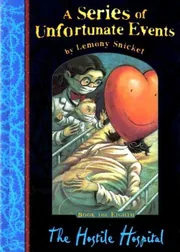
The Hostile Hospital
by Lemony Snicket, Brett Helquist · 2001
It suits confident young readers who enjoy wordplay and dark comedy, and it works well read aloud.
263 pages, about 4 to 6 hours.
A wry, mock-gloomy orphan adventure that rewards the curious young reader. 54% taste match
About the book
The Hostile Hospital, first published in 2001, is a children's novel by Lemony Snicket. It is a humorous work of juvenile fiction that follows the Baudelaire children, a group of orphaned brothers and sisters whose misfortunes carry them through a series of troubles. The story takes them into a hospital, and the medical setting gives the book its title and much of its backdrop.
Along the way the siblings meet a suspicious shopkeeper and face the prospect of unnecessary surgery, and the story also includes heart-shaped balloons and alarming news concerning a fire. The narration is dry and comic in tone, addressing grim events with a wry, mock-cautionary voice. The book opens with a remark about why a writer might end a sentence with a certain word in capital letters.
At around 263 pages, it is a quick read for younger readers, and it has appeared in about 25 editions. Readers who enjoy English humorous stories, orphan tales, and stories about siblings looking out for one another will find it fits comfortably among them.
There are two reasons why a writer would end a sentence with the word "stop" written entirely in capital letters STOP.
Themes
OrphansBrothers and sistersHumorous storiesHospitalsRécits humoristiques anglaisEnglish Humorous storiesHumourSteampunk
- Want to read 94
- Reading now 6
- Read 70
Readers are split between finishing it and saving it for later.
Of 170 readers who put it on a shelf, 55% want to read it, 4% are reading it now, 41% have finished it and 0% stopped before the end.
By the numbers
- The median edition runs 263 pages. Counting about 275 words a page and an adult reading pace of 250 words a minute, that is about 4.8 hours of reading.
- Open Library tracks 25 editions from 17 publishers, the earliest dated 2001 and the latest 2018, across 4 languages.
- On reader demand it ranks in the top 5% of the modern books in our catalog (15,152 of them).
- Libraries shelve it under Dewey [Fic] and Library of Congress class PZ-0007.00000000.S6795 Hos 2010.
 BookWard’s take
A wry, mock-gloomy orphan adventure that rewards the curious young reader
The Hostile Hospital is the eighth Baudelaire misfortune, and it works because its narrator never stops talking to you. That voice is the book's real engine: dry, warned-you-so, and unmistakably Snicket's. Few children's books treat misery with such a straight, comic face, and the originality holds up. At 263 pages it moves briskly, and the siblings' ingenuity keeps the middle from drooping. Where it frustrates me is the exposition: the narrator explains words and ideas outright, and the series format means it is far from standalone. Still, the cleverness is real, the logic of each scheme is easy to follow, and the darkness is played for wit rather than shock.
At 263 pages it is short and tidy, well within BookWard's liking for tight books.
Short chapters and constant trouble keep things moving, though not at BookWard's fastest.
The mock-warning narration and gloom played as comedy make it distinct in children's fiction.
The language is plain on the surface but playful and deliberate in its diction.
Events and escapes drive the story more than inner change in the characters.
The tone leans gloomy by design, yet the children's cleverness keeps a thread of hope alive.
The form is conventional, though the narrator's interruptions give it a slight twist.
Dry, mock-cautionary humor runs through nearly every page, a strong match for BookWard's taste for funny.
The premise is grim, but the dark events are softened by comic distance.
Feelings run beneath the wry tone, but the book rarely turns intense.
See all 50 dialsEvery position, side by side with this book
Where it lines up
- PaceBookWard 8 · book 7
- OriginalityBookWard 9 · book 8
- SentimentBookWard 8 · book 7
Where it pulls apart
- ExpositionBookWard 2 · book 9
- Familiar tropesBookWard 10 · book 6
- Internal logicBookWard 10 · book 7
At 263 pages it is short and tidy, well within BookWard's liking for tight books.
The narrator opens with a direct, attention-grabbing remark, which suits BookWard's love of an immediate pull.
Orphans and villains are familiar shapes, but the deadpan treatment keeps it from feeling stock.
The children's schemes and the villain's plots follow clear cause and effect, close to what BookWard wants.
Short chapters and constant trouble keep things moving, though not at BookWard's fastest.
The mock-warning narration and gloom played as comedy make it distinct in children's fiction.
The siblings have clear talents and roles, but they are drawn more simply than BookWard prefers.
Each volume resolves its immediate trouble but leaves the larger mystery open, so BookWard may want more closure.
Warmth between siblings is present but kept under a wry, unsentimental surface, which BookWard likes.
Dark events are handled with wit rather than gratuitous effect, so the darkness feels earned.
This is a novel, so rigor does not apply.
The narrator's tone is among the most recognisable in children's books, exactly what BookWard prizes.
Story leads, though the narrator's asides about words and ideas add an idea-driven layer.
The narrator regularly stops to define terms and explain, the opposite of BookWard's show-in-scene preference.
Steady incident carries the middle, with only the occasional digression slowing it.
The language is plain on the surface but playful and deliberate in its diction.
Events and escapes drive the story more than inner change in the characters.
The tone leans gloomy by design, yet the children's cleverness keeps a thread of hope alive.
The form is conventional, though the narrator's interruptions give it a slight twist.
Dry, mock-cautionary humor runs through nearly every page, a strong match for BookWard's taste for funny.
Written for younger readers, it is an easy read with some vocabulary stretches.
The story follows the Baudelaire children through a single narrator's frame.
The events unfold in a straight line from one misfortune to the next.
The world is stylised and slightly steampunk, not strictly realistic but not magical either.
The siblings are joined by a good number of adults and villains along the way.
The stakes are mainly personal to the children, though the wider mystery adds some breadth.
Action and incident outweigh reflection, with the children mostly reacting to events.
Conversation carries a fair share of the story, mixed with narrator commentary.
Romance is essentially absent from this book.
The setting is an invented, off-kilter world rather than a recognisable one.
The setting feels like a stylised past, not the present day.
Its comic voice and orphan-adventure shape have held up well since 2001.
The narrator is open about being a storyteller and mostly trustworthy, if theatrical.
Heroes and villains are clearly marked, though the adults' failings blur the picture slightly.
Description is present but economical, serving the jokes and the plot.
This is fiction, so the nonfiction dial does not apply.
This is fiction, so the perspective dial does not apply.
It is a numbered entry in a long series that rewards reading in order.
Schemes, disguises, and reveals arrive often across the book.
It is more entertaining than confronting, with only mild emotional demands.
The premise is grim, but the dark events are softened by comic distance.
Feelings run beneath the wry tone, but the book rarely turns intense.
The humor is dry and ironic more than slapstick.
Peril is constant but kept off the page or played down.
There is no sexual content.
Politics is not a concern of the story.
The language is plain, with occasional defined vocabulary.
The narrator offers strong opinions and warnings on nearly every page.
The mood is more rooted in gloomy circumstance than in any forward-looking vision.
The children's loyalty is idealistic, set against a cynical adult world.
Review written by BookWard, dial version 1, November 2026.
Who is The Hostile Hospital right for?
It suits confident young readers who enjoy wordplay and dark comedy, and it works well read aloud. It features constant peril, unsafe adults, and the threat of unnecessary surgery, which may unsettle very sensitive children.
Written for younger readers, it is an easy read with some vocabulary stretches.
The premise is grim, but the dark events are softened by comic distance.
Feelings run beneath the wry tone, but the book rarely turns intense.
Peril is constant but kept off the page or played down.
Book CompanionThe Hostile Hospital: ideas, characters, themes
Three clever orphans keep outwitting the adults who fail them, while a wry narrator warns you off the whole sorry business.
- A hospital setting. The medical backdrop gives the book its title and shapes much of the trouble the siblings face.
- A suspicious shopkeeper. The children meet a suspicious shopkeeper along the way, one of the many wary adults in their path.
- Unnecessary surgery. The prospect of unnecessary surgery hangs over the children and adds to the book's menace.
- Heart-shaped balloons. A quirky detail that adds to the book's offbeat, slightly steampunk feel.
- Alarming news about a fire. The story includes startling news concerning a fire, one of the book's most alarming moments.
Characters
The Baudelaire children
Protagonists
A group of orphaned brothers and sisters who rely on each other's cleverness to survive.
Themes
The children protect and rely on one another when adults fail them.
Authority figures are often useless, suspicious, or dangerous.
Grim events are told with dry wit instead of despair.
The children must judge whom they can safely believe.
Discussion questions
- Why does the narrator keep warning readers away from the story, and does it make you want to read more?
- How do the siblings use their different strengths to solve problems?
- What makes the adults in the book so unreliable?
- How does humor change the way we feel about sad or frightening events?
- Would the story work as well if the narrator were less present?
Personalize your Book Companion
This is the general edition. In BookWard, the Companion is written for you: your reading profile, your notes, and spoiler-safe to the page you are on.
Buy, listen or borrow The Hostile Hospital
Each link opens a search for this book on that store, in a new tab.
Read on a device
Borrow
Reviews and community
If you liked The Hostile Hospital
Snicket's tenth Baudelaire misfortune takes the orphans up a mountain
The Grim GrottoLemony SnicketThe Baudelaires go under water in a dark, funny, deeply unlucky volume
The Vile VillageLemony SnicketA dark, funny orphan tale where the whole village is the villain
The Wide WindowLemony SnicketAunt Josephine fears everything, and Lake Lachrymose has plenty to be afraid of
Sources: Open Library.
Track The Hostile Hospital and find your next favorite
Add it to your shelf, rate what you have read, and BookWard will recommend what fits you.
Free to start. No credit card needed.