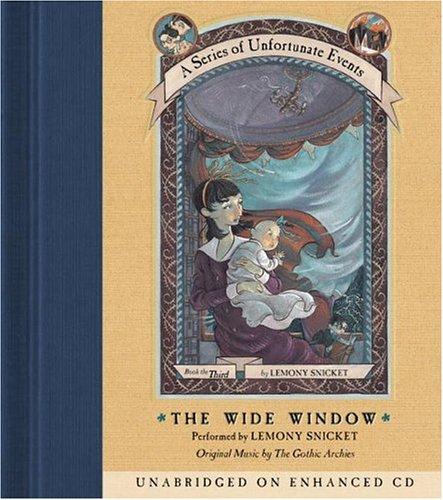
The Wide Window
by Lemony Snicket
★ Top 25 book of 2000 · #14 on Best Books of 2000
The Baudelaire orphans head into another thrilling chapter of their story. Count Olaf is back, and the children are once again in serious trouble.
Best for: Young fans of the Baudelaire orphans following their ongoing misadventures with Count Olaf
The Wide Window is #14 on BookWard's Best Books of 2000, out of 46 2000 books that cleared our data bar.
What The Wide Window is about
The Baudelaire orphans, Violet, Klaus and Sunny, are sent by Mr. Poe to live with their Aunt Josephine in a house on a hill above Lake Lachrymose. Aunt Josephine is afraid of nearly everything, from cooking to her own welcome mat, and she adores grammar, with a library packed with books about it. The house has a wide window that looks out over the lake.
The children are relieved to be safe, but Count Olaf turns up in a new disguise as a sailor called Captain Sham. The children recognize him, yet their guardian refuses to believe them. Once again, the adults around them are no help, and the three siblings must rely on their own wits, each other and a few clues hidden in plain sight. This third book in A Series of Unfortunate Events, illustrated by Brett Helquist, blends gloom and dry humour for young readers who enjoy a mystery.
The Wide Window on the Best Books of 2000
The Wide Window came out in 2000. Of the 46 books first published in 2000 that met BookWard's data bar, it ranks #14 on our Best Books of 2000 list.
Why it made the list: 246 readers have shelved it on Open Library; readers rate it 4 out of 5 (44 ratings). The list ranks each year’s books on how many readers have picked them up, how highly readers rate them, and how many are reading them right now.
Nearby on the 2000 list
- A Living Nightmare... (Cirque Du Freak #1) Darren Shan, #12
- Stargirl Jerry Spinelli, #13
- Gathering Blue Lois Lowry, #15
- Basic Economics Thomas Sowell, #16
See all Best Books of 2000 Best books by year
More years: Best Books of 1999 Best Books of 2001.
The numbers behind it
- Readers: 133 want to read it, 16 are reading it now and 97 have read it, according to Open Library.
- Ratings: 4 out of 5 from 44 Open Library ratings.
| Signal | This book (0 to 100) | Weight |
|---|---|---|
| Reach | 59 | 55% |
| Reader love | 65 | 25% |
| Being read right now | 57 | 20% |
Questions about The Wide Window
When was The Wide Window published?
The Wide Window by Lemony Snicket was first published in 2000.
Was The Wide Window one of the best books of 2000?
The Wide Window is #14 on BookWard's Best Books of 2000, out of 46 2000 books that cleared our data bar. 246 readers have shelved it on Open Library; readers rate it 4 out of 5 (44 ratings).
Why is The Wide Window on the Best Books of 2000 list?
246 readers have shelved it on Open Library; readers rate it 4 out of 5 (44 ratings).
More of the best books of 2000
- Harry Potter and the Goblet of Fire J. K. Rowling, #1
- The 48 Laws of Power Robert Greene, #2
- Because of Winn-Dixie Kate DiCamillo, #3
- The Gruffalo Julia Donaldson, #4
- Life of Pi Yann Martel, #5
- Esperanza Rising Pam Muñoz Ryan, #6
See the full Best Books of 2000, the Top 100, or new books on Rising.
How we know
This page uses public data: Open Library reader counts and ratings, and Wikipedia page views for recent years. The description is paraphrased from real source text. Rankings reflect reading interest, not quality or sales, and can be affected by data gaps. Lists update monthly.
This suits readers around middle-grade age who enjoy dark comedy and puzzles.
Depends on the edition you pick.
Aunt Josephine fears everything, and Lake Lachrymose has plenty to be afraid of. 60% taste match
 BookWard’s take
Aunt Josephine fears everything, and Lake Lachrymose has plenty to be afraid of
The third Baudelaire book trades the gloomy city and country settings for a clifftop house above Lake Lachrymose, and leaves the orphans in the care of an aunt who is afraid of her own stove. It is short and quick, and the hook arrives almost at once, with Count Olaf turning up in a new disguise. Its quiet strength is internal logic: the grammar clues hold together, and the children solve problems with what they know rather than through luck. Familiar tropes are used knowingly rather than leaned on, and Snicket's narrating voice, all arch warnings and defined words, is unmistakable. It sits part way through a series, so the ending resolves this episode but not the larger story.
A children's novel built for a single sitting or two, which suits BookWard's taste for tight books.
Short chapters and a steady run of crises keep things moving, close to BookWard's preference.
Snicket's mix of mock-Victorian gloom and deadpan comedy has a flavor few children's books share.
Clean, formal and playful, with elaborate sentences used for comic effect rather than ornament.
Events and puzzles push the story along more than inner change in the characters.
The orphans keep improvising and sticking together, but the world around them stays stacked against them.
A conventional chapter-by-chapter adventure, with the narrator's digressions as the only formal play.
Deadpan misery and absurd adults make this reliably funny despite the grim situation.
Bleak premises with loss and menace at the edges, but handled lightly for young readers.
Feelings are kept at arm's length by the narrator's dry tone.
See all 50 dialsEvery position, side by side with this book
Where it lines up
- PaceBookWard 8 · book 8
- Story or ideasBookWard 3 · book 3
- LengthBookWard 1 · book 2
Where it pulls apart
- Familiar tropesBookWard 10 · book 6
- ExpositionBookWard 2 · book 6
- Internal logicBookWard 10 · book 8
A children's novel built for a single sitting or two, which suits BookWard's taste for tight books.
Count Olaf reappears as Captain Sham early on, so the menace starts almost immediately, matching BookWard's love of quick openings.
It plays with orphan-story conventions on purpose, and the villain's disguises are a running joke, though the series pattern is familiar.
The plot turns on grammar errors hiding a coded message, a puzzle that follows its own rules and rewards attention.
Short chapters and a steady run of crises keep things moving, close to BookWard's preference.
Snicket's mix of mock-Victorian gloom and deadpan comedy has a flavor few children's books share.
The children are drawn by their talents (inventing, reading, biting) and Aunt Josephine by her fears, more sketch than deep portrait.
This episode's mystery resolves, but the wider story of the orphans and Olaf stays open for the next book.
Sadness is handled with dry understatement, though the orphans' loyalty to each other carries some warmth.
The darkness comes from real stakes and Olaf's schemes, played for dread and humor rather than cheap shocks.
The narrator's warnings, definitions and doom-laden asides make this one of the most distinctive voices in children's fiction.
This is story-led, with a mystery and a hurricane driving events, though wordplay and grammar add idea-flavored texture.
The narrator often pauses to define words and comment outright, which is a deliberate part of the charm but runs against BookWard's preference.
Short and constantly escalating, with little room for a slump between the discovery of Olaf and the hurricane.
Clean, formal and playful, with elaborate sentences used for comic effect rather than ornament.
Events and puzzles push the story along more than inner change in the characters.
The orphans keep improvising and sticking together, but the world around them stays stacked against them.
A conventional chapter-by-chapter adventure, with the narrator's digressions as the only formal play.
Deadpan misery and absurd adults make this reliably funny despite the grim situation.
Easy to read, with words explained as it goes and short chapters.
The story follows the Baudelaires together, with the narrator's commentary overlaying it.
The events unfold in order, with no jumps in time.
The setting is stylized and exaggerated, a slightly off-kilter world with its own rules, though not magical.
A small group: the three orphans, their guardian, Count Olaf in disguise, and a few townsfolk.
The stakes are personal, one family and one disguised villain, even with a hurricane in play.
Action and problem-solving lead, with the characters' feelings mostly implied.
Conversations carry a good share of the comedy, but scenes also run on narration and action.
No romance of note.
Lake Lachrymose and its odd, hostile locals feel invented and unfamiliar.
The book is set in an unspecified, vaguely old-fashioned time rather than the present.
Its storybook gloom and wordplay don't depend on any particular moment.
Snicket the narrator is candid about his own bias and gloom, so he can be trusted, if not cheered.
Olaf is plainly the villain and the children plainly deserve better, so the moral lines are clear.
Settings are drawn with enough detail to feel eerie, without long passages of scenery.
This is Book the Third in A Series of Unfortunate Events and builds on the earlier books.
Disguises and coded clues give a steady supply of reveals, though the pattern is somewhat predictable.
A gentle read, with little to unsettle a young reader beyond mild peril.
Bleak premises with loss and menace at the edges, but handled lightly for young readers.
Feelings are kept at arm's length by the narrator's dry tone.
The humor is dry and ironic, built on deadpan understatement.
Threat and danger are present, but the book keeps them mostly offstage.
None.
Not a concern of the book.
Plain language, with unusual words stopped and explained along the way.
The narrator editorializes constantly, warning readers and delivering his own judgments.
Rooted in an old-fashioned feel, though driven by the next danger rather than reflection.
The orphans' cleverness and loyalty are quietly admired in an unhelpful, cynical world.
Review written by BookWard, dial version 1, November 2026.
Who is The Wide Window right for?
This suits readers around middle-grade age who enjoy dark comedy and puzzles. It has mild peril, a guardian in distress and an ominous tone, so very sensitive younger readers may want company.
Easy to read, with words explained as it goes and short chapters.
Bleak premises with loss and menace at the edges, but handled lightly for young readers.
Feelings are kept at arm's length by the narrator's dry tone.
Threat and danger are present, but the book keeps them mostly offstage.
Book CompanionThe Wide Window: ideas, characters, themes
Three clever orphans use their wits to outmaneuver a disguised villain when the adults around them won't listen.
- A fearful guardian. The orphans are placed with Aunt Josephine, who is afraid of nearly everything, from the stove to the doormat.
- A familiar face in disguise. At the grocery store the children spot Count Olaf posing as a sailor called Captain Sham, but their aunt won't believe it.
- The note. Aunt Josephine leaves a note naming Captain Sham as their new guardian, and it is full of grammar mistakes.
- A hidden message. Klaus works out that the errors in the note encode a message, which points the children toward Curdled Cave.
- A big lake and a big storm. Lake Lachrymose is so large it can produce hurricanes, and Hurricane Herman arrives to raise the stakes.
Characters
Violet Baudelaire
Eldest orphan and inventor
She thinks practically and builds solutions, and she comes up with the peppermint plan to buy the children time.
Klaus Baudelaire
The reader of the family
His love of books helps him decode the hidden message in the note.
Sunny Baudelaire
The baby of the family
Sunny communicates in her own way, and her biting is a recurring strength.
Aunt Josephine
Fearful guardian
Terrified of everyday things but devoted to grammar, she lives in a house overlooking the lake.
Count Olaf
The villain
He returns in disguise as Captain Sham, charming enough to fool the adults.
Themes
How anxiety can shrink a person's life and make them miss real danger.
The children are right about Olaf but ignored because they are young.
Grammar and careful reading become the key to the puzzle.
The three Baudelaires rely on each other's different talents.
Discussion questions
- Why do the adults in this book refuse to believe the children about Captain Sham?
- How does Aunt Josephine's fear of everything change what she can notice or do?
- What does the narrator's habit of explaining words add to the story?
- Which of the three orphans' skills mattered most here, and why?
- How does the setting by the lake shape the mood of the book?
Personalize your Book Companion
This is the general edition. In BookWard, the Companion is written for you: your reading profile, your notes, and spoiler-safe to the page you are on.
Buy, listen or borrow The Wide Window
Each link opens a search for this book on that store, in a new tab.
Read on a device
Borrow
Reviews and community
If you liked The Wide Window
A wry, mock-gloomy orphan adventure that rewards the curious young reader
The Vile VillageLemony SnicketA dark, funny orphan tale where the whole village is the villain
The Bad BeginningLemony SnicketA short, wry orphan tale that dares you to keep reading
The Austere AcademyLemony SnicketA gleefully bleak boarding-school entry in a famously morbid series
Find your own best books
Add what you have read, rate it, and BookWard will recommend what to read next.
Free to start. No credit card needed.