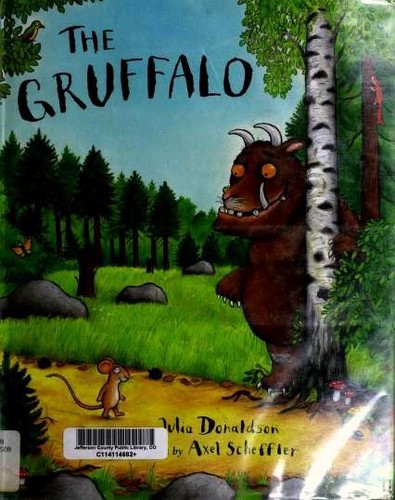
The Gruffalo
by Julia Donaldson
★ Top 5 book of 2000 · #4 on Best Books of 2000
This British picture book by Julia Donaldson, with illustrations by Axel Scheffler, tells of a mouse taking a walk in the woods. It has sold over 13 million copies, won several children's literature prizes, and inspired stage shows and an Oscar-nominated film.
Best for: Families looking for a picture book about a mouse's woodland walk
The Gruffalo is #4 on BookWard's Best Books of 2000, out of 46 2000 books that cleared our data bar.
What The Gruffalo is about
A small, clever mouse is walking through a deep, dark wood, and everyone he meets seems to fancy him for dinner. A fox, an owl and a snake each offer him a meal, and each invitation is a trick. The mouse answers with a trick of his own: he invents a fearsome creature called a Gruffalo, complete with sharp teeth and claws, to frighten the hungry animals away. Then he comes across a creature who looks just as he described. Julia Donaldson tells it in bouncing rhyming couplets with repeating verses that children soon join in on, and Axel Scheffler's pictures add to the fun. It celebrates wit over strength and works well as a read-aloud for young children.
The Gruffalo on the Best Books of 2000
The Gruffalo came out in 2000. Of the 46 books first published in 2000 that met BookWard's data bar, it ranks #4 on our Best Books of 2000 list.
Why it made the list: 1,086 readers have shelved it on Open Library; readers rate it 4.3 out of 5 (88 ratings); 49 are reading it right now. The list ranks each year’s books on how many readers have picked them up, how highly readers rate them, and how many are reading them right now.
It earns Reader favorite.
Nearby on the 2000 list
- The 48 Laws of Power Robert Greene, #2
- Because of Winn-Dixie Kate DiCamillo, #3
- Life of Pi Yann Martel, #5
- Esperanza Rising Pam Muñoz Ryan, #6
See all Best Books of 2000 Best books by year
More years: Best Books of 1999 Best Books of 2001.
The numbers behind it
- Readers: 856 want to read it, 49 are reading it now and 181 have read it, according to Open Library.
- Ratings: 4.3 out of 5 from 88 Open Library ratings.
| Signal | This book (0 to 100) | Weight |
|---|---|---|
| Reach | 87 | 55% |
| Reader love | 100 | 25% |
| Being read right now | 87 | 20% |
Questions about The Gruffalo
When was The Gruffalo published?
The Gruffalo by Julia Donaldson was first published in 2000.
Was The Gruffalo one of the best books of 2000?
The Gruffalo is #4 on BookWard's Best Books of 2000, out of 46 2000 books that cleared our data bar. 1,086 readers have shelved it on Open Library; readers rate it 4.3 out of 5 (88 ratings); 49 are reading it right now.
Why is The Gruffalo on the Best Books of 2000 list?
1,086 readers have shelved it on Open Library; readers rate it 4.3 out of 5 (88 ratings); 49 are reading it right now.
More of the best books of 2000
- Harry Potter and the Goblet of Fire J. K. Rowling, #1
- The 48 Laws of Power Robert Greene, #2
- Because of Winn-Dixie Kate DiCamillo, #3
- Life of Pi Yann Martel, #5
- Esperanza Rising Pam Muñoz Ryan, #6
- Rich Dad's Guide to Investing Robert T. Kiyosaki, #7
See the full Best Books of 2000, the Top 100, or new books on Rising.
How we know
This page uses public data: Open Library reader counts and ratings, and Wikipedia page views for recent years. The description is paraphrased from real source text. Rankings reflect reading interest, not quality or sales, and can be affected by data gaps. Lists update monthly.
It suits young children, especially as a read-aloud, and works well for early readers who enjoy rhyme and repetition.
Depends on the edition you pick.
A tiny mouse outwits the whole forest in rhyme. 62% taste match
 BookWard’s take
A tiny mouse outwits the whole forest in rhyme
The Gruffalo runs about 700 words, written in rhyming couplets with repetitive verse, and it wastes none of them. A mouse strolls into a wood, meets a fox, an owl and a snake, and talks his way out of each invitation by inventing a monster. That is the whole machine, and it is airtight: every trick sets up the next. It is as short as a book gets, it hooks from the first lines, and the pace never stalls, with no sagging middle to speak of. The ending is fully resolved, and the tone is closer to funny than frightening. It is a trickster story at heart, so it leans on familiar tropes, but the voice is unmistakable and the rhythm is made to be read aloud.
About 700 words in rhyming couplets, as short as a book gets, which is exactly where BookWard likes to sit.
The repeating encounters move briskly through short verses, so the story never lingers.
The trickster frame is old, but the Gruffalo and its rhyming delivery feel like Donaldson's own.
The language is simple and musical, with the rhyme carrying the style more than ornament does.
The plot drives it: the mouse's cleverness matters because of what it does, not who he becomes.
A small creature beats bigger ones by wit and ends up safe and smiling, an upbeat outlook.
It follows a plain repeating pattern of encounters and a reversal, conventional by design.
The mouse's bluffing and the monsters' panic play for gentle laughs rather than solemnity.
See all 50 dialsEvery position, side by side with this book
Where it lines up
- LengthBookWard 1 · book 1
- OpeningBookWard 10 · book 10
- PaceBookWard 8 · book 8
Where it pulls apart
- Familiar tropesBookWard 10 · book 4
- Character depthBookWard 8 · book 4
- OriginalityBookWard 9 · book 6
About 700 words in rhyming couplets, as short as a book gets, which is exactly where BookWard likes to sit.
The mouse is already walking through the wood and meeting the fox in the opening lines, so the story starts moving at once.
It is a trickster tale with a clever small hero, a familiar shape, though the monster itself is a fresh invention.
Each invitation, each invented feature and the final reversal follow a tight cause-and-effect chain with no loose threads.
The repeating encounters move briskly through short verses, so the story never lingers.
The trickster frame is old, but the Gruffalo and its rhyming delivery feel like Donaldson's own.
The mouse, fox, owl and snake are sharply drawn types built to serve the trick, not deeply explored people.
The mouse sits down to his nut and every threat is settled, a fully resolved close.
It leans warm and playful rather than tearful, with comfort coming from the mouse's win, not from tugging at feelings.
Nothing is there for shock; the scary creature is a device the story resolves gently.
This is a picture book of fiction, so the rigor dial does not apply.
The bouncing couplets and repeated refrains give it a voice you can recognise from a single page.
This is pure story, a mouse, a wood and a sequence of encounters, with no argument to make.
Everything is shown through encounters and spoken lines, never explained to the reader.
At 700 words there is no middle to sag; each encounter builds on the last.
The language is simple and musical, with the rhyme carrying the style more than ornament does.
The plot drives it: the mouse's cleverness matters because of what it does, not who he becomes.
A small creature beats bigger ones by wit and ends up safe and smiling, an upbeat outlook.
It follows a plain repeating pattern of encounters and a reversal, conventional by design.
The mouse's bluffing and the monsters' panic play for gentle laughs rather than solemnity.
Short rhyming lines and repetition make it about as easy to read as a book can be.
The story stays with the mouse's walk through the wood from a single point of view.
Events unfold in a straight line from the walk to the final nut.
Talking animals and an invented monster put it clearly in fantasy, though the wood itself is ordinary.
A mouse, a fox, an owl, a snake and the Gruffalo make a very small cast.
The whole story is one mouse's walk in a wood, as intimate as it gets.
We follow what the mouse says and does and meet creatures in turn, with little reflection on his thoughts.
Most of the story moves through spoken exchanges between the mouse and each animal.
There is no romance anywhere in the story.
A deep, dark wood with animals is a setting any child already knows.
The wood and its creatures carry no date, so it reads as neither past nor contemporary.
A folk-tale trickster plot with rhyme that still holds up as a read-aloud favourite.
The narration reports what happens plainly and can be taken at face value.
Cleverness beats brute strength and that is the single, clear takeaway.
Detail is kept sparse, with the Gruffalo's features given in a few vivid lines, and Scheffler's illustrations do the rest.
Review written by BookWard, dial version 1, November 2026.
Who is The Gruffalo right for?
It suits young children, especially as a read-aloud, and works well for early readers who enjoy rhyme and repetition. The Gruffalo is a monster who says it will eat the mouse, which can be briefly spooky for very small listeners.
Short rhyming lines and repetition make it about as easy to read as a book can be.
Book CompanionThe Gruffalo: ideas, characters, themes
A small, clever mouse survives a dangerous wood by inventing a monster, then outwits the real one when it appears.
- The walk begins. A mouse sets off through a deep, dark wood looking for food.
- Three invitations. A fox, an owl and a snake each invite him to a meal, and the mouse sees each is a trap.
- The invented monster. To escape, he describes a made-up creature, the Gruffalo, and says he is on his way to meet it.
- The real Gruffalo. He then meets a creature that matches his description exactly and says it will eat him.
- The final bluff. The mouse tells the Gruffalo he is the scariest creature in the wood and walks it past the other animals to prove it.
Characters
The Mouse
Hero
A small, quick-witted animal who survives by talking his way out of danger.
The Fox
First predator
Invites the mouse to his home for a meal, intending to eat him.
The Owl
Second predator
Makes a similar invitation and is scared off by the mouse's tale.
The Snake
Third predator
Offers the mouse a meal at his home and is also frightened away.
The Gruffalo
Monster
A beast that looks exactly as the mouse described and is outwitted in turn.
Themes
Cleverness and quick thinking can beat much bigger, hungrier creatures.
Bluffing and invention are the mouse's tools, in the tradition of the trickster story.
What others believe about you can protect you as much as what is true.
The mouse keeps his nerve when the danger turns out to be real.
The book draws on a Chinese folk tale about a fox who borrows the terror of a tiger.
Discussion questions
- How does the mouse use what the other animals fear to escape each time?
- Why do you think the story repeats the same pattern of meeting and escaping?
- What would have happened if the Gruffalo had not been real?
- How do the rhymes change the way the story feels when read aloud?
- Which of the mouse's tricks do you think is the cleverest, and why?
Personalize your Book Companion
This is the general edition. In BookWard, the Companion is written for you: your reading profile, your notes, and spoiler-safe to the page you are on.
Buy, listen or borrow The Gruffalo
Each link opens a search for this book on that store, in a new tab.
Read on a device
Borrow
Reviews and community
If you liked The Gruffalo
A rhyming broomstick tale where kindness gets crowded and then pays off
The Gruffalo's ChildJulia DonaldsonA winter-wood sequel where brains still beat brawn, in bouncing rhyme
The Tale of Peter RabbitBeatrix PotterA tiny garden chase that still moves faster than most thrillers
The Cat in the HatDr. SeussA rainy-day romp in rhyme that still moves fast
Find your own best books
Add what you have read, rate it, and BookWard will recommend what to read next.
Free to start. No credit card needed.