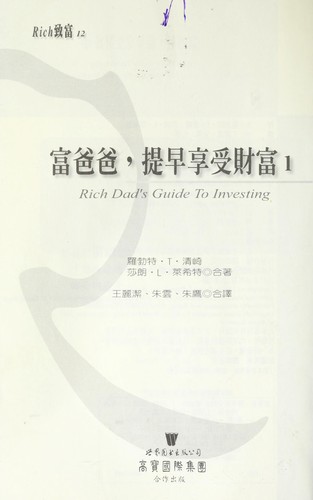
Rich Dad's Guide to Investing
by Robert T. Kiyosaki
★ Top 10 book of 2000 · #7 on Best Books of 2000
Following earlier Rich Dad bestsellers, this guide explores what wealthy people invest in that others overlook. It offers rules of investing, ways to lower risk, and methods for turning earned income into passive and portfolio income.
Best for: Aspiring investors wanting to learn how the rich approach investing and risk
Rich Dad's Guide to Investing is #7 on BookWard's Best Books of 2000, out of 46 2000 books that cleared our data bar.
What Rich Dad's Guide to Investing is about
Robert T. Kiyosaki and Sharon Lechter follow the New York Times bestsellers Rich Dad, Poor Dad and Rich Dad's CASHFLOW Quadrant with a guide focused on investing. His central claim is that the best investments never make it to market, and he sets out what the rich put their money into that the poor and middle class do not. He offers an insider's view of how wealthy investors find good opportunities, lays out Rich Dad's basic rules of investing and his 10 Investor Controls, and explains ways to reduce risk. He also shows how to turn earned income into passive and portfolio income. Sharon Lechter is named alongside him for the rules and methods. The tone is brash and motivational. It will suit readers who have read the earlier books and want to move from ideas about money toward a plan for building wealth.
Rich Dad's Guide to Investing on the Best Books of 2000
Rich Dad's Guide to Investing came out in 2000. Of the 46 books first published in 2000 that met BookWard's data bar, it ranks #7 on our Best Books of 2000 list.
Why it made the list: 473 readers have shelved it on Open Library; readers rate it 4.2 out of 5 (13 ratings); 31 are reading it right now. The list ranks each year’s books on how many readers have picked them up, how highly readers rate them, and how many are reading them right now.
Nearby on the 2000 list
- Life of Pi Yann Martel, #5
- Esperanza Rising Pam Muñoz Ryan, #6
- Angels & Demons Dan Brown, #8
- Stormbreaker Anthony Horowitz, #9
See all Best Books of 2000 Best books by year
More years: Best Books of 1999 Best Books of 2001.
The numbers behind it
- Readers: 427 want to read it, 31 are reading it now and 15 have read it, according to Open Library.
- Ratings: 4.2 out of 5 from 13 Open Library ratings.
| Signal | This book (0 to 100) | Weight |
|---|---|---|
| Reach | 78 | 55% |
| Reader love | 67 | 25% |
| Being read right now | 80 | 20% |
Questions about Rich Dad's Guide to Investing
When was Rich Dad's Guide to Investing published?
Rich Dad's Guide to Investing by Robert T. Kiyosaki was first published in 2000.
Was Rich Dad's Guide to Investing one of the best books of 2000?
Rich Dad's Guide to Investing is #7 on BookWard's Best Books of 2000, out of 46 2000 books that cleared our data bar. 473 readers have shelved it on Open Library; readers rate it 4.2 out of 5 (13 ratings); 31 are reading it right now.
Why is Rich Dad's Guide to Investing on the Best Books of 2000 list?
473 readers have shelved it on Open Library; readers rate it 4.2 out of 5 (13 ratings); 31 are reading it right now.
More of the best books of 2000
- Harry Potter and the Goblet of Fire J. K. Rowling, #1
- The 48 Laws of Power Robert Greene, #2
- Because of Winn-Dixie Kate DiCamillo, #3
- The Gruffalo Julia Donaldson, #4
- Life of Pi Yann Martel, #5
- Esperanza Rising Pam Muñoz Ryan, #6
See the full Best Books of 2000, the Top 100, or new books on Rising.
How we know
This page uses public data: Open Library reader counts and ratings, and Wikipedia page views for recent years. The description is paraphrased from real source text. Rankings reflect reading interest, not quality or sales, and can be affected by data gaps. Lists update monthly.
Best suited to adults and older teens curious about personal finance.
Depends on the edition you pick.
A cash-flow-first investing primer in Kiyosaki's loud, anecdotal style. 34% taste match
 BookWard’s take
A cash-flow-first investing primer in Kiyosaki's loud, anecdotal style
This 2000 follow-up to Rich Dad, Poor Dad and Rich Dad's CASHFLOW Quadrant promises an insider's look at what the rich invest in that most people never see. Kiyosaki and Sharon Lechter lay out seven basic rules, ten Investor Controls, and a route from earned income to passive and portfolio income. The weak spot is rigor: the case rests on stories and bold assertion more than on evidence. The voice is stronger, because the confident, repetitive pitch is unmistakably Kiyosaki. It leans toward ideas over narrative, and it explains its lessons outright instead of letting them emerge. Treat it as a motivational framework for thinking about money, then verify the specifics elsewhere.
Its cash-flow framing was distinctive in 2000, but it largely extends ideas from the author's earlier bestsellers.
Plain, conversational language aimed at non-experts, with little ornament.
Its central message is that anyone can build passive income, an openly optimistic outlook.
Straightforward and earnest, with only the occasional wry aside.
A gentle, motivational tone with nothing disturbing.
Aspirational and motivational, but not emotionally intense.
See all 50 dialsEvery position, side by side with this book
Where it lines up
- Authorial voiceBookWard 9 · book 9
- PaceBookWard 8 · book 6
- LengthBookWard 1 · book 4
Where it pulls apart
- Familiar tropesBookWard 10 · book 3
- Internal logicBookWard 10 · book 4
- Character depthBookWard 8 · book 1
Its pitch about what the rich invest in is a strong draw, though not the immediate pull BookWard prizes.
Self-help money advice leans on familiar motivational framing and rags-to-riches talk, well short of the fresh angles BookWard wants.
Claims are pitched confidently but rest on assertion and anecdote rather than tight reasoning, which falls short of BookWard's airtight standard.
Its cash-flow framing was distinctive in 2000, but it largely extends ideas from the author's earlier bestsellers.
Rich Dad appears as a teaching device, not a drawn person, so character depth is essentially absent.
Seven rules and ten controls give the book a clear, practical frame, though a guide of this kind leaves the real work to the reader.
Aspirational, motivational language and personal money stories lean warm rather than restrained.
Advice leans on anecdote and strong assertion more than data or sourcing, well below the rigor BookWard values.
Kiyosaki's blunt, repetitive, confident pitch is instantly recognizable, a clear plus for BookWard.
The book exists to deliver a financial philosophy, with stories serving only as illustrations.
Lessons are stated outright through rules, controls and lists, the opposite of showing in scene, which BookWard dislikes.
A list-driven structure keeps sections self-contained, though repetition of core themes softens the momentum.
Plain, conversational language aimed at non-experts, with little ornament.
Its central message is that anyone can build passive income, an openly optimistic outlook.
Straightforward and earnest, with only the occasional wry aside.
Short sections and plain language make it an easy read, even if the concepts need checking elsewhere.
Everything arrives through the author's single, insistent perspective.
A guide organized around rules and lessons, it moves forward topic by topic rather than playing with time.
Entirely grounded in money and markets.
Very few people appear, mainly the author and his two father figures.
It stays focused on individual finances and personal choices.
It centers on mindset and financial thinking, with action as a follow-on.
No romantic thread; this is a book about money.
Investing is the territory, which will feel familiar to anyone who follows personal finance.
The mindset themes travel, but market particulars from 2000 limit how long it stays useful.
The author speaks plainly in his own voice, so there is no unreliable narrator device.
It argues for one clear path to wealth and frames rival approaches as mistaken.
Little scene-setting; the page is given over to argument and instruction.
Rules, controls and frameworks drive it more than storytelling, though anecdotes appear throughout.
Kiyosaki's own experience and his two dads shape the argument from the first pages.
It follows Rich Dad, Poor Dad and Rich Dad's CASHFLOW Quadrant and belongs to a wider Rich Dad franchise.
Advice books deliver ideas, not surprises, though a few reframes of conventional wisdom land.
It pushes against the conventional save-and-wait approach to money, which some readers will find bracing.
A gentle, motivational tone with nothing disturbing.
Aspirational and motivational, but not emotionally intense.
None.
None.
Plain, jargon-light prose that stays accessible.
Strongly opinionated and pitched as certainty, with little room for opposing views.
It urges readers to build future income, pointing forward rather than dwelling on the past.
It holds out financial freedom as an achievable goal for anyone willing to learn.
Review written by BookWard, dial version 1, November 2026.
Who is Rich Dad's Guide to Investing right for?
Best suited to adults and older teens curious about personal finance. It contains no mature content, but the confident claims about wealth and risk deserve a skeptical read.
Short sections and plain language make it an easy read, even if the concepts need checking elsewhere.
A gentle, motivational tone with nothing disturbing.
Aspirational and motivational, but not emotionally intense.
None.
Book CompanionRich Dad's Guide to Investing: ideas, characters, themes
Real wealth comes from learning to buy assets that generate income, and the rich invest differently from everyone else.
- Seven basic rules. The book lays out seven basic rules of investing meant to give readers a base to build on.
- Reducing risk. It promises to show readers how to reduce their investment risk.
- Ten Investor Controls. Rich Dad's ten Investor Controls are presented as a core part of how the rich invest.
- Income types. It shows how to convert earned income into passive and portfolio income.
- The best investments. It claims the best investments never reach the public market and explains how insiders find them.
Characters
Robert T. Kiyosaki
Author and narrator
He tells the story in his own voice, using personal experience to anchor the lessons.
Sharon Lechter
Co-author
She is credited alongside Kiyosaki in showing readers the rules and controls.
Rich Dad
Mentor figure
He serves as the source of the investing philosophy the book passes on.
Themes
Learning how money works matters more than earning a high salary.
Wealth comes from assets that pay without constant labor.
Staying in charge of your investments reduces risk.
The best deals are found outside public markets.
Beliefs about money shape what people do with it.
Discussion questions
- Which of the seven rules would you test first, and how?
- Does the claim that the best investments never reach the market hold up?
- How much weight should anecdote carry when giving investment advice?
- What does converting earned income into passive income require of a reader?
- How would you check these ideas against independent financial sources?
Personalize your Book Companion
This is the general edition. In BookWard, the Companion is written for you: your reading profile, your notes, and spoiler-safe to the page you are on.
Buy, listen or borrow Rich Dad's Guide to Investing
Each link opens a search for this book on that store, in a new tab.
Read on a device
Borrow
Reviews and community
If you liked Rich Dad's Guide to Investing
Hill's lesson-by-lesson course on success, earnest and influential, but short on proof
Rich Dad, Poor DadRobert T. KiyosakiA short, punchy money primer built on parables, light on proof
Rich Dad, Poor Dad for TeensRobert T. KiyosakiKiyosaki's money lessons, trimmed and tuned for teenage readers
The think and grow rich action packNapoleon HillNapoleon Hill's success gospel, packaged for doing rather than just reading
Find your own best books
Add what you have read, rate it, and BookWard will recommend what to read next.
Free to start. No credit card needed.