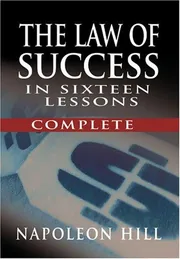
The Law of Success
by Napoleon Hill · 1928
Suited to adult and older teenage readers interested in motivation, business, or the history of self-help.
374 pages, about 6 to 8.5 hours.
Hill's lesson-by-lesson course on success, earnest and influential, but short on proof. 31% taste match
What it covers
The Law of Success is a self-improvement and motivational work by Napoleon Hill, first published in 1928. It is nonfiction aimed at ordinary readers who want to understand the principles behind achievement, with a particular focus on business, management, and personal psychology. The material belongs to the New Thought tradition and is presented as a course on the fundamentals of success, laid out as a series of lessons that build step by step.
The book began as a manuscript Hill wrote in 1925, which was issued as a set of 15 separate booklets before being reworked with the help of several contributors. The 1928 version appeared as a multi-volume correspondence course in 16 lessons, and later editions gathered the material into a single volume. Its origins trace to 1908, when Hill was assigned a magazine profile of the steel baron and philanthropist Andrew Carnegie, an encounter that led to an offer to introduce him to leading figures in American business. The text draws on the experience of those business leaders. More than 90 editions have been issued, including a 75th anniversary collector's edition, and a typical printing runs to roughly 374 pages.
This is a course on the fundamentals of success.
Themes
SuccessBusinessManagementSelf-ImprovementMotivation (Psychology)Success in businessExito en los negociosMotivación (Psicología)
- Want to read 380
- Reading now 43
- Read 8
Most people shelving it are saving it for later.
Of 431 readers who put it on a shelf, 88% want to read it, 10% are reading it now, 2% have finished it and 0% stopped before the end.
By the numbers
- The median edition runs 374 pages. Counting about 275 words a page and an adult reading pace of 250 words a minute, that is about 6.9 hours of reading.
- Open Library tracks 90 editions from 46 publishers, the earliest dated 1969 and the latest 2022, across 2 languages.
- On reader demand it ranks in the top 5% of the classic books in our catalog (8,749 of them).
- Libraries shelve it under Dewey 650.1 and Library of Congress class HF-5386.00000000.H55 2011.
 BookWard’s take
Hill's lesson-by-lesson course on success, earnest and influential, but short on proof
The Law of Success is Napoleon Hill's 1928 course on achievement, built as a run of lessons that stack one principle on the next. It began as booklets and a correspondence course, and the structure shows: Hill states a principle, explains it, then moves on. This is a book of ideas rather than story, and it explains outright instead of showing anything in scene. Rigor is the weak point, since the method leans on anecdote and the experience of business figures rather than measured evidence. Where it earns its place is in its lasting influence: the vocabulary of modern motivation traces back here. Read it as a foundational text, with a skeptic's eye.
At 374 pages in one edition, and part of a larger multi-volume work, it runs long for a self-help title.
Each lesson takes its time explaining and illustrating a principle, so it moves at a measured, instructional pace.
It was groundbreaking in 1928, though its ideas have since become common property in the genre.
The language is plain and direct, meant for ordinary readers, with period flavor rather than ornament.
Its central promise is that anyone can achieve success by following the steps, an openly optimistic outlook.
A sequence of lessons is a clear, conventional course format, with origins in booklets and correspondence study.
It is a serious instructional work with little interest in humor.
The tone stays upbeat and instructional throughout.
It aims to motivate, so the feeling is stirring but not deeply emotional.
See all 50 dialsEvery position, side by side with this book
Where it lines up
- EndingBookWard 8 · book 6
- Authorial voiceBookWard 9 · book 7
- Sagging middleBookWard 8 · book 5
Where it pulls apart
- Familiar tropesBookWard 10 · book 3
- OpeningBookWard 10 · book 4
- Internal logicBookWard 10 · book 4
At 374 pages in one edition, and part of a larger multi-volume work, it runs long for a self-help title.
As an instructional course, it builds through explained principles rather than a gripping scene, so the pull is gentle.
Its advice shaped the genre, but modern readers will meet many of its ideas as familiar motivational staples.
Lessons follow in order, yet claims rest on assertion and anecdote, so the reasoning is not tightly proven.
Each lesson takes its time explaining and illustrating a principle, so it moves at a measured, instructional pace.
It was groundbreaking in 1928, though its ideas have since become common property in the genre.
The course closes by gathering its principles into a unified philosophy, a fairly complete finish.
Encouraging and earnest in tone, it favors uplift over restraint.
It draws on the experience of business leaders, but leans on anecdote over measured evidence, which cuts against BookWard's taste.
Hill's earnest, exhorting teacher's voice is recognizable, though the text was reworked with several contributors.
It is a course built around principles, with almost no narrative drive, and sits firmly on the ideas side.
Each principle is explained outright in lesson form rather than dramatized, the opposite of BookWard's preference.
The lesson structure keeps each part purposeful, though a long course invites some repetition.
The language is plain and direct, meant for ordinary readers, with period flavor rather than ornament.
Its central promise is that anyone can achieve success by following the steps, an openly optimistic outlook.
A sequence of lessons is a clear, conventional course format, with origins in booklets and correspondence study.
It is a serious instructional work with little interest in humor.
The writing is accessible and aimed at the average reader, with modest effort required.
Hill teaches throughout, drawing on business leaders' experience, but one guiding voice dominates.
Lessons build step by step in a straightforward, forward-moving order.
It is a practical, real-world program, though its New Thought roots lean on mental forces.
Few named figures recur, with Andrew Carnegie and business leaders as background influences.
It addresses one reader's personal achievement, though with ambitions about success in general.
Its focus is on mindset and habits, with an emphasis on what goes on within the reader.
As an instructional course, it relies on explanation rather than conversation.
Romance is not part of this business and personal achievement course.
The world is the familiar one of business and everyday ambition.
Written in the 1920s, it carries the business world of its time, though later editions add contemporary stories.
Repeated reprints, including a 75th anniversary edition, show a lasting hold, even as the examples date.
The author speaks plainly as a guide, with no hint of an unreliable voice.
Its principles, such as the Golden Rule and cooperation, are presented as clear right answers.
Illustration comes through anecdotes and examples rather than rich scene-setting.
It mixes anecdote with principle-by-principle instruction, leaning slightly analytical but staying readable.
Hill addresses the reader directly and draws on his own mission, giving it a personal, mentoring tone.
The 1928 version was issued as a multi-volume course, with later editions gathering the lessons.
A teaching course offers progression rather than surprises.
It encourages the reader but mostly confirms a hopeful program instead of unsettling beliefs.
The tone stays upbeat and instructional throughout.
It aims to motivate, so the feeling is stirring but not deeply emotional.
There is no violence in a book about personal achievement.
Nothing of a sexual nature belongs in this self-help course.
Business and success dominate, with little overt political argument.
Period phrasing is clear enough for modern readers to follow easily.
Hill argues forcefully for his philosophy, and the whole book is one opinionated case.
It urges readers toward future achievement and the goals they have yet to reach.
It presents success as open to anyone willing to follow the principles, a strongly idealistic stance.
Review written by BookWard, dial version 1, November 2026.
Who is The Law of Success right for?
Suited to adult and older teenage readers interested in motivation, business, or the history of self-help. It has no graphic content, though it was written in the 1920s and reflects the outlook of its time.
The writing is accessible and aimed at the average reader, with modest effort required.
The tone stays upbeat and instructional throughout.
It aims to motivate, so the feeling is stirring but not deeply emotional.
There is no violence in a book about personal achievement.
Book CompanionThe Law of Success: ideas, characters, themes
Success follows from a set of learnable principles, drawn from the experience of leading business figures, that any ordinary person can apply.
- Success has principles. The course breaks achievement into a set of named principles instead of treating it as luck or talent.
- Cooperation matters. One of the closing principles holds that working with others multiplies what a person can do alone.
- Profiting by failure. Setbacks are framed as material to learn from rather than reasons to quit.
- Tolerance. Success is tied to dealing fairly and openly with people who differ from you.
- The Golden Rule. Personal integrity and treating others as you would be treated sit near the heart of the philosophy.
Characters
Napoleon Hill
Author and guide
He presents the course as the fruit of years spent studying successful people.
Andrew Carnegie
Steel baron and origin of the project
His 1908 interview with Hill led to the offer that shaped the whole undertaking.
Themes
Change comes from the reader's own habits and mindset.
Achievement grows when people work together.
Success is linked to fair dealing and the Golden Rule.
Setbacks become useful when studied rather than avoided.
The book's confidence that anyone can improve their circumstances.
Discussion questions
- Which of the principles still feels useful today, and which feels dated?
- How much weight should anecdotes from business leaders carry as evidence?
- Does framing success as a set of steps help or oversimplify?
- How do cooperation and the Golden Rule fit with a focus on personal achievement?
- Why do you think this book's ideas spread so widely and last so long?
Personalize your Book Companion
This is the general edition. In BookWard, the Companion is written for you: your reading profile, your notes, and spoiler-safe to the page you are on.
Buy, listen or borrow The Law of Success
Each link opens a search for this book on that store, in a new tab.
Read on a device
Borrow
Reviews and community
If you liked The Law of Success
A cash-flow-first investing primer in Kiyosaki's loud, anecdotal style
The think and grow rich action packNapoleon HillNapoleon Hill's success gospel, packaged for doing rather than just reading
Think and Grow RichNapoleon HillA 1937 success manual: 13 principles, big promises, thin proof
Ageless Body, Timeless MindDeepak ChopraChopra's case that aging bends to belief, argued with conviction
Sources: Open Library.
Track The Law of Success and find your next favorite
Add it to your shelf, rate what you have read, and BookWard will recommend what fits you.
Free to start. No credit card needed.