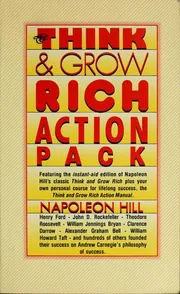
The think and grow rich action pack
by Napoleon Hill · 1972
Suited to adults and older teens interested in motivation, business and personal goals.
345 pages, about 5.5 to 8 hours.
Napoleon Hill's success gospel, packaged for doing rather than just reading. 29% taste match
What it covers
The Think and Grow Rich Action Pack is a self-help work by Napoleon Hill, first published in 1972 and running to roughly 345 pages. It belongs to the success literature that treats personal achievement, and particularly achievement in business, as something a reader can pursue through deliberate habits of mind. The book appears in seven editions.
The opening line sets the tone: thoughts are things, and they gain real force when joined with a clear purpose, persistence, and a strong desire to turn them into riches or other material goals. From there the book takes up the subject of success and how a person might work toward it in a business setting. Andrew Carnegie, who lived from 1835 to 1919, is among the figures connected with its subject matter. Readers interested in motivational writing on wealth, ambition, and the mindset behind professional achievement will find the territory familiar and the approach direct.
Truly, "thoughts are things," and powerful things at that when they are mixed with definiteness of purpose, persistence, and a burning desire for their translation into riches, or other material objects.
Themes
SuccessSuccess in businessCarnegie, andrew, 1835-1919
- Want to read 312
- Reading now 60
- Read 14
Most people shelving it are saving it for later.
Of 386 readers who put it on a shelf, 81% want to read it, 16% are reading it now, 4% have finished it and 0% stopped before the end.
By the numbers
- The median edition runs 345 pages. Counting about 275 words a page and an adult reading pace of 250 words a minute, that is about 6.3 hours of reading.
- Open Library tracks 7 editions from 5 publishers, the earliest dated 1972 and the latest 1988.
- On reader demand it ranks in the top 5% of the classic books in our catalog (8,749 of them).
- Libraries shelve it under Dewey 158.1.
 BookWard’s take
Napoleon Hill's success gospel, packaged for doing rather than just reading
This is a self-help workbook built on Hill's belief that thoughts are things, aimed at readers who want to turn desire and persistence into material results. It's a mixed bag. The method rests on testimony and assertion rather than evidence, so anyone looking for rigor will come away empty-handed. It leans hard on the genre's standard promises and mostly restates ideas the success literature already circulates, which makes it feel well-worn rather than fresh. Where it does well is in getting started: the central claim lands in the very first line, and the book explains its ideas outright instead of dramatizing them, so you always know what it wants from you. The outlook is strongly hopeful throughout. Pick it up as a motivational tool and as a document of a very particular school of American ambition, not as a work of argument.
At 345 pages it is a substantial workbook, longer than BookWard's tight ideal, though its exercises break it into manageable stretches.
The material moves at a steady instructional pace, neither rushed nor slow, a little under BookWard's brisk preference.
The ideas belong to a well-worn tradition of success writing, so it reads as familiar rather than new.
The writing is plain and direct, in service of the message, a touch plainer than BookWard's middle ground.
With no plot or characters to speak of, this dial does not apply.
It is relentlessly optimistic about what a determined reader can achieve, well above BookWard's hopeful lean.
It follows the conventional chapter-by-chapter layout of a self-help guide, with little formal play.
The tone is earnest and serious throughout, with no comic edge.
The content is encouraging and clean, with nothing dark.
It aims to energize and motivate, with a moderate emotional charge.
See all 50 dialsEvery position, side by side with this book
Where it lines up
- OpeningBookWard 10 · book 8
- PaceBookWard 8 · book 5
- Authorial voiceBookWard 9 · book 6
Where it pulls apart
- Familiar tropesBookWard 10 · book 2
- Internal logicBookWard 10 · book 4
- ExpositionBookWard 2 · book 10
At 345 pages it is a substantial workbook, longer than BookWard's tight ideal, though its exercises break it into manageable stretches.
The opening line states the thesis that thoughts are things, so the premise arrives at once, which BookWard rewards.
It works squarely within the success-literature formula of desire, persistence and purpose, which BookWard counts against it.
Its claims are asserted as principles rather than built step by step, so the reasoning is looser than BookWard wants.
The material moves at a steady instructional pace, neither rushed nor slow, a little under BookWard's brisk preference.
The ideas belong to a well-worn tradition of success writing, so it reads as familiar rather than new.
This is a self-help book with no characters to draw, so the dial does not apply.
A practical guide has no plot to resolve, so an ending dial does not apply.
It is openly inspirational and aims to stir the reader, which sits on the sentimental side of BookWard's restraint.
Nothing here seeks to shock, so the dial does not apply.
The method leans on conviction and example rather than evidence, well short of the rigor BookWard values.
Hill's exhortative, confident manner is recognizable, giving it more personality than generic advice.
It is almost entirely about ideas and method, with next to no story, the opposite of BookWard's lean.
It explains its principles outright instead of dramatizing them, far from BookWard's show-in-scene preference.
As a repeated cycle of principle and exercise it holds a consistent rhythm without much of a middle to sag.
The writing is plain and direct, in service of the message, a touch plainer than BookWard's middle ground.
With no plot or characters to speak of, this dial does not apply.
It is relentlessly optimistic about what a determined reader can achieve, well above BookWard's hopeful lean.
It follows the conventional chapter-by-chapter layout of a self-help guide, with little formal play.
The tone is earnest and serious throughout, with no comic edge.
The language and ideas are accessible and meant to be applied, making it an easy read.
One authorial voice speaks to the reader throughout, a single viewpoint.
It proceeds in a straightforward order from principle to principle, with no time shifts.
It is grounded in business and personal ambition, with nothing fantastical.
It speaks to a single reader, with only a few historical figures such as Andrew Carnegie in the background.
Its focus is the individual's own pursuit of success, intimate in scope, though the ambition it describes is large.
Much of the program works on mindset, desire and belief, which puts it on the inner side.
It is exposition and instruction rather than conversation, so dialogue is almost absent.
Romance plays no part in a book about achievement and money.
The business and success setting is a familiar one, with nothing unfamiliar to learn.
First published in 1972 and rooted in earlier success writing, it reads as an older work, not a present-day one.
Its core appeal of desire and persistence keeps drawing readers, though its style and examples date it.
The author speaks plainly and directly to the reader, a reliable guide by design.
It presents success as a clear goal with a clear path, with little moral ambiguity.
It deals in principles and exercises rather than scenery, so description stays sparse.
It is more a method to apply than a story to follow, leaning toward the analytical side.
Hill addresses the reader directly and personally, urging them to act, which keeps it close and engaged.
It is an action-pack companion built on the original Think and Grow Rich, so it belongs to a wider line of related editions.
A method book offers no plot, so there are no surprises to speak of.
It mostly affirms the reader's ambition, though it asks for discipline, so it sits on the comforting side.
The content is encouraging and clean, with nothing dark.
It aims to energize and motivate, with a moderate emotional charge.
The book is not comic, so humor style does not apply.
There is no violence in a book about success habits.
There is no sexual content.
It concerns personal achievement rather than public affairs, so politics is absent.
The wording is plain and accessible, with no dialect or dense language.
Hill argues forcefully for his philosophy, so the narration is strongly opinionated.
It pushes the reader toward future goals and gains, looking forward.
It holds that desire and persistence can deliver wealth, a thoroughly idealistic worldview.
Review written by BookWard, dial version 1, November 2026.
Who is The think and grow rich action pack right for?
Suited to adults and older teens interested in motivation, business and personal goals. Nothing graphic, though its promises about wealth are worth reading with a critical eye.
The language and ideas are accessible and meant to be applied, making it an easy read.
The content is encouraging and clean, with nothing dark.
It aims to energize and motivate, with a moderate emotional charge.
There is no violence in a book about success habits.
Book CompanionThe think and grow rich action pack: ideas, characters, themes
Thoughts are things, and when joined with clear purpose, persistence and strong desire they can be turned into riches or other material goals.
- Thoughts are things. The opening premise holds that what you think and hold in mind shapes what you achieve.
- Clear purpose. Success starts with knowing precisely what you want rather than wishing in general terms.
- Persistence. Sticking with a goal through setbacks is presented as a core ingredient of achievement.
- Burning desire. A strong, specific want is treated as the engine that turns an idea into results.
- Action over reading. As an action pack, it asks the reader to apply the ideas through exercises, not just absorb them.
Characters
Andrew Carnegie
Historical figure linked to the subject
The industrialist (1835-1919) is among the figures connected with the book's subject matter.
Themes
The belief that attitude and habits of thought drive outcomes.
The drive to pursue wealth and professional achievement deliberately.
Continuing toward a goal despite obstacles.
Defining a clear, specific aim before acting.
The idea that individual effort and attitude determine success.
Discussion questions
- Do you find the claim that thoughts are things persuasive, and what would count as evidence for or against it?
- Which ideas here would you apply to your own work, and which would you set aside?
- How does a book that promises riches differ from one that promises understanding?
- What does the success-literature tradition get right about persistence, and what might it overlook?
- Is a workbook format more useful than a plain narrative for ideas like these?
Personalize your Book Companion
This is the general edition. In BookWard, the Companion is written for you: your reading profile, your notes, and spoiler-safe to the page you are on.
Buy, listen or borrow The think and grow rich action pack
Each link opens a search for this book on that store, in a new tab.
Read on a device
Borrow
Reviews and community
If you liked The think and grow rich action pack
Peale's faith-based playbook for swapping worry for confidence
Think and Grow RichNapoleon HillA 1937 success manual: 13 principles, big promises, thin proof
The Law of SuccessNapoleon HillHill's lesson-by-lesson course on success, earnest and influential, but short on proof
Rich Dad's Guide to InvestingRobert T. KiyosakiA cash-flow-first investing primer in Kiyosaki's loud, anecdotal style
Sources: Open Library.
Track The think and grow rich action pack and find your next favorite
Add it to your shelf, rate what you have read, and BookWard will recommend what fits you.
Free to start. No credit card needed.