Updated November 2, 2026 · reading data through October 2026
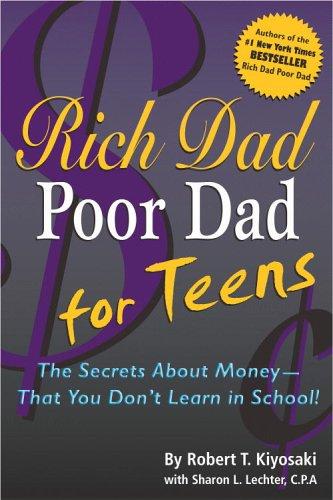
Rich Dad, Poor Dad for Teens
by Robert T. Kiyosaki
★ Top 5 book of 2004 · #2 on Best Books of 2004
A version of Robert Kiyosaki's money philosophy written with young readers in mind, introducing ideas about earning, saving and investing. It aims to spark an early interest in financial independence. Read the full description
Best for: Teens and parents wanting an easy introduction to personal finance
Rich Dad, Poor Dad for Teens is #100 on BookWard's Top 100 books for November 2026, with a BookWard Score of 44 out of 100. It is new on the chart this month.
Rich Dad, Poor Dad for Teens: reading interest over the past 12 months
Sources: Open Library’s public reading-log and ratings data (dump of 2026-10-31), Wikipedia page views and Wikidata. Monthly counts are exact; they show relative interest among readers of these public sources, not total readership.
Ranked against the other books on this list, Rich Dad, Poor Dad for Teens’s reading interest has run from #66 to #98 over these 12 months. Interest rank blends shelf adds, Wikipedia page views and rating activity, each compared with the other 99 books that month.
Shelf adds by month
Rich Dad, Poor Dad for Teens was added to Open Library readers’ shelves 353 times in the past 12 months, peaking in October 2026 with 63 (114% above its monthly average of 29). The latest three months matched the three before. 84% of the adds were “want to read”, 12% “currently reading” and 3% “already read”.
Want to read Currently reading Already read
What the data says about Rich Dad, Poor Dad for Teens
- Moderate swings. Monthly shelf adds averaged 29 with some ups and downs.
- Busiest and quietest months. October 2026 was its busiest month (63 adds), about 4.5 times its quietest, August 2026 (14).
- Against its genre. It had 73% fewer shelf adds than the average Business book on this list.
- Share of the list. It accounts for 0.3% of all shelf adds recorded for the Top 100 over these 12 months, #90 of 100.
- Its age. First published in 2004 (22 years ago), it is older than 53% of the books on the list.
Each finding is computed from the public data above and shown only when the numbers support it.
Rich Dad, Poor Dad for Teens on the Top 100: rank history
First charted in November 2026. The chart gains a point with every monthly update, so its peak, climbs and falls will show here as they happen.
| Month | Rank | Score |
|---|---|---|
| November 2026 | #100 | 44 |
Is Rich Dad, Poor Dad for Teens rising or falling?
Cooling It ranks lower this week than over the past year, so interest is softening from its recent level.
On Open Library, Rich Dad, Poor Dad for Teens ranks #139 this week, #153 this month, and #179 over the past year. A longer bar means a higher position. Comparing the three windows shows whether readers are arriving faster than the book's long-term pace. Readings as of 2026-11-02.
Why Rich Dad, Poor Dad for Teens made the Top 100
Rich Dad, Poor Dad for Teens made the list mainly on momentum (+16.9 points) and being read right now (+14.3 points). Its smallest contribution is rising (+0.9). The BookWard Score blends five public signals, each scored from 0 to 100 and weighted as shown.
The reading-now, rating and rank signals come from Open Library’s public data, not from BookWard’s own readers. The score measures reading interest, not quality or sales. How the score works.
Open Library reader stats for Rich Dad, Poor Dad for Teens
Source: Open Library public reading logs, as of 2026-11-02. BookWard’s own monthly snapshots are added to the picture, and anonymous BookWard reader data will be layered in as the community grows.
More readers have Rich Dad, Poor Dad for Teens open right now than 23% of the other books on this list. These counts come from one public source, so they show relative interest rather than total readership.
Where it sits among Business books
It is #8 of the 8 Business books on this month’s list.
About Rich Dad, Poor Dad for Teens
What it’s about
Written for young readers, this is a teen edition of Robert Kiyosaki's money advice, published in 2004. It starts from the idea that confidence comes first: if teenagers believe in themselves, they can aim for financial security, even in a job market that feels increasingly uncertain. The core lessons are simple and memorable. Work to learn, not just to earn. Swap "I can't afford it" for "How can I afford it?" Don't work for money; make money work for you. Sidebars, examples and straight talk, in a clean design with an accessible voice, keep things approachable. It suits teens starting to think about work and money, and parents who want a friendly way to begin that conversation.
At a glance
- First published
- 2004
- Genre
- Business
- Length
- about 144 pages (the median across its editions)
- Languages
- editions in 3 languages listed on Open Library
- Editions
- 27 on Open Library
From Open Library and Wikidata public records. Missing rows mean the records do not list that fact.
What reading it is like
At about 144 pages it is a short read: roughly 3 hours at an average reading pace (about 250 words a minute, 300 words a page). Audiobook and edition lengths vary.
The premise
This is a teen-friendly version of Kiyosaki's money philosophy, built around the contrast between two father figures with very different attitudes toward wealth. It introduces young readers to ideas about earning, saving, investing, and thinking about money early in life.
What you’ll get
- Simple money lessons for beginners
- A teen-focused, easy-to-follow tone
- Motivation to start thinking about finances early
You might skip it if you want detailed, technical investing advice rather than a broad introduction to money mindset.
More by Robert T. Kiyosaki on the Top 100: Rich Dad, Poor Dad
Pairs well with: Rich Dad, Poor Dad · The Richest Man in Babylon
Keep exploring the chart
Also on the chart at #99 and #101
Rich Dad, Poor Dad for Teens on the Best Books of 2004
Rich Dad, Poor Dad for Teens came out in 2004. Of the 48 books first published in 2004 that met BookWard's data bar, it ranks #2 on our Best Books of 2004 list.
Why it made the list: 1,624 readers have shelved it on Open Library; readers rate it 4 out of 5 (43 ratings); 181 are reading it right now. The list ranks each year’s books on how many readers have picked them up, how highly readers rate them, and how many are reading them right now.
It earns Being read right now.
Nearby on the 2004 list
- Darkly Dreaming Dexter Jeffry P. Lindsay, #1
- The Ruins of Gorlan John Flanagan, #3
- Blink Malcolm Gladwell, #4
See all Best Books of 2004 Best books by year
More years: Best Books of 2003 Best Books of 2005.
Questions about Rich Dad, Poor Dad for Teens
What rank is Rich Dad, Poor Dad for Teens on the Top 100 books?
Rich Dad, Poor Dad for Teens is #100 on BookWard's Top 100 books for November 2026, with a BookWard Score of 44 out of 100. It is new on the chart this month.
Is Rich Dad, Poor Dad for Teens rising or falling?
Cooling. It ranks lower this week than over the past year, so interest is softening from its recent level. On Open Library, Rich Dad, Poor Dad for Teens ranks #139 this week, #153 this month, and #179 over the past year.
Why is Rich Dad, Poor Dad for Teens on the Top 100?
Rich Dad, Poor Dad for Teens made the list mainly on momentum (+16.9 points) and being read right now (+14.3 points). Its smallest contribution is rising (+0.9).
How many people are reading Rich Dad, Poor Dad for Teens right now?
Open Library's reading logs show 188 readers currently reading Rich Dad, Poor Dad for Teens, 1,421 who want to read it and 77 who have logged it as read (as of 2026-11-02). These are counts from one public source, not all readers.
How much interest has Rich Dad, Poor Dad for Teens had over the past year?
353 Open Library shelf adds in the past 12 months (peak October 2026, 63). Figures come from Open Library and Wikipedia public data.
Who is Rich Dad, Poor Dad for Teens best for?
Teens and parents wanting an easy introduction to personal finance.
Ask a question about Rich Dad, Poor Dad for Teens
Ask about this book's chart history, reading interest, or who it is for. Answers come from this page's data and can be wrong.
Answers are AI-written from BookWard’s own help content and can be wrong. Please do not share personal information: questions and answers may be saved and, if they are useful, shown on this site without your name.
How we know
This page is built from public data: Open Library’s dated reading-log and ratings dumps, Wikipedia page views, Wikidata, and BookWard’s own monthly Top 100 snapshots. The interest rank blends shelf adds (45%), Wikipedia page views (30%), rating activity (10%) and, for months where a snapshot exists, BookWard’s own score (15%), each as a percentile among the Top 100 books. Every month shown is real data; nothing is estimated. Rankings reflect reading interest, not quality or sales, and can be affected by data gaps. Last updated November 2026. Read the full methodology.
It is written for teenagers and suits young readers starting to think about money, work and saving.
144 pages, about 2.5 to 3.5 hours.
Kiyosaki's money lessons, trimmed and tuned for teenage readers. 41% taste match
 BookWard’s take
Kiyosaki's money lessons, trimmed and tuned for teenage readers
This is the teen edition of Kiyosaki's best-known money book, and it is short, clean and built to be finished in a sitting or two. At 144 pages, it leans on straight talk, sidebars and plain examples rather than argument. Its core advice is stated outright: work to learn, not to earn, and ask 'How can I afford it?' instead of 'I can't afford it.' It explains everything directly, with none of the scene-building that lets a reader work things out for themselves. The case rests on anecdote and slogan more than evidence, and the ideas are the familiar self-help kind. Where it earns its place is in the pacing and the start: it moves quickly and gets to its point at once. A useful, easy first door into thinking about money, not a deep one.
At 144 pages it is compact and quick to finish, which BookWard likes in principle.
Short chapters and sidebars keep it moving briskly, close to where BookWard sits.
The core advice is widely repeated money-mindset material, less original than BookWard prefers.
The writing is deliberately plain and accessible for teenagers.
It is neither plot nor character driven; it is a teaching text that leans on ideas.
It is framed as empowerment, telling teens financial security is within their reach.
It follows a conventional, tidy layout with clean design and short sections.
The tone is earnest and instructional, with little attempt at humour.
The content is gentle and suited to young readers.
It aims for confidence and motivation rather than deep feeling.
See all 50 dialsEvery position, side by side with this book
Where it lines up
- PaceBookWard 8 · book 8
- LengthBookWard 1 · book 2
- Shock for effectBookWard 9 · book 8
Where it pulls apart
- Familiar tropesBookWard 10 · book 3
- Internal logicBookWard 10 · book 4
- Rigor (nonfiction)BookWard 9 · book 2
At 144 pages it is compact and quick to finish, which BookWard likes in principle.
It states its big ideas straight away rather than building slowly, which suits BookWard.
Its message follows well-worn self-help patterns, which sits below BookWard's appetite for freshness.
The arguments are simple and slogan-driven, so the reasoning is easy to follow but not tightly proven.
Short chapters and sidebars keep it moving briskly, close to where BookWard sits.
The core advice is widely repeated money-mindset material, less original than BookWard prefers.
It is built around lessons rather than people, so there is little character depth to speak of.
It closes on clear takeaways and encouragement, leaving readers with a defined next step.
The tone is motivational and encouraging rather than cool or restrained.
There is no darkness to earn; it sets out to be plain and encouraging.
It relies on advice, examples and straight talk rather than data, well short of BookWard's rigor.
Kiyosaki's blunt, confident teaching voice is easy to recognise, even if it is not literary.
The book exists to deliver ideas about money, far more than to tell a story.
Its lessons are explained outright rather than dramatised, the opposite of BookWard's taste.
At this length there is no room to sag, and the sidebars keep the energy even.
The writing is deliberately plain and accessible for teenagers.
It is neither plot nor character driven; it is a teaching text that leans on ideas.
It is framed as empowerment, telling teens financial security is within their reach.
It follows a conventional, tidy layout with clean design and short sections.
The tone is earnest and instructional, with little attempt at humour.
It is written to be easy to read, with accessible language and a streamlined structure.
It speaks from essentially one teaching perspective throughout.
It moves forward in simple, orderly steps without time jumps.
It is entirely grounded in everyday money and work.
The focus stays on the reader and a small circle of ideas, not a cast.
It stays personal, aimed at one young reader's choices about money.
It nudges readers toward action and decisions more than inward reflection.
Romance does not feature in a book about money habits.
The settings are the ordinary worlds of school, jobs and spending.
It speaks to a present-day teen job market, though it dates from 2004.
The basic money mindset travels, though specifics may age.
The author speaks plainly and directly, with no trickery in the voice.
It tells readers clearly what to do and what to avoid.
Its sidebars and examples are functional rather than richly described.
It mixes simple stories with advice but leans toward lessons over analysis.
It speaks warmly and directly to the young reader, not at a distance.
It belongs to the larger Rich Dad family of books, adapted for teens.
A lesson-based guide has few surprises beyond its core reframes.
It nudges teens to rethink money habits but stays reassuring, not confronting.
The content is gentle and suited to young readers.
It aims for confidence and motivation rather than deep feeling.
Any humour is light and incidental to the lessons.
There is no violence in a personal finance guide.
There is no sexual content.
It touches on work and wealth but keeps away from political argument.
The language is plain and written for easy understanding.
It is strongly opinionated, pushing a clear philosophy about money.
It points teens toward future security and what they can build.
It is upbeat about what young people can achieve with the right mindset.
Review written by BookWard, dial version 1, November 2026.
Who is Rich Dad, Poor Dad for Teens right for?
It is written for teenagers and suits young readers starting to think about money, work and saving. Nothing in it is graphic, though some of its advice is opinion that readers may want to weigh against other sources.
It is written to be easy to read, with accessible language and a streamlined structure.
The content is gentle and suited to young readers.
It aims for confidence and motivation rather than deep feeling.
There is no violence in a personal finance guide.
Book CompanionRich Dad, Poor Dad for Teens: ideas, characters, themes
Financial confidence starts with changing how you think about work and money, so that you learn first and make money work for you.
- Work to learn, not to earn. The book urges teens to value what a job teaches them over what it pays.
- Reframe 'I can't afford it'. Asking 'How can I afford it?' pushes you to look for solutions instead of stopping.
- Make money work for you. Rather than only trading time for pay, readers are encouraged to think about money as something that can work on their behalf.
- Build self-confidence first. The book frames financial security as growing from belief in yourself before technique.
- Financial intelligence is for everyone. It argues that being 'good in school' is not required to understand money.
Themes
How your thinking about money shapes your choices.
Believing you can reach financial security.
Valuing skills and experience above a paycheck.
Aiming to make money work for you.
Seeing possibility in a challenging job market.
Discussion questions
- What is the difference between saying 'I can't afford it' and 'How can I afford it?'
- When might working to learn be worth more than working to earn?
- What does it mean to make money work for you?
- Which advice here feels most useful for your own life, and why?
- What would you want to check or test before trusting any single money philosophy?
Personalize your Book Companion
This is the general edition. In BookWard, the Companion is written for you: your reading profile, your notes, and spoiler-safe to the page you are on.
Buy, listen or borrow Rich Dad, Poor Dad for Teens
Each link opens a search for this book on that store, in a new tab.
Read on a device
Borrow
Reviews and community
If you liked Rich Dad, Poor Dad for Teens
A short, punchy money primer built on parables, light on proof
The Compound EffectDarren HardySmall habits, big results: a short, forceful self-help pitch
High Road LeadershipJohn MaxwellMaxwell's leadership framework: low road, middle road, high road
Rich Dad's Guide to InvestingRobert T. KiyosakiA cash-flow-first investing primer in Kiyosaki's loud, anecdotal style
Track Rich Dad, Poor Dad for Teens and find your next favorite
Add it to your shelf, rate what you have read, and BookWard will recommend what fits you.
Free to start. No credit card needed.