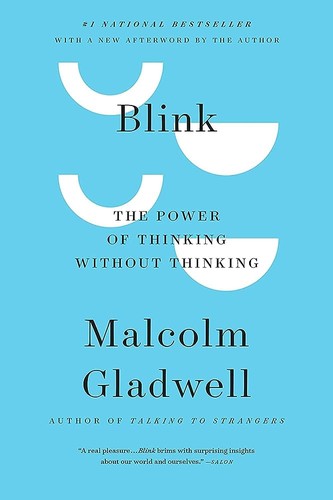
Blink
by Malcolm Gladwell
★ Top 5 book of 2004 · #4 on Best Books of 2004
Gladwell argues that intuition is no mysterious gift but the result of long practice, good design, and the right working conditions. The book shows how to sharpen snap judgments and make better decisions at home, at work, and beyond.
Best for: Curious readers who want to improve their instinctive decision-making in daily life
Blink is #4 on BookWard's Best Books of 2004, out of 48 2004 books that cleared our data bar.
What Blink is about
Malcolm Gladwell takes on the gut feeling. Published in 2004, the book argues that intuition is not a mysterious gift that appears from nowhere. It grows from long hours of experience, thoughtful design, meaningful work environments and particular rules and principles. From there it shows how we can sharpen our ability to know something in an instant, and it hopes to make readers better decision-makers at home, at work and in daily life. Gladwell, who earlier developed the idea of the tipping point, claims that the power of the "blink" could change relationships, the way we buy, create and communicate, how businesses run, and even societies. It will appeal to curious general readers and anyone who has to make quick calls.
Blink on the Best Books of 2004
Blink came out in 2004. Of the 48 books first published in 2004 that met BookWard's data bar, it ranks #4 on our Best Books of 2004 list.
Why it made the list: 791 readers have shelved it on Open Library; readers rate it 3.8 out of 5 (91 ratings); 22 are reading it right now. The list ranks each year’s books on how many readers have picked them up, how highly readers rate them, and how many are reading them right now.
Nearby on the 2004 list
- Rich Dad, Poor Dad for Teens Robert T. Kiyosaki, #2
- The Ruins of Gorlan John Flanagan, #3
- Alexander Hamilton Ron Chernow, #5
- She Comes First Ian Kerner, #6
See all Best Books of 2004 Best books by year
More years: Best Books of 2003 Best Books of 2005.
The numbers behind it
- Readers: 645 want to read it, 22 are reading it now and 124 have read it, according to Open Library.
- Ratings: 3.8 out of 5 from 91 Open Library ratings.
| Signal | This book (0 to 100) | Weight |
|---|---|---|
| Reach | 98 | 55% |
| Reader love | 29 | 25% |
| Being read right now | 90 | 20% |
Questions about Blink
When was Blink published?
Blink by Malcolm Gladwell was first published in 2004.
Was Blink one of the best books of 2004?
Blink is #4 on BookWard's Best Books of 2004, out of 48 2004 books that cleared our data bar. 791 readers have shelved it on Open Library; readers rate it 3.8 out of 5 (91 ratings); 22 are reading it right now.
Why is Blink on the Best Books of 2004 list?
791 readers have shelved it on Open Library; readers rate it 3.8 out of 5 (91 ratings); 22 are reading it right now.
More of the best books of 2004
- Darkly Dreaming Dexter Jeffry P. Lindsay, #1
- Rich Dad, Poor Dad for Teens Robert T. Kiyosaki, #2
- The Ruins of Gorlan John Flanagan, #3
- Alexander Hamilton Ron Chernow, #5
- She Comes First Ian Kerner, #6
- The Plot Against America Philip Roth, #7
See the full Best Books of 2004, the Top 100, or new books on Rising.
How we know
This page uses public data: Open Library reader counts and ratings, and Wikipedia page views for recent years. The description is paraphrased from real source text. Rankings reflect reading interest, not quality or sales, and can be affected by data gaps. Lists update monthly.
Suits curious teens and adults, and is easy to pick up without any background.
Depends on the edition you pick.
Gladwell on snap judgments: brisk, vivid, and sometimes too neat. 47% taste match
 BookWard’s take
Gladwell on snap judgments: brisk, vivid, and sometimes too neat
Blink asks how much we can trust the verdicts our minds reach in a flash, and Gladwell argues that good intuition is trained, not mystical. The opening hooks at once, and the short, story-driven chapters keep the pace quick with little sag. On voice, it is unmistakably Gladwell: confident, conversational, built around vivid case studies. Rigor is where BookWard hesitates. The book leans on anecdote and tidy narrative, so its claims feel persuasive more than proven. It is idea-led and easy to read, with plain prose and little demand on the reader. If you want a lively tour of how quick thinking works and where it fails, it delivers. If you want airtight argument, treat its conclusions as starting points.
A compact, chapter-by-chapter argument that moves along; it is longer than the tightest reads but never sprawls, which suits BookWard.
Short chapters and punchy stories keep it moving, close to BookWard's own fast tempo.
Making snap judgment a mainstream topic felt fresh, though much of the underlying research is borrowed rather than new.
Plain, clear, conversational sentences that stay out of the way, a touch plainer than BookWard's middle ground.
As an argument-driven nonfiction book it has no plot to speak of, and its people serve the ideas.
Broadly encouraging that intuition can be trained and improved, with cautionary notes along the way.
A conventional run of themed chapters built around case studies, more orthodox than BookWard's mild appetite for structure.
Light wit surfaces here and there, but the tone stays mostly earnest and explanatory.
Mostly everyday subject matter, with a few sobering examples of snap judgment going wrong.
Cool and intellectual overall, with a few moments of human weight.
See all 50 dialsEvery position, side by side with this book
Where it lines up
- PaceBookWard 8 · book 8
- Authorial voiceBookWard 9 · book 9
- Sagging middleBookWard 8 · book 7
Where it pulls apart
- Internal logicBookWard 10 · book 5
- Familiar tropesBookWard 10 · book 6
- Character depthBookWard 8 · book 2
A compact, chapter-by-chapter argument that moves along; it is longer than the tightest reads but never sprawls, which suits BookWard.
The premise of instant judgment pulls you in right away, which matches BookWard's love of an immediate opening.
Pop-psychology framing and the case-study formula are familiar, though the subject keeps it fresh; a little more formula than BookWard prefers.
The throughline holds together, but conclusions often rest on selected examples, so it is looser than BookWard's airtight ideal.
Short chapters and punchy stories keep it moving, close to BookWard's own fast tempo.
Making snap judgment a mainstream topic felt fresh, though much of the underlying research is borrowed rather than new.
People appear as case-study illustrations rather than fully drawn characters, which is fine for the form but thin by BookWard's standard.
It closes by tying its themes together with clear takeaways, resolving the argument rather than leaving it hanging.
Mostly analytical with occasional human-interest moments; it stays fairly restrained without being cold.
Surprising reversals come from the evidence itself, and the book does not lean on shock for effect.
It draws on research but favors vivid anecdote over careful proof, falling short of the rigor BookWard values in nonfiction.
Gladwell's easy, confident, storytelling voice is instantly recognizable, exactly the distinctiveness BookWard rewards.
Ideas drive everything here, with stories serving the argument, far more idea-led than BookWard's story-leaning taste.
Gladwell explains his points outright, which is natural for nonfiction but sits well away from BookWard's show-it-in-scene preference.
Self-contained chapters each deliver a fresh hook, so the middle stays lively.
Plain, clear, conversational sentences that stay out of the way, a touch plainer than BookWard's middle ground.
As an argument-driven nonfiction book it has no plot to speak of, and its people serve the ideas.
Broadly encouraging that intuition can be trained and improved, with cautionary notes along the way.
A conventional run of themed chapters built around case studies, more orthodox than BookWard's mild appetite for structure.
Light wit surfaces here and there, but the tone stays mostly earnest and explanatory.
Easy to read and quick to absorb, less demanding than BookWard's moderate comfort zone.
It moves across many people, fields and case studies, though one authorial voice ties them together.
Largely linear within each chapter, with occasional detours into background research.
Entirely grounded in real-world research and everyday decisions.
A broad parade of experts, subjects and case studies populates the chapters.
Focused on individual minds and snap decisions, with some reach into institutions and society.
Centered on what happens inside the mind in an instant, with outer events as illustration.
Mostly narration and explanation, with only occasional quoted speech from interviewees.
Not a subject the book touches.
Everyday workplaces, homes and lab settings that feel familiar rather than strange.
Rooted in early-2000s research and examples, though framed for the present.
The central question of trusting our instincts endures, even as some examples and findings date.
Gladwell narrates plainly in his own voice, with no unreliable framing.
Mostly straightforward lessons, though some chapters touch murkier questions of bias and split-second judgment.
Vivid scene-setting for case studies, but kept in service of the argument rather than lingering.
Narrative-first nonfiction that builds arguments through stories rather than dry analysis.
Gladwell steps in with his own observations and asides, so it reads as an engaged guide rather than a detached survey.
A standalone book with no series structure.
Counterintuitive reveals recur through the case studies, though they are about ideas rather than plot.
Gently unsettles assumptions about thinking without being heavy-going.
Mostly everyday subject matter, with a few sobering examples of snap judgment going wrong.
Cool and intellectual overall, with a few moments of human weight.
Dry, wry touches rather than broad comedy.
Touches on high-stakes snap decisions in passing, without dwelling on violence.
Not a feature of the book.
Occasionally brushes against social bias and institutions without being a political book.
Clear, accessible language throughout.
Gladwell argues a point of view openly, guiding you toward his conclusions.
Looks at how we decide now, with an eye toward making better decisions ahead.
Believes our instincts can be understood and improved, an optimistic streak.
Review written by BookWard, dial version 1, November 2026.
Who is Blink right for?
Suits curious teens and adults, and is easy to pick up without any background. It touches on bias and high-stakes snap decisions, which may prompt serious discussion.
Easy to read and quick to absorb, less demanding than BookWard's moderate comfort zone.
Mostly everyday subject matter, with a few sobering examples of snap judgment going wrong.
Cool and intellectual overall, with a few moments of human weight.
Touches on high-stakes snap decisions in passing, without dwelling on violence.
Book CompanionBlink: ideas, characters, themes
Quick, unconscious judgments can be remarkably accurate or badly wrong, and we can learn to understand and improve them.
- Thin-slicing. We can read a lot from very small slivers of experience, reaching conclusions in moments.
- Intuition is built, not magic. Good snap judgment comes from practice, experience and well-designed conditions.
- When instinct misleads. Snap judgments can be skewed by bias and by pressure, with real consequences.
- Less can be more. Too much information can swamp good decisions and cloud what matters.
- Design the environment. Rules, training and surroundings shape how well people decide in an instant.
Themes
Fast, unconscious thinking and how far to trust it.
How hidden attitudes shape quick judgments.
How practice sharpens instinct.
Why more data can worsen decisions.
Discussion questions
- When have you trusted a snap judgment and been right, or wrong?
- Does the book prove its claims or mainly illustrate them?
- How should we guard against bias in split-second decisions?
- Can intuition really be trained, and how would you do it?
- Which case study stayed with you most, and why?
Personalize your Book Companion
This is the general edition. In BookWard, the Companion is written for you: your reading profile, your notes, and spoiler-safe to the page you are on.
Buy, listen or borrow Blink
Each link opens a search for this book on that store, in a new tab.
Read on a device
Borrow
Reviews and community
If you liked Blink
A short, sharp case that your own ego is the obstacle
OutliersMalcolm GladwellSuccess has a postcode and a birthday, not just talent
The Power of HabitCharles DuhiggHabit science told through stories, with a framework you can use
DriveDaniel H. PinkA lively case that autonomy, mastery and purpose beat carrots and sticks
Find your own best books
Add what you have read, rate it, and BookWard will recommend what to read next.
Free to start. No credit card needed.