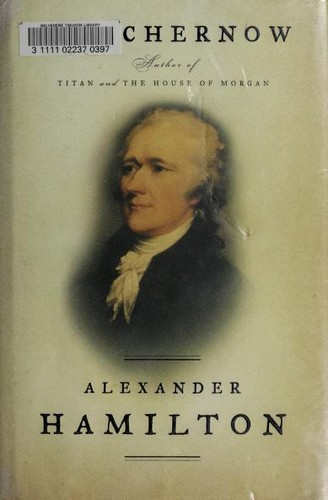
Alexander Hamilton
by Ron Chernow
★ Top 5 book of 2004 · #5 on Best Books of 2004
Chernow offers a full-length life of Hamilton, an orphan from the Caribbean who rose to become Washington's aide, a coauthor of The Federalist Papers, and the first Treasury Secretary. The book argues his ideas shaped modern America.
Best for: Readers of American history who want a detailed portrait of a Founding Father
Alexander Hamilton is #5 on BookWard's Best Books of 2004, out of 48 2004 books that cleared our data bar.
What Alexander Hamilton is about
Ron Chernow's biography follows Alexander Hamilton from an illegitimate, largely self-taught orphan in the Caribbean to one of the Founding Fathers of the United States. Hamilton became an instrumental promoter of the Constitution, the first Secretary of the Treasury, and the founder of the nation's financial system.
Chernow argues that America's political and economic strengths grew out of Hamilton's sacrifices, made to champion ideas that were often wildly disputed in his own time. It was described as the first full-length Hamilton biography in decades and won the inaugural George Washington Book Prize.
Alexander Hamilton on the Best Books of 2004
Alexander Hamilton came out in 2004. Of the 48 books first published in 2004 that met BookWard's data bar, it ranks #5 on our Best Books of 2004 list.
Why it made the list: 321 readers have shelved it on Open Library; readers rate it 4.6 out of 5 (12 ratings). The list ranks each year’s books on how many readers have picked them up, how highly readers rate them, and how many are reading them right now.
Nearby on the 2004 list
- The Ruins of Gorlan John Flanagan, #3
- Blink Malcolm Gladwell, #4
- She Comes First Ian Kerner, #6
- The Plot Against America Philip Roth, #7
See all Best Books of 2004 Best books by year
More years: Best Books of 2003 Best Books of 2005.
The numbers behind it
- Readers: 285 want to read it, 18 are reading it now and 18 have read it, according to Open Library.
- Ratings: 4.6 out of 5 from 12 Open Library ratings.
| Signal | This book (0 to 100) | Weight |
|---|---|---|
| Reach | 75 | 55% |
| Reader love | 88 | 25% |
| Being read right now | 81 | 20% |
Questions about Alexander Hamilton
When was Alexander Hamilton published?
Alexander Hamilton by Ron Chernow was first published in 2004.
Was Alexander Hamilton one of the best books of 2004?
Alexander Hamilton is #5 on BookWard's Best Books of 2004, out of 48 2004 books that cleared our data bar. 321 readers have shelved it on Open Library; readers rate it 4.6 out of 5 (12 ratings).
Why is Alexander Hamilton on the Best Books of 2004 list?
321 readers have shelved it on Open Library; readers rate it 4.6 out of 5 (12 ratings).
More of the best books of 2004
- Darkly Dreaming Dexter Jeffry P. Lindsay, #1
- Rich Dad, Poor Dad for Teens Robert T. Kiyosaki, #2
- The Ruins of Gorlan John Flanagan, #3
- Blink Malcolm Gladwell, #4
- She Comes First Ian Kerner, #6
- The Plot Against America Philip Roth, #7
See the full Best Books of 2004, the Top 100, or new books on Rising.
How we know
This page uses public data: Open Library reader counts and ratings, and Wikipedia page views for recent years. The description is paraphrased from real source text. Rankings reflect reading interest, not quality or sales, and can be affected by data gaps. Lists update monthly.
Best suited to adults and mature teens who are comfortable with long, detailed history.
Depends on the edition you pick.
A sweeping, readable life of the man behind the Treasury. 55% taste match
 BookWard’s take
A sweeping, readable life of the man behind the Treasury
Chernow gives Hamilton a full-length biography, following him from an orphaned start in the Caribbean to Washington's side and the founding of the nation's financial system. It is a long, sprawling book, the opposite of a tight one. The research is deep and the rigor is strong, yet the whole thing reads as narrative rather than analysis, leaning toward story. Character depth is where it earns its place: Hamilton is drawn as brilliant, driven and flawed, not as a marble statue. The pace is steady rather than fast, but the life itself supplies momentum, and Chernow's voice is confident and clear. A big commitment, a rewarding one.
A full-length life of a major figure, long and expansive, which sits at the far end from BookWard's preference for tight books.
The narrative moves steadily through a crowded life, brisk in its best stretches but not fast overall.
A well-worn subject area, made fresh by a fuller, more sympathetic portrait than earlier accounts offered.
Readable and polished without being showy, with some richness in its period detail.
The life of one man drives everything, so character and ambition lead over any plotting.
A story of rise against the odds, tempered by conflict, scandal and a hard ending.
A conventional chronological biography from birth onward, with no structural experiments.
Serious in tone overall, with only occasional dry touches in the period's quarrels.
Includes war, political venom and personal tragedy, but handled soberly and not graphically.
Moments of loss and conflict land with weight, but the book stays measured.
See all 50 dialsEvery position, side by side with this book
Where it lines up
- Shock for effectBookWard 9 · book 9
- Rigor (nonfiction)BookWard 9 · book 9
- Internal logicBookWard 10 · book 9
Where it pulls apart
- LengthBookWard 1 · book 10
- OpeningBookWard 10 · book 6
- Familiar tropesBookWard 10 · book 7
A full-length life of a major figure, long and expansive, which sits at the far end from BookWard's preference for tight books.
It corrects the stock image of a Founding Father and gives Hamilton a more complicated portrait, though the genre has familiar beats.
A biography that follows documented events and ties his ideas to his actions, with cause and effect laid out clearly.
The narrative moves steadily through a crowded life, brisk in its best stretches but not fast overall.
A well-worn subject area, made fresh by a fuller, more sympathetic portrait than earlier accounts offered.
Hamilton emerges as ambitious, brilliant and flawed, drawn with real depth across his whole life.
As a biography it runs its subject's life to its close, so the arc is resolved by history itself.
Warm toward its subject but not syrupy; it admires Hamilton without turning him into a saint.
Its drama comes from real events and consequences rather than manufactured shock, which BookWard values.
Built on extensive research into a well-documented life, it reads as authoritative and carefully grounded.
Chernow writes with a confident, engaged narrative presence, clear and assured rather than generic.
Mostly story-led, tracing a life, though it carries real arguments about economics and the nation's founding.
Context and political background are often explained directly, as a biography of this scope requires.
A book this long has quieter stretches, but Hamilton's career keeps supplying fresh stakes.
Readable and polished without being showy, with some richness in its period detail.
The life of one man drives everything, so character and ambition lead over any plotting.
A story of rise against the odds, tempered by conflict, scandal and a hard ending.
A conventional chronological biography from birth onward, with no structural experiments.
Serious in tone overall, with only occasional dry touches in the period's quarrels.
Accessible in style, but its length and density of names and events ask for sustained attention.
Anchored firmly in Hamilton's life, though it draws in the people and rivals around him.
Told in largely linear order from his youth to his death.
Entirely grounded in real history and documented events.
The founding era brings a huge cast of statesmen, soldiers, rivals and family members.
It spans a life but also the birth of a nation and its financial system, so the canvas is wide.
Balances public action, politics and war with an account of Hamilton's motives and temperament.
Mostly narration and analysis, with quoted letters and speeches rather than scenes of dialogue.
His marriage and personal life appear, but the book is chiefly about public work and ideas.
The late eighteenth century is distant from readers today, though the setting is well explained.
Set in the founding years of the United States, firmly in the past.
Its subject and the debates it covers keep it relevant, and it has stayed in conversation for years.
A biographer's voice, reliable and anchored in sources.
Hamilton is shown with both achievements and failings, leaving his legacy open to judgment.
Rich in period detail, places and personalities, giving the era real texture.
Leans narrative, telling a life as a story, with analysis of policy woven in.
Written with evident engagement and sympathy for its subject rather than cold detachment.
A standalone biography.
Few surprises in the sense of plot twists, though a reader may find some turns in Hamilton's life unexpected.
It asks readers to rethink a figure they may only half know, which is mildly challenging.
Includes war, political venom and personal tragedy, but handled soberly and not graphically.
Moments of loss and conflict land with weight, but the book stays measured.
Humor is rare and mostly dry when it appears.
War and a famous duel feature, but violence is not dwelt on for effect.
A scandal appears as part of his story, treated as history, not as explicit content.
Political fights, parties and policy run through the whole book.
Period quotations add some density, but Chernow's own prose is clear.
Chernow is clearly an advocate for his subject, though he does not hide the flaws.
Looks back at the founding, while arguing it shaped the modern world.
Admires Hamilton's vision for the nation while acknowledging the compromises and conflicts.
Review written by BookWard, dial version 1, November 2026.
Who is Alexander Hamilton right for?
Best suited to adults and mature teens who are comfortable with long, detailed history. It touches on war, a famous duel and a personal scandal, all treated factually.
Accessible in style, but its length and density of names and events ask for sustained attention.
Includes war, political venom and personal tragedy, but handled soberly and not graphically.
Moments of loss and conflict land with weight, but the book stays measured.
War and a famous duel feature, but violence is not dwelt on for effect.
Book CompanionAlexander Hamilton: ideas, characters, themes
Alexander Hamilton rose from orphaned obscurity to help build the political and financial foundations of the United States, and Chernow argues his legacy has been underrated.
- An unlikely start. Hamilton came from the Caribbean as an illegitimate, largely self-taught orphan, which shapes his drive.
- Beside Washington. He served as George Washington's aide-de-camp in the Continental Army.
- The Federalist Papers. He co-authored these essays in support of the Constitution.
- Founding the financial system. As first Secretary of the Treasury, he established the nation's financial framework.
- A contested legacy. Chernow argues Hamilton has been misunderstood and that his ideas underpin the modern nation.
Characters
Alexander Hamilton
Subject
A brilliant, ambitious statesman who rose from nothing to shape the new nation.
George Washington
Mentor and commander
The general and president under whom Hamilton served as aide-de-camp and Treasury Secretary.
Themes
How drive and talent carry someone from obscurity to power, and what it costs.
The disputes and compromises that shaped early American government.
How financial systems underpin political strength.
How a life is remembered, distorted or corrected over time.
Discussion questions
- Does Chernow persuade you that Hamilton has been undervalued?
- How much should a biographer admire their subject?
- Which of Hamilton's ideas still shape the country today?
- What did Hamilton's background give him that his rivals lacked?
- Where does the book show Hamilton at his least admirable?
Personalize your Book Companion
This is the general edition. In BookWard, the Companion is written for you: your reading profile, your notes, and spoiler-safe to the page you are on.
Buy, listen or borrow Alexander Hamilton
Each link opens a search for this book on that store, in a new tab.
Read on a device
Borrow
Reviews and community
If you liked Alexander Hamilton
Sandburg's one-volume Lincoln: a poet's long march from prairie to presidency
PachinkoMin Jin LeeFour generations of a Korean family in Japan, told with patience
MarshaTourmalineA full-color biography of Marsha P. Johnson, by Tourmaline
A Beautiful MindSylvia NasarA mathematician's genius and illness, told with a reporter's patience
Find your own best books
Add what you have read, rate it, and BookWard will recommend what to read next.
Free to start. No credit card needed.