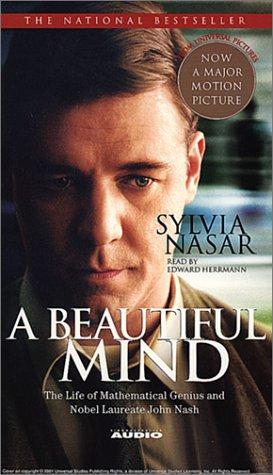
A Beautiful Mind
by Sylvia Nasar
★ Top 25 book of 1998 · #15 on Best Books of 1998
This is the account of mathematical genius John Forbes Nash, Jr., who broke down at thirty-one and was diagnosed with schizophrenia. Three decades later, his illness went into remission.
Best for: Readers curious about brilliant minds and mental illness in a real life
A Beautiful Mind is #15 on BookWard's Best Books of 1998, out of 36 1998 books that cleared our data bar.
What A Beautiful Mind is about
Sylvia Nasar's biography follows John Nash, the Nobel Prize-winning economist and mathematician. It traces his ambition and his gift for mathematics, then follows what happened when, at thirty-one, he suffered a breakdown and was diagnosed with schizophrenia. It also looks at the long road toward recovery, with a remission arriving three decades later. The tone is compassionate and thorough. Note that it was written without Nash's authorization, and some critics have pointed to factual errors and a heavy reliance on interview sources.
A Beautiful Mind on the Best Books of 1998
A Beautiful Mind came out in 1998. Of the 36 books first published in 1998 that met BookWard's data bar, it ranks #15 on our Best Books of 1998 list.
Why it made the list: 235 readers have shelved it on Open Library; readers rate it 3.3 out of 5 (12 ratings). The list ranks each year’s books on how many readers have picked them up, how highly readers rate them, and how many are reading them right now.
Nearby on the 1998 list
- The Poisonwood Bible Barbara Kingsolver, #13
- Working with Emotional Intelligence Daniel Goleman, #14
- Change Your Brain, Change Your Life Daniel G. Amen, #16
- Cows Matthew Stokoe, #17
See all Best Books of 1998 Best books by year
More years: Best Books of 1997 Best Books of 1999.
The numbers behind it
- Readers: 204 want to read it, 14 are reading it now and 17 have read it, according to Open Library.
- Ratings: 3.3 out of 5 from 12 Open Library ratings.
| Signal | This book (0 to 100) | Weight |
|---|---|---|
| Reach | 53 | 55% |
| Reader love | 8 | 25% |
| Being read right now | 58 | 20% |
Questions about A Beautiful Mind
When was A Beautiful Mind published?
A Beautiful Mind by Sylvia Nasar was first published in 1998.
Was A Beautiful Mind one of the best books of 1998?
A Beautiful Mind is #15 on BookWard's Best Books of 1998, out of 36 1998 books that cleared our data bar. 235 readers have shelved it on Open Library; readers rate it 3.3 out of 5 (12 ratings).
Why is A Beautiful Mind on the Best Books of 1998 list?
235 readers have shelved it on Open Library; readers rate it 3.3 out of 5 (12 ratings).
More of the best books of 1998
- Harry Potter and the Chamber of Secrets J. K. Rowling, #1
- Holes Louis Sachar, #2
- A Clash of Kings George R. R. Martin, #3
- Among the Hidden Margaret Peterson Haddix, #4
- Who Moved My Cheese? Spencer Johnson, #5
- No, David! David Shannon, #6
See the full Best Books of 1998, the Top 100, or new books on Rising.
How we know
This page uses public data: Open Library reader counts and ratings, and Wikipedia page views for recent years. The description is paraphrased from real source text. Rankings reflect reading interest, not quality or sales, and can be affected by data gaps. Lists update monthly.
Suits mature teens and adults interested in science, biography or mental health.
Depends on the edition you pick.
A mathematician's genius and illness, told with a reporter's patience. 58% taste match
 BookWard’s take
A mathematician's genius and illness, told with a reporter's patience
Sylvia Nasar's 1998 biography follows John Nash from brilliant young mathematician through a breakdown at thirty-one and a diagnosis of schizophrenia, to a remission three decades later. It is a life told as narrative rather than argument, and the hook is immediate: a famous mind and a famous collapse. Character depth is the book's real strength, since Nash is drawn at length rather than reduced to a case. On rigor, the book has been criticized for factual errors and heavy reliance on interview sources, which is a real weakness for a work of this kind. It is also long and detailed, which will test readers who prefer something brisk. Still, this is a serious, humane biography that earns its emotion without sentimentality, with some sourcing caveats worth knowing.
A full-scale biography of a whole life and its academic world, so it runs long; BookWard prefers tighter books.
Steady and detailed rather than brisk, with stretches of academic background that slow the momentum.
Biographies of tormented geniuses are a known genre, but Nash's particular story is distinctive.
Clear, measured journalistic prose without ornament, a plain style that suits the subject.
Driven by who Nash is and what happens to his mind rather than by plot mechanics.
The long road to remission lends a hopeful note after years of suffering.
A conventional biography that follows the life in order.
A serious account of illness and ambition with little room for humor.
Schizophrenia and its toll make for a heavy subject, handled without sensationalism.
The suffering and eventual recovery carry real feeling throughout.
See all 50 dialsEvery position, side by side with this book
Where it lines up
- EndingBookWard 8 · book 8
- Story or ideasBookWard 3 · book 3
- Character depthBookWard 8 · book 9
Where it pulls apart
- LengthBookWard 1 · book 7
- Familiar tropesBookWard 10 · book 6
- Internal logicBookWard 10 · book 7
A full-scale biography of a whole life and its academic world, so it runs long; BookWard prefers tighter books.
A brilliant mind that breaks down at thirty-one is a premise that grips quickly, which BookWard rewards.
The genius-and-madness frame is familiar, but a real life with its own detail keeps it from feeling stock.
As a chronological life story it holds together well, though its factual errors dent how airtight it feels.
Steady and detailed rather than brisk, with stretches of academic background that slow the momentum.
Biographies of tormented geniuses are a known genre, but Nash's particular story is distinctive.
Nash is drawn at length and with nuance, which is exactly the depth BookWard values.
The remission after thirty years gives the life a real arc and a resolved close.
It treats suffering and recovery with feeling but avoids tearjerking, a restrained approach BookWard appreciates.
The darker material comes from the actual illness and is not used for effect.
Criticized for factual errors and uncritical use of interview sources, so it falls short of BookWard's high bar.
A capable journalist's clear voice, solid and readable rather than strongly stamped.
This is story-led: a life told in sequence, with the mathematics kept in the background.
Mostly narrated events, though the mathematics and economics need some direct explaining.
The academic and institutional passages can drag a little before the story regains its pull.
Clear, measured journalistic prose without ornament, a plain style that suits the subject.
Driven by who Nash is and what happens to his mind rather than by plot mechanics.
The long road to remission lends a hopeful note after years of suffering.
A conventional biography that follows the life in order.
A serious account of illness and ambition with little room for humor.
Accessible to general readers, with some effort needed for the academic and mathematical stretches.
Built from many interviews, so family, colleagues and rivals all shape the picture.
Told largely in chronological order through the course of one life.
Entirely grounded in a real person's documented life.
A sizable circle of colleagues, family and rivals fills out Nash's world.
Intimate in focus on one man, though set against a broad academic landscape.
The weight falls on Nash's mind and its unraveling more than on external events.
A biography built on narration and documented accounts, not scenes of dialogue.
Nash's relationships matter to the story but do not drive it.
The cloistered world of elite mathematics will be unfamiliar to many readers.
Rooted in the mid-twentieth century and its aftermath, though published in the late 1990s.
A human story of genius, illness and recovery that has endured beyond its publication.
A biographer's straightforward account with no unreliable voice.
It raises hard questions about genius and illness without handing down tidy verdicts.
Rich in the textures of Nash's academic world and the experience of his illness.
Reads as a narrative life story rather than an analytical treatise.
Written by a journalist at a reporter's distance, close to the subject without being personal.
A standalone biography.
The turns come from the real life itself, not from engineered surprises.
Confronts serious mental illness and its costs, asking more of the reader than a comfort read.
Schizophrenia and its toll make for a heavy subject, handled without sensationalism.
The suffering and eventual recovery carry real feeling throughout.
Humor is largely absent from a grave story.
Little physical violence; the harm is psychological.
Little sexual content; personal relationships are treated discreetly.
Cold War institutions appear in the background without taking over the story.
Plain language, with only occasional technical terms.
Reports and interprets with a measured stance, though it leans on its sources' accounts.
Looks back across the arc of a finished life.
Moves from despair toward recovery, giving it a hopeful undertone.
Review written by BookWard, dial version 1, November 2026.
Who is A Beautiful Mind right for?
Suits mature teens and adults interested in science, biography or mental health. It deals frankly with serious mental illness, which some readers may find heavy.
Accessible to general readers, with some effort needed for the academic and mathematical stretches.
Schizophrenia and its toll make for a heavy subject, handled without sensationalism.
The suffering and eventual recovery carry real feeling throughout.
Little physical violence; the harm is psychological.
Book CompanionA Beautiful Mind: ideas, characters, themes
The brilliance of John Nash and the illness that overtook him are told as a single life, from early promise through breakdown to a late remission.
- A famous mind. Nash is introduced as a mathematical genius whose work earned him a Nobel Prize in economics.
- The breakdown. At thirty-one he suffered a breakdown and was diagnosed with schizophrenia.
- Decades of illness. The book follows the long years during which the illness shaped his life and work.
- Remission. Roughly thirty years later he experienced a remission of his illness.
- Unauthorized account. The book is an unauthorized biography built substantially on interviews.
Characters
John Forbes Nash, Jr.
Subject
The mathematician and economist whose life the book traces, and who won a Nobel Prize.
Sylvia Nasar
Author
The journalism professor at Columbia University who wrote the biography.
Themes
How extraordinary ability and vulnerability can coexist in one person.
The experience of schizophrenia and how it reshapes a life.
What remission means after decades of suffering.
The limits of reconstructing a life from interviews and sources.
Discussion questions
- How does the book balance Nash's achievements against his illness?
- What does the criticism about factual errors change about how you read it?
- How does an unauthorized biography differ from an authorized one?
- What does the remission add to the shape of the story?
- How does the book portray the people who stood by Nash?
Personalize your Book Companion
This is the general edition. In BookWard, the Companion is written for you: your reading profile, your notes, and spoiler-safe to the page you are on.
Buy, listen or borrow A Beautiful Mind
Each link opens a search for this book on that store, in a new tab.
Read on a device
Borrow
Reviews and community
If you liked A Beautiful Mind
Four generations of a Korean family in Japan, told with patience
BuckeyePatrick RyanA small Ohio town, two families, and one buried secret
Tomorrow, and Tomorrow, and TomorrowGabrielle ZevinA thirty-year friendship told through the games two people build
A tree grows in BrooklynBetty SmithA tender, unsentimental portrait of poverty and girlhood in Williamsburg
Find your own best books
Add what you have read, rate it, and BookWard will recommend what to read next.
Free to start. No credit card needed.