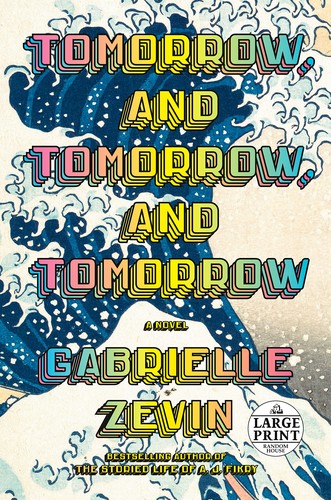
Tomorrow, and Tomorrow, and Tomorrow
by Gabrielle Zevin
★ Top 25 book of 2022 · #19 on Best Books of 2022
Two childhood friends, Sam and Sadie, team up to create a hit video game and find sudden fame and fortune. Over thirty years, their partnership is tested by ambition, failure and matters of the heart.
Best for: Readers who enjoy long, character-driven stories about friendship, creativity and gaming
Tomorrow, and Tomorrow, and Tomorrow is #19 on BookWard's Best Books of 2022, out of 62 2022 books that cleared our data bar.
What Tomorrow, and Tomorrow, and Tomorrow is about
Sadie Green and Sam Masur were childhood friends who lose touch and meet again as students in Cambridge, Massachusetts. Sam first spots Sadie on a subway platform in December of his junior year at Harvard. Soon they are making games together, joined by Sam's roommate and friend Marx Watanabe.
Before they graduate they have created Ichigo, their first blockbuster, and together they run a successful studio called Unfair Games. The story follows them across thirty years, from Cambridge to Venice Beach, California and beyond. It is Gabrielle Zevin's fifth novel for adults, and her publisher calls it a love story unlike ones readers have read before. Warm and bittersweet, it explores friendship, creativity, disability, failure and the need to connect.
Tomorrow, and Tomorrow, and Tomorrow on the Best Books of 2022
Tomorrow, and Tomorrow, and Tomorrow came out in 2022. Of the 62 books first published in 2022 that met BookWard's data bar, it ranks #19 on our Best Books of 2022 list.
Why it made the list: 387 readers have shelved it on Open Library; readers rate it 4.2 out of 5 (26 ratings). The list ranks each year’s books on how many readers have picked them up, how highly readers rate them, and how many are reading them right now.
Nearby on the 2022 list
- Every Summer After Carley Fortune, #17
- The American Roommate Experiment Elena Armas, #18
See all Best Books of 2022 Best books by year
More years: Best Books of 2021 Best Books of 2023.
The numbers behind it
- Readers: 323 want to read it, 10 are reading it now and 54 have read it, according to Open Library.
- Ratings: 4.2 out of 5 from 26 Open Library ratings.
| Signal | This book (0 to 100) | Weight |
|---|---|---|
| Reach | 55 | 55% |
| Reader love | 82 | 25% |
| Being read right now | 45 | 20% |
Questions about Tomorrow, and Tomorrow, and Tomorrow
When was Tomorrow, and Tomorrow, and Tomorrow published?
Tomorrow, and Tomorrow, and Tomorrow by Gabrielle Zevin was first published in 2022.
Was Tomorrow, and Tomorrow, and Tomorrow one of the best books of 2022?
Tomorrow, and Tomorrow, and Tomorrow is #19 on BookWard's Best Books of 2022, out of 62 2022 books that cleared our data bar. 387 readers have shelved it on Open Library; readers rate it 4.2 out of 5 (26 ratings).
Why is Tomorrow, and Tomorrow, and Tomorrow on the Best Books of 2022 list?
387 readers have shelved it on Open Library; readers rate it 4.2 out of 5 (26 ratings).
More of the best books of 2022
- I'm Glad My Mom Died Jennette McCurdy, #1
- King of Wrath Ana Huang, #2
- I Fell in Love with Hope Lancali, #3
- It Starts with Us Colleen Hoover, #4
- Things We Never Got over Lucy Score, #5
- The Ballad of Never After Stephanie Garber, #6
See the full Best Books of 2022, the Top 100, or new books on Rising.
How we know
This page uses public data: Open Library reader counts and ratings, and Wikipedia page views for recent years. The description is paraphrased from real source text. Rankings reflect reading interest, not quality or sales, and can be affected by data gaps. Lists update monthly.
Best suited to adult readers and mature older teens comfortable with long, emotional stories.
Depends on the edition you pick.
A thirty-year friendship told through the games two people build. 67% taste match
 BookWard’s take
A thirty-year friendship told through the games two people build
Gabrielle Zevin follows Sadie Green and Sam Masur, childhood friends who reunite at university and build a game studio together. The novel opens on a subway platform, and the pull is immediate. Its real draw is the people: Sam and Sadie are drawn closely across decades, so the book is driven more by character than by plot. It mostly steers clear of familiar tropes, since a love story that is not a conventional romance and a setting inside game design both feel fresh. The story moves across thirty years and the viewpoints shift, so it asks a little more of you than a straight line would. Expect real emotion, handled with more care than syrup.
A story spanning thirty years takes room to unfold, so it runs long, which is the opposite of BookWard's preference for tight books.
Thirty years pass in steady, readable movement rather than a sprint, a little slower than BookWard's taste for brisk pacing.
A friendship built around making video games is an uncommon subject for literary fiction, which BookWard values highly.
The writing is clear and readable with moments of lift, in the same middle range BookWard likes.
The book runs on the bond between two people far more than on plot machinery, which BookWard enjoys.
It deals with failure and loss yet keeps faith in connection and play, landing on the hopeful side, in step with BookWard.
The story spans decades with some formal play, but stays accessible rather than experimental, close to BookWard's comfort zone.
There is wit in the friendship and the game world, though the tone stays mostly serious, a little under BookWard's lean.
It faces real pain and loss without turning bleak, a middle degree of darkness similar to BookWard's.
The friendship drives strong feeling throughout, a bit stronger than BookWard's measured preference.
See all 50 dialsEvery position, side by side with this book
Where it lines up
- OpeningBookWard 10 · book 9
- OriginalityBookWard 9 · book 8
- Character depthBookWard 8 · book 9
Where it pulls apart
- LengthBookWard 1 · book 7
- Internal logicBookWard 10 · book 7
- Familiar tropesBookWard 10 · book 8
A story spanning thirty years takes room to unfold, so it runs long, which is the opposite of BookWard's preference for tight books.
It opens with a chance meeting on a cold subway platform and a game begins at once, matching BookWard's love of an immediate pull.
It reframes the love story and sets it in game design, so it sidesteps most stock moves, which BookWard rewards.
The partnership, the studio and the games hold together with a sound internal sense, though the long timespan leaves some room for looseness.
Thirty years pass in steady, readable movement rather than a sprint, a little slower than BookWard's taste for brisk pacing.
A friendship built around making video games is an uncommon subject for literary fiction, which BookWard values highly.
Sam and Sadie are the heart of the book and are followed closely across decades, a strong match for BookWard.
It leans into feeling and love, with some sentiment in the mix, a touch warmer than BookWard's restrained preference.
Its hard moments come from the characters' lives rather than staged jolts, which BookWard prefers.
Zevin's narration has a clear, personal stamp that stands out from generic fiction, something BookWard prizes.
This is story and relationship first, with ideas about play and identity carried inside the characters, close to BookWard's story-led lean.
Mostly dramatized through scenes and the games themselves, though some explanation of the industry appears, near BookWard's scene-first taste.
A book this long can slacken in places, but the central pull of the partnership keeps most of it moving.
The writing is clear and readable with moments of lift, in the same middle range BookWard likes.
The book runs on the bond between two people far more than on plot machinery, which BookWard enjoys.
It deals with failure and loss yet keeps faith in connection and play, landing on the hopeful side, in step with BookWard.
The story spans decades with some formal play, but stays accessible rather than experimental, close to BookWard's comfort zone.
There is wit in the friendship and the game world, though the tone stays mostly serious, a little under BookWard's lean.
It is a readable, absorbing novel that asks for some attention across its time span but is never a struggle.
The story moves between several perspectives while keeping Sam and Sadie central, fairly in tune with BookWard.
It runs across thirty years and moves through time, a little more mobile than BookWard's slightly linear preference.
The world is realistic, though games within it add imaginative layers, so it stays grounded overall.
The focus is on a few central figures, with a modest wider circle, close to BookWard's smaller-cast comfort.
It covers decades and places but stays personal in focus, sitting in the middle of BookWard's range.
Much of the weight sits in feelings and relationships rather than action, leaning toward inner life.
It is a love story but not a conventional one, with the central bond mattering more than any couple plot.
The game industry and its creative culture are a less common setting for most readers, a good match for BookWard.
Its themes of friendship, creativity and loss should keep it relevant well beyond its release year.
The narration is straightforward and trustworthy, in contrast to BookWard's openness to unreliable voices.
The characters make hard, tangled choices without tidy verdicts, which suits BookWard's liking for ambiguity.
Worlds, places and games are rendered in vivid detail, rich enough to be a real strength.
It is a standalone novel with a complete story, a fair fit for BookWard's open attitude.
There are turns that reshape the relationships, but they grow from character rather than gimmick, a decent number.
It deals with failure, disability and heartbreak, so it pushes beyond comfort reading, in line with BookWard.
It faces real pain and loss without turning bleak, a middle degree of darkness similar to BookWard's.
The friendship drives strong feeling throughout, a bit stronger than BookWard's measured preference.
Humor is wry and character-based rather than broad, leaning dry, a good fit for BookWard.
Intimacy appears as part of the relationships but is not a focus, so it sits low.
It touches on identity and culture without being a political book, so politics stays in the background.
The language is plain and easy to follow, apart from some game-industry vocabulary.
The narration holds a point of view on creativity and connection without lecturing, a balanced stance.
It looks back across decades while ending with a sense of forward motion, so it holds a middle position.
Faith in play and connection runs through it, tempered by real setbacks, which BookWard finds appealing.
Review written by BookWard, dial version 1, November 2026.
Who is Tomorrow, and Tomorrow, and Tomorrow right for?
Best suited to adult readers and mature older teens comfortable with long, emotional stories. It deals with pain, disability, loss and relationship conflict.
It is a readable, absorbing novel that asks for some attention across its time span but is never a struggle.
It faces real pain and loss without turning bleak, a middle degree of darkness similar to BookWard's.
The friendship drives strong feeling throughout, a bit stronger than BookWard's measured preference.
Book CompanionTomorrow, and Tomorrow, and Tomorrow: ideas, characters, themes
Two friends turn their bond into games and a company, and across thirty years the work and the friendship keep reshaping each other.
- The reunion. Sam and Sadie meet again as students in Cambridge, which sets their partnership in motion.
- The first game. Their early project, Ichigo, becomes a hit and changes their lives while still young.
- The studio. With Marx Watanabe they co-manage Unfair Games, a successful video game studio.
- Success and strain. Wealth and acclaim arrive but do not protect them from creative disputes or personal pain.
- A love story of another kind. The central bond is about connection and understanding rather than a standard romance.
Characters
Sadie Green
Game developer and co-founder
One half of the central partnership, a childhood friend of Sam who studies in Cambridge.
Sam Masur
Game developer and co-founder
The other half of the partnership, who first calls Sadie's name on a subway platform.
Marx Watanabe
Friend and collaborator
Sam's roommate and friend, who helps develop the first game and later joins the studio.
Themes
The long, shifting bond between two people who share work and history.
What it costs and gives to make something together.
How people see themselves and are seen by others over time.
How physical limits and pain shape a life and its choices.
What setbacks teach and how people recover from them.
The value of games as a place to connect and imagine.
Discussion questions
- Why do Sam and Sadie keep returning to each other even when it hurts?
- How does making games shape the way they understand the world?
- In what sense is this a love story, and in what sense is it not?
- How does success change their friendship compared with their early days?
- What does the book suggest about play as a way to survive hard times?
Personalize your Book Companion
This is the general edition. In BookWard, the Companion is written for you: your reading profile, your notes, and spoiler-safe to the page you are on.
Buy, listen or borrow Tomorrow, and Tomorrow, and Tomorrow
Each link opens a search for this book on that store, in a new tab.
Read on a device
Borrow
Reviews and community
If you liked Tomorrow, and Tomorrow, and Tomorrow
A small Ohio town, two families, and one buried secret
The Color of WaterJames McBrideA son's memoir, and his mother's own voice breaking through it
Mina vännerFredrik BackmanA lonely teenager chases the story behind a famous painting
Cursed DaughtersOyinkan BraithwaiteA Lagos family curse, a reincarnation belief, and a girl fighting her fate
Find your own best books
Add what you have read, rate it, and BookWard will recommend what to read next.
Free to start. No credit card needed.