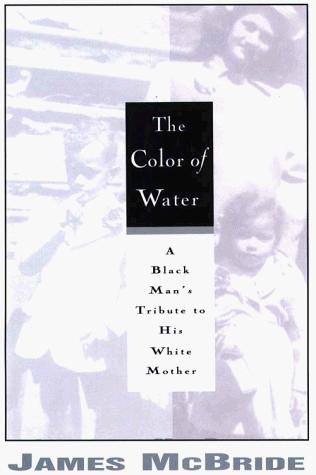
The Color of Water
by James McBride
★ Top 25 book of 1996 · #19 on Best Books of 1996
James McBride recounts growing up among twelve siblings in Brooklyn's Red Hook, raised by a determined mother who hid her white heritage. Her own story of fleeing her rabbi father's home anchors this reflective memoir on race, identity and a mother's devotion.
Best for: Memoir lovers drawn to family stories, race, identity and a remarkable mother
The Color of Water is #19 on BookWard's Best Books of 1996, out of 39 1996 books that cleared our data bar.
What The Color of Water is about
James McBride grew up as one of twelve children in the housing projects of Red Hook, Brooklyn, raised by a white mother who never spoke about where she came from. This memoir tells two stories side by side, alternating between his own early life and Ruth's first-person account of hers.
Ruth was born Ruchel Zylska into an Orthodox Jewish family in Poland and came to America as a toddler. Her family settled in Suffolk, Virginia, and she left for New York, was cut off by her family, and went on to marry a black man, convert to Christianity, and help found a church. McBride only learned the truth as an adult, and the book is his warm, reflective attempt to understand her. It speaks to anyone curious about race, identity, religion, and the fierce love of a mother.
The Color of Water on the Best Books of 1996
The Color of Water came out in 1996. Of the 39 books first published in 1996 that met BookWard's data bar, it ranks #19 on our Best Books of 1996 list.
Why it made the list: 220 readers have shelved it on Open Library; readers rate it 4.3 out of 5 (11 ratings). The list ranks each year’s books on how many readers have picked them up, how highly readers rate them, and how many are reading them right now.
Nearby on the 1996 list
- Vampire Breath Robert Lawrence Stine, #17
- Alias Grace Margaret Atwood, #18
- Frindle Andrew Clements, #20
- Exquisite Corpse Poppy Z. Brite, #21
See all Best Books of 1996 Best books by year
More years: Best Books of 1995 Best Books of 1997.
The numbers behind it
- Readers: 188 want to read it, 15 are reading it now and 17 have read it, according to Open Library.
- Ratings: 4.3 out of 5 from 11 Open Library ratings.
| Signal | This book (0 to 100) | Weight |
|---|---|---|
| Reach | 36 | 55% |
| Reader love | 62 | 25% |
| Being read right now | 56 | 20% |
Questions about The Color of Water
When was The Color of Water published?
The Color of Water by James McBride was first published in 1996.
Was The Color of Water one of the best books of 1996?
The Color of Water is #19 on BookWard's Best Books of 1996, out of 39 1996 books that cleared our data bar. 220 readers have shelved it on Open Library; readers rate it 4.3 out of 5 (11 ratings).
Why is The Color of Water on the Best Books of 1996 list?
220 readers have shelved it on Open Library; readers rate it 4.3 out of 5 (11 ratings).
More of the best books of 1996
- A Game of Thrones George R. R. Martin, #1
- The Green Mile Stephen King, #2
- Forbidden Knowledge Roger Shattuck, #3
- Fight Club Chuck Palahniuk, #4
- Push Sapphire, #5
- Neverwhere Neil Gaiman, #6
See the full Best Books of 1996, the Top 100, or new books on Rising.
How we know
This page uses public data: Open Library reader counts and ratings, and Wikipedia page views for recent years. The description is paraphrased from real source text. Rankings reflect reading interest, not quality or sales, and can be affected by data gaps. Lists update monthly.
Suits mature teens and adults, and is often read in schools and book groups.
Depends on the edition you pick.
A son's memoir, and his mother's own voice breaking through it. 63% taste match
 BookWard’s take
A son's memoir, and his mother's own voice breaking through it
James McBride alternates between his own boyhood in a crowded Brooklyn household and his mother Ruth's account of the life she kept hidden, so the book works as two portraits that slowly explain each other. The structure looks conventional on paper, but the back-and-forth between two voices gives it real lift. Character depth is the main strength: Ruth is drawn with force and contradiction, and McBride lays out his own confusions about race and identity plainly. He also shows restraint. The book earns its darker material rather than milking it, and the sentiment stays measured for a tribute. Expect a warm, humane read with an unmistakable authorial voice. It is closer to a story than an argument, which is where it does its best work.
A mid-length memoir that gives two lives room without sprawling; BookWard prefers tighter, though the structure justifies the space.
Moves steadily between childhood scenes and Ruth's history without rushing or lingering too long.
A son and his mother telling intertwined halves of one story is a distinctive take on the memoir.
Clear and conversational with occasional lyrical lift, never ornate.
The drive is the people: Ruth's choices and her son's search to understand them.
There is real pain in it, but the overall arc honors endurance, family and love.
Alternating son and mother narration is a modest formal choice, more arranged than experimental.
Warmth and wry family moments appear, but the tone is largely serious.
Includes abuse and family estrangement, handled seriously rather than gratuitously.
Deeply felt, built around a son's love for and need to understand his mother.
See all 50 dialsEvery position, side by side with this book
Where it lines up
- Authorial voiceBookWard 9 · book 9
- OriginalityBookWard 9 · book 8
- Character depthBookWard 8 · book 9
Where it pulls apart
- LengthBookWard 1 · book 5
- OpeningBookWard 10 · book 7
- Familiar tropesBookWard 10 · book 8
A mid-length memoir that gives two lives room without sprawling; BookWard prefers tighter, though the structure justifies the space.
The premise of a Black son discovering his white mother's hidden past pulls you in early, if not instantly.
Immigrant-family and race memoir territory, but the specific story and alternating form keep it from feeling stock.
Both lives are told in a coherent, cause-and-effect way, so events and choices follow clearly.
Moves steadily between childhood scenes and Ruth's history without rushing or lingering too long.
A son and his mother telling intertwined halves of one story is a distinctive take on the memoir.
Ruth in particular is drawn as a fully contradictory person, and McBride is candid about his own confusion.
A memoir of lives lived rather than puzzles solved, so it closes with understanding more than a neat bow.
It is a tribute and openly affectionate, yet it mostly avoids syrup and lets events carry the feeling.
The harder episodes of Ruth's past serve the story and are not used for effect.
It rests on personal testimony and recollection rather than documentary research, which suits the form.
McBride's and Ruth's voices are both unmistakable, and the contrast between them is the book's signature.
Race and identity run through it, but it is carried by lived story, not abstract argument.
Mostly shown through scenes and memory, with some reflective commentary from McBride on identity.
The alternating chapters keep momentum up, so the middle holds without a noticeable lull.
Clear and conversational with occasional lyrical lift, never ornate.
The drive is the people: Ruth's choices and her son's search to understand them.
There is real pain in it, but the overall arc honors endurance, family and love.
Alternating son and mother narration is a modest formal choice, more arranged than experimental.
Warmth and wry family moments appear, but the tone is largely serious.
Accessible and readable, though it asks for some attention to its two voices.
Essentially two perspectives, McBride's and his mother's, in alternating chapters.
Chapters move between McBride's childhood and Ruth's earlier life, so time shifts regularly.
A memoir rooted entirely in real events and places.
A household of twelve children plus Ruth's family makes for a fairly full cast, though two figures dominate.
Centered on one family and its home, even as it touches larger questions of race.
Much of the weight is in reflection, memory and identity rather than action.
Conversations and recalled speech carry a fair share of the telling.
Ruth's relationships matter to her story, but love is not the book's main thread.
Orthodox Jewish life, the segregated South and Brooklyn's housing projects will be unfamiliar to many readers.
Set mostly in the mid-twentieth century, looking back from the author's adulthood.
Its themes of family, race and identity keep it relevant decades after publication.
McBride tells his own story and records his mother's, so the narration is straightforward.
It does not hand down verdicts; the people in it are complicated and so are the judgments.
Places and rooms are brought to life with vivid concrete detail.
A story-driven memoir, closer to storytelling than analysis.
First-person throughout, with McBride and Ruth speaking for themselves.
A standalone memoir.
The big revelations come from learning Ruth's hidden past, not from plot mechanics.
It asks readers to think hard about race, identity and family secrets, with some painful material.
Includes abuse and family estrangement, handled seriously rather than gratuitously.
Deeply felt, built around a son's love for and need to understand his mother.
Any humor is gentle and observational rather than broad.
Hardship and abuse are present but not depicted in graphic detail.
Abuse in Ruth's past is part of the story, but it is not dwelt on explicitly.
Race is central to the subject, but it is explored through lives, not argument.
Plain language, with a few Yiddish terms and period speech.
McBride reflects openly and sometimes pointedly on race, faith and identity.
It looks back, recovering a past that shaped the present.
Despite hardship, it affirms faith in family and in people's capacity to endure and love.
Review written by BookWard, dial version 1, November 2026.
Who is The Color of Water right for?
Suits mature teens and adults, and is often read in schools and book groups. It includes discussion of racism, abuse and family estrangement.
Accessible and readable, though it asks for some attention to its two voices.
Includes abuse and family estrangement, handled seriously rather than gratuitously.
Deeply felt, built around a son's love for and need to understand his mother.
Hardship and abuse are present but not depicted in graphic detail.
Book CompanionThe Color of Water: ideas, characters, themes
A son pieces together his mother's hidden life, and in doing so finds the roots of his own identity.
- Two voices, one story. Chapters alternate between James's early life and Ruth's first-person account of her past.
- A hidden origin. James grew up unaware that his mother was a white woman born into an Orthodox Jewish family.
- Leaving the family behind. Ruth cut ties with her Jewish family after they disowned her for marrying a Black man.
- A crowded Brooklyn childhood. James was one of twelve children raised in a chaotic household in Red Hook.
- Early hardship. Ruth's childhood in Virginia involved an abusive father and heavy demands in the family store.
Characters
James McBride
Author and narrator
The son who explores his mother's past and his own sense of identity.
Ruth McBride
His mother
Born Ruchel Zylska, a white woman who built a life with a Black husband and raised twelve children.
Andrew Dennis McBride
James's father
A Black man from North Carolina whom Ruth married.
Fishel Shilsky (Tateh)
Ruth's father
An Orthodox rabbi turned storekeeper whose abuse shaped Ruth's early life.
Themes
How color and heritage shape who a person is, and who gets to define it.
What is kept hidden and the cost of silence across generations.
How religion and community both shelter and exclude people.
A mother's will to protect and educate her children against the odds.
How telling a life aloud reshapes it and the people who hear it.
Discussion questions
- Why does Ruth refuse to talk about her past, and what does silence protect?
- How does alternating between James and Ruth change how you read each story?
- What does the book suggest about race as identity versus race as experience?
- How do faith and religion both help and hurt the people in the book?
- What does James gain by finally learning his mother's story?
Personalize your Book Companion
This is the general edition. In BookWard, the Companion is written for you: your reading profile, your notes, and spoiler-safe to the page you are on.
Buy, listen or borrow The Color of Water
Each link opens a search for this book on that store, in a new tab.
Read on a device
Borrow
Reviews and community
If you liked The Color of Water
Four King novellas, one for each season, with horror held back
Tomorrow, and Tomorrow, and TomorrowGabrielle ZevinA thirty-year friendship told through the games two people build
Cat's EyeMargaret AtwoodA painter's return to Toronto, and the girlhood that made her
The Joy Luck ClubAmy TanFour mothers, four daughters, and the stories between them
Find your own best books
Add what you have read, rate it, and BookWard will recommend what to read next.
Free to start. No credit card needed.