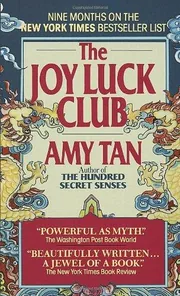
The Joy Luck Club
by Amy Tan, Gwendoline Yeo · 1989
Best for mature teens and adults, and it is a common pick for school and book club discussion.
312 pages, about 5 to 7.5 hours.
Four mothers, four daughters, and the stories between them. 65% taste match
The story
The Joy Luck Club is a novel by Amy Tan, first published in 1989 and placed among literary and general fiction. It centers on Chinese American women in San Francisco, following several immigrant mothers and their American-born daughters through the 20th century. The mothers meet regularly to play mahjong, and the club they form gives the book its name and its opening scene, in which a daughter is asked to take a place at the table.
The story moves through short, interlinked pieces in which each woman recounts her own life, with the mothers looking back on what they left behind in China and the daughters describing their lives in the United States. Mothers and daughters, friendship between women, loss, and death run through these accounts, along with the gap between generations and between two cultures. The book is organized in four parts with sixteen chapters, a structure modeled on a game of mahjong, and each part opens with a short parable. It runs about 312 pages in its typical edition.
My father has asked me to be the fourth corner at the Joy Luck Club.
Setting
San Francisco (Calif.)United States
Period
20th century
Themes
Chinese AmericanChinese American womenChinese AmericansDeathFemale friendshipLiteratureLoss (Psychology)Mothers
- Want to read 486
- Reading now 35
- Read 70
Most people shelving it are saving it for later.
Of 591 readers who put it on a shelf, 82% want to read it, 6% are reading it now, 12% have finished it and 0% stopped before the end.
By the numbers
- The median edition runs 312 pages. Counting about 275 words a page and an adult reading pace of 250 words a minute, that is about 5.7 hours of reading.
- Open Library tracks 57 editions from 41 publishers, the earliest dated 1989 and the latest 2014, across 6 languages.
- On reader demand it ranks in the top 1% of the modern books in our catalog (15,152 of them).
- Libraries shelve it under Dewey 813 and Library of Congress class PS-3570.00000000.A48 J6 1989.
 BookWard’s take
Four mothers, four daughters, and the stories between them
Amy Tan builds The Joy Luck Club from short, interlinked pieces, with each woman telling her own story in her own voice. That gives it strong Authorial voice and Character depth: eight narrators, none of them a type. The Structure is a quiet experiment, sixteen chapters shaped like a mahjong game, and it is far from conventional. It is also compact at about 312 pages, so Length sits close to BookWard's taste. The Pace is steady rather than fast, and the Timeline moves between China and San Francisco, so it asks a little more of you than a straight line would. What it earns is Emotion without cheap Sentiment. The book looks hard at how mothers and daughters misread each other across a cultural gap, and it respects both sides.
At about 312 pages it is lean for a multigenerational saga, which suits BookWard's preference for tight books.
Short vignettes keep it moving, but it lingers on memory and feeling, so it reads steadier than fast.
The mahjong-shaped structure and paired mother and daughter voices give familiar family material a fresh frame.
The language is clear and image-rich without ornament, closer to plain than to ornate.
Its force comes from the women and their bonds rather than from plot mechanics.
Loss and hardship run deep, but the book reaches toward connection between generations.
Four parts, sixteen chapters and framing parables modeled on mahjong make it noticeably unconventional, which BookWard likes in moderation.
There is wit in the exchanges, but the tone stays mostly serious.
Loss, death and painful pasts are present, but the book is not relentlessly grim.
Feeling runs high, especially in the mother-daughter relationships and the women's memories.
See all 50 dialsEvery position, side by side with this book
Where it lines up
- Authorial voiceBookWard 9 · book 9
- Story or ideasBookWard 3 · book 3
- Character depthBookWard 8 · book 9
Where it pulls apart
- Familiar tropesBookWard 10 · book 7
- Internal logicBookWard 10 · book 7
- LengthBookWard 1 · book 3
At about 312 pages it is lean for a multigenerational saga, which suits BookWard's preference for tight books.
The first sentence hands a daughter a seat at the mahjong table, which pulls you in quickly, though not with a jolt.
Immigrant and mother-daughter stories have familiar shapes, but the eight-voice treatment keeps it from feeling formulaic.
The interlinked stories fit together coherently, and each woman's account holds up against the others.
Short vignettes keep it moving, but it lingers on memory and feeling, so it reads steadier than fast.
The mahjong-shaped structure and paired mother and daughter voices give familiar family material a fresh frame.
Each of the eight women is drawn with her own history, wants and blind spots, which BookWard rewards.
The threads come to rest with real closure for its central relationships, though not every question is tied off.
It touches tender ground but leans on specific detail rather than easy comfort, so it stays mostly grounded.
Its hard moments come from the women's histories and feel earned rather than staged for effect.
This is a novel, so rigor does not apply.
Each narrator sounds distinct, and the whole carries a clear, recognizable authorial stamp.
It is story-led, with its themes surfacing through the women's lives rather than argued as ideas.
Backstory comes through the women telling their own stories in scene, not through explanation from outside.
The vignette form keeps each section fresh, so momentum rarely drops across the four parts.
The language is clear and image-rich without ornament, closer to plain than to ornate.
Its force comes from the women and their bonds rather than from plot mechanics.
Loss and hardship run deep, but the book reaches toward connection between generations.
Four parts, sixteen chapters and framing parables modeled on mahjong make it noticeably unconventional, which BookWard likes in moderation.
There is wit in the exchanges, but the tone stays mostly serious.
The prose is accessible, though tracking eight narrators and two timelines takes some attention.
Eight women take turns telling their stories, which is a defining feature of the book.
It moves between pre-war China and later San Francisco, so the time frame keeps shifting.
The world is realistic and grounded in lived history, with no fantasy element.
Four families and eight narrators make a sizable but manageable cast.
It spans generations and two countries, yet it stays focused on intimate family bonds.
Memory, feeling and relationships drive it far more than external action.
Conversation matters, especially between mothers and daughters, but the book leans on narration as well.
Marriages appear throughout, but the central bonds are between mothers and daughters, not lovers.
For many readers the China scenes and the immigrant San Francisco community are an unfamiliar world.
Set mostly in the 20th century, it is a book of the past more than the present.
Mother-daughter misunderstanding and inheritance are lasting themes that keep the book relevant.
The women tell their own stories candidly, and reliability is rarely in play.
Choices are shown with their reasons, so judgments are rarely simple, but the book guides sympathy clearly.
Detail of place, food and memory is vivid and used with purpose.
This is fiction, so nonfiction style does not apply.
This is fiction, so nonfiction perspective does not apply.
It stands on its own as a single, self-contained novel.
Revelations about the women's pasts land along the way, though the book is not driven by twists.
It asks readers to sit with grief and cultural tension without handing out easy answers.
Loss, death and painful pasts are present, but the book is not relentlessly grim.
Feeling runs high, especially in the mother-daughter relationships and the women's memories.
Humor is dry and wry, found in small observations rather than broad comedy.
Some hardship and harm appear in the women's histories, but they are not dwelt on graphically.
Relationships are part of the story, but explicit content is minimal.
Culture, immigration and war form the background, not a political argument.
The language is plain and readable, with occasional touches of Chinese phrasing.
The narrators have personal views, but the book does not editorialize.
The stories look back at what was left behind, while the daughters look toward their own lives.
It sees hardship clearly while still believing in understanding between generations.
Review written by BookWard, dial version 1, November 2026.
Who is The Joy Luck Club right for?
Best for mature teens and adults, and it is a common pick for school and book club discussion. It touches on loss, death and hardship in the women's pasts, handled seriously rather than graphically.
The prose is accessible, though tracking eight narrators and two timelines takes some attention.
Loss, death and painful pasts are present, but the book is not relentlessly grim.
Feeling runs high, especially in the mother-daughter relationships and the women's memories.
Some hardship and harm appear in the women's histories, but they are not dwelt on graphically.
Book CompanionThe Joy Luck Club: ideas, characters, themes
Four Chinese immigrant mothers and their American-born daughters tell their stories, showing how much each generation carries of the one before.
- The club. The mothers form the Joy Luck Club in San Francisco, meeting weekly to play mahjong and share stories of what they left in China.
- Eight voices. The women take turns narrating, so the book is built from short, interlinked pieces rather than one continuous plot.
- Mahjong structure. Four parts and sixteen chapters echo a mahjong game, and each part opens with a short parable.
- Two worlds. Mothers recall China while daughters live in the United States, and the gap in culture and language drives much of the tension.
- Inheritance. The daughters, who think their mothers' advice is irrelevant, find in their own crises how much of the past they carry.
Themes
The close, often painful bond between generations and the ways each misreads the other.
How stories, habits and wounds pass quietly from one generation to the next.
The pull between Chinese roots and American life, and the identity conflicts it creates.
What the mothers left behind and how remembering shapes who they are now.
The club as a place where women find support and shared history.
Discussion questions
- Why might the book use eight narrators instead of one?
- How does the mahjong structure shape the way you read the stories?
- Where do the mothers and daughters misunderstand each other most, and why?
- What do the mothers hope their daughters will keep, and what do they hope to spare them?
- Which woman's story stayed with you most, and what made it land?
Personalize your Book Companion
This is the general edition. In BookWard, the Companion is written for you: your reading profile, your notes, and spoiler-safe to the page you are on.
Buy, listen or borrow The Joy Luck Club
Each link opens a search for this book on that store, in a new tab.
Read on a device
Borrow
Reviews and community
If you liked The Joy Luck Club
A small Ohio town, two families, and one buried secret
The Color of WaterJames McBrideA son's memoir, and his mother's own voice breaking through it
Tomorrow, and Tomorrow, and TomorrowGabrielle ZevinA thirty-year friendship told through the games two people build
Extremely Loud and Incredibly CloseJonathan Safran FoerA grieving nine-year-old crosses New York with a key
Sources: Open Library.
Track The Joy Luck Club and find your next favorite
Add it to your shelf, rate what you have read, and BookWard will recommend what fits you.
Free to start. No credit card needed.