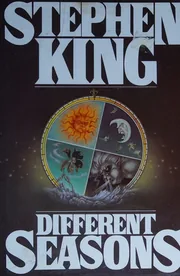
Best for mature teens and adults.
529 pages, about 8.5 to 12.5 hours.
Four King novellas, one for each season, with horror held back. 65% taste match
The story
Different Seasons is a Stephen King collection from 1982 that gathers four novellas, each linked to one of the four seasons. It belongs to King's work outside straight horror, leaning toward drama and character-driven storytelling. The stories span several decades of the twentieth century and move between Maine and California, with a prison called Shawshank, the town of Castle Rock, and Los Angeles among the places that appear.
The first novella follows a long-serving inmate who narrates his years behind bars, and its opening line introduces him as the man in any prison who can obtain things for others. Another centers on a California schoolboy and an elderly neighbor whose past involves the Nazis and the Holocaust. A third follows four boys from Maine who set out together into the woods. The fourth is told inside a mysterious club and concerns a woman determined to carry a pregnancy to birth. Across the collection, subjects include war crimes, blackmail, forgery, and the lingering effects of war, with references to World War II and the Vietnam War.
Three of the four novellas were later adapted for film, including The Shawshank Redemption and Stand by Me. The book runs about 529 pages in its median edition, and it has appeared in 61 editions.
There's a guy like me in every state and federal prison in America, I guess-I'm the guy who can get it for you.
Characters
Red
Setting
Castle RockMaineChamberlainCaliforniaUnited States
Period
20th century19741959
Themes
first-person narrativepost-traumatic stress disorderWorld War IIlaw schoolVietnam WarGermansNaziswar crime
- Want to read 450
- Reading now 19
- Read 57
Most people shelving it are saving it for later.
Of 526 readers who put it on a shelf, 86% want to read it, 4% are reading it now, 11% have finished it and 0% stopped before the end.
By the numbers
- The median edition runs 529 pages. Counting about 275 words a page and an adult reading pace of 250 words a minute, that is about 9.7 hours of reading.
- Open Library tracks 61 editions from 41 publishers, the earliest dated 1982 and the latest 2020, across 10 languages.
- On reader demand it ranks in the top 2% of the modern books in our catalog (15,152 of them).
- Libraries shelve it under Dewey 813 and Library of Congress class PS-3561.00000000.I483 D5 1983.
 BookWard’s take
Four King novellas, one for each season, with horror held back
Different Seasons collects four Stephen King novellas from 1982, each tied to a season, and it is the book where King steps away from straight horror toward drama. The opening story hooks at once, with a prison narrator introducing himself as the man who can get things for others, and a fast start like that is hard to resist. The stories are driven by character rather than plot machinery, and the voice is unmistakably King's. At 529 pages it is a long read, though the novella form keeps the middle from sagging. Three of the four became films, including The Shawshank Redemption and Stand by Me, which says plenty about how well these stories are built.
At 529 pages across four novellas, it runs long, which pulls against BookWard's preference for tight books, though each story is self-contained.
Novella length keeps things moving, though the stories take their time with character before the pressure rises.
The premises are recognizable ones, yet the execution and the choice to leave horror behind give the book its own identity.
The prose is plainspoken and colloquial, built for storytelling rather than ornament, though it has moments of lyricism.
Character drives the stories more than plot machinery, in line with the collection's turn toward drama.
The collection balances grim material with real hope, most visibly in the prison story's themes of endurance and escape.
A framework of four seasons gives the book a gentle organizing idea, but each story is told in a conventional way.
Humor shows up in voice and banter, but these are largely serious stories.
Carries heavy material, including war crimes and death, yet the book is not wall-to-wall bleakness.
Friendship, loss and fear land with real force, so the emotional register runs high.
See all 50 dialsEvery position, side by side with this book
Where it lines up
- Character depthBookWard 8 · book 8
- Authorial voiceBookWard 9 · book 9
- Story or ideasBookWard 3 · book 3
Where it pulls apart
- LengthBookWard 1 · book 7
- Familiar tropesBookWard 10 · book 6
- OpeningBookWard 10 · book 8
At 529 pages across four novellas, it runs long, which pulls against BookWard's preference for tight books, though each story is self-contained.
The first novella opens on a narrator announcing himself as the man who can get things, a strong, immediate pull BookWard values.
Prison, a boyhood trek and a gentleman's club are familiar settings, but King handles them with enough specificity to keep them fresh.
Each novella builds cleanly from its premise, and the plots hold together without hand-waving, which BookWard rewards.
Novella length keeps things moving, though the stories take their time with character before the pressure rises.
The premises are recognizable ones, yet the execution and the choice to leave horror behind give the book its own identity.
These are character-led stories, with narrators and kids drawn in detail, a strong match for BookWard's taste.
The novellas land on clear resolutions rather than leaving threads open, which sits well with BookWard.
There is real warmth, especially around friendship and hope, though King tends to earn it rather than pour it on.
The darker material, including a Nazi past and a child's fascination with it, is tied to the story rather than used as spectacle.
Not a nonfiction book, so rigor does not apply.
King's conversational, confiding narration is instantly recognizable and gives each novella a strong personal stamp.
Story leads throughout; themes emerge from what happens to the characters rather than from argument.
King narrates freely and explains motives at times, so it leans more explained than BookWard prefers, but scenes carry most of the load.
Novella structure means each tale keeps its momentum, with little room for the middle to go slack.
The prose is plainspoken and colloquial, built for storytelling rather than ornament, though it has moments of lyricism.
Character drives the stories more than plot machinery, in line with the collection's turn toward drama.
The collection balances grim material with real hope, most visibly in the prison story's themes of endurance and escape.
A framework of four seasons gives the book a gentle organizing idea, but each story is told in a conventional way.
Humor shows up in voice and banter, but these are largely serious stories.
Easy to read and quick to pull you in, with no real barrier in language or form.
Each novella has its own narrator or focus, but within a story the viewpoint stays fairly tight.
Mostly told in order, though framing and remembered events add some looking back.
Largely grounded in the real world, with the supernatural kept at bay in most of the collection.
Each story has a focused core group, but across four novellas the combined cast is sizable.
These are small-scale stories about individuals and small groups, even when history looms behind them.
A balance of internal reflection and external events, with narrators who think as much as they act.
Conversation drives a good share of the scenes, especially between boys and between the leads.
Romance is not a focus in any of the four stories.
Prisons, small Maine towns and California suburbs are largely familiar American settings.
The stories are set across decades of the twentieth century, so they read as past rather than present.
Three of four becoming films points to stories that have held up and keep finding audiences.
The narrators are generally trustworthy guides, speaking plainly about what they saw and did.
The book wades into moral murk, especially in the Nazi story, but still lets readers know where it stands.
King paints his settings and period details with generous, specific touches.
A standalone collection, though Castle Rock and Shawshank tie it loosely to King's wider world.
Some real surprises along the way, though the stories are driven more by tension than by twists.
Some of the subject matter is uncomfortable, but the collection is more absorbing than difficult.
Carries heavy material, including war crimes and death, yet the book is not wall-to-wall bleakness.
Friendship, loss and fear land with real force, so the emotional register runs high.
What humor there is leans dry and character-based rather than broad.
Violence appears and carries weight, though the book is not gratuitous about it.
Sexual content is present only in passing and is not a focus.
Historical atrocity is part of the backdrop, but the book is not a political treatise.
The language is plain and conversational, easy to follow.
King's narrators have strong, personal takes, so the narration is far from neutral.
The stories look back toward memory and history more than they project forward.
There is a streak of hope and perseverance, balanced by an awareness of how dark people can be.
Review written by BookWard, dial version 1, November 2026.
Who is Different Seasons right for?
Best for mature teens and adults. The book deals with war crimes, violence and death, and includes disturbing material involving a young person's fixation on atrocity.
Easy to read and quick to pull you in, with no real barrier in language or form.
Carries heavy material, including war crimes and death, yet the book is not wall-to-wall bleakness.
Friendship, loss and fear land with real force, so the emotional register runs high.
Violence appears and carries weight, though the book is not gratuitous about it.
Book CompanionDifferent Seasons: ideas, characters, themes
Four novellas, each tied to a season, explore endurance, friendship, corruption and fear without leaning on conventional horror.
- A collection, not a novel. The book gathers four separate novellas, each with its own story and characters.
- Seasons as structure. Each novella carries a subtitle linked to one of the four seasons, giving the collection a loose frame.
- Beyond horror. The stories lean toward drama and character, showing a side of King that is less about monsters.
- Wide-ranging settings. The stories move between Maine and California, with Shawshank and Castle Rock among the places that appear.
- Screen life. Three of the four novellas were adapted into films, including The Shawshank Redemption and Stand by Me.
Themes
How people hold on through long stretches of confinement and hardship.
The bonds that shape young people and shape what they become.
How fascination with evil can slowly change a person.
How wars and histories reach forward into ordinary lives.
The belief in a way out, held against long odds.
Discussion questions
- Which of the four novellas works best for you, and why?
- How does the seasonal framing shape the mood of each story?
- What changes when King writes drama instead of horror?
- How do the narrators' voices color what we believe about each story?
- Why do you think three of these stories translated so well to film?
Personalize your Book Companion
This is the general edition. In BookWard, the Companion is written for you: your reading profile, your notes, and spoiler-safe to the page you are on.
Buy, listen or borrow Different Seasons
Each link opens a search for this book on that store, in a new tab.
Read on a device
Borrow
Reviews and community
If you liked Different Seasons
Stephen King's death row serial, tender and terrible in turns
The Color of WaterJames McBrideA son's memoir, and his mother's own voice breaking through it
Hearts in AtlantisStephen KingStephen King's elegy for the sixties and the generation that blew it
The Dead ZoneStephen KingA coma, a touch, and a choice only Johnny can make
Sources: Open Library.
Track Different Seasons and find your next favorite
Add it to your shelf, rate what you have read, and BookWard will recommend what fits you.
Free to start. No credit card needed.