Best suited to adult and mature teen readers who are comfortable with thrillers.
426 pages, about 6.5 to 10 hours.
A coma, a touch, and a choice only Johnny can make. 65% taste match
The story
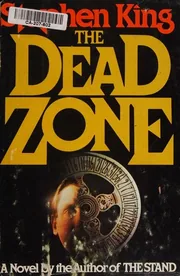
The Dead Zone is a novel by Stephen King, first published in 1979 and shelved under horror and gothic fiction. It is a science fiction thriller built around Johnny Smith, a high school teacher who wakes after almost five years in a coma. Brain damage seems to have left him with visions of the past and future that come when he touches people or objects. When some details stay hidden from him, he describes them as lying in the damaged part of his mind, which he calls the dead zone.
Johnny's visions draw him toward two threats. One is a serial killer at large in the town of Castle Rock, which makes its first appearance in King's fiction here. The other is Greg Stillson, an ambitious politician on the rise. The story reaches across places such as Maine, New Hampshire and Iowa, and its time span runs from the 1950s into the 1970s. Subjects along the way include brain tumors, assassination, murder and the workings of the House of Representatives. The book runs about 426 pages in its median edition.
The two things Sarah remembered about that night later were his run of luck at the Wheel of Fortune and the mask.
Characters
John Smith
Setting
New EnglandIowaMaineCarmelCalifornia
Period
19531970
Themes
brain tumorsrifleshuman shieldsassassinationprocrastinationmurderFederal Bureau of Investigationcar bombs
- Want to read 564
- Reading now 21
- Read 125
Most people shelving it are saving it for later.
Of 710 readers who put it on a shelf, 79% want to read it, 3% are reading it now, 18% have finished it and 0% stopped before the end.
By the numbers
- The median edition runs 426 pages. Counting about 275 words a page and an adult reading pace of 250 words a minute, that is about 7.8 hours of reading.
- Open Library tracks 90 editions from 65 publishers, the earliest dated 1979 and the latest 2024, across 13 languages.
- On reader demand it ranks in the top 1% of the modern books in our catalog (15,152 of them).
- Libraries shelve it under Dewey [Fic] and Library of Congress class PS-3561.00000000.I483 D27.
 BookWard’s take
A coma, a touch, and a choice only Johnny can make
The Dead Zone is Stephen King at his most humane. It opens on a night of luck and a mask, then drops Johnny Smith into a five-year coma and brings him out the other side with visions that arrive when he touches people or objects. The setup holds together on its own terms, and the book keeps its rules straight as it moves between a serial killer in Castle Rock and the rise of politician Greg Stillson. Character is the draw: Johnny is a man, not a gimmick, and the story leans on his choices more than on spectacle. The darkness feels earned rather than shocking. At 426 pages it isn't short, but the pace never sags, and the ending resolves what the book sets in motion. It's a strong pick for readers who value tight logic and restraint.
At 426 pages it runs well past tight, though it earns the space; BookWard prefers shorter, so this sits mid-scale.
The story moves steadily through its threads without rushing; BookWard likes it a touch faster, but the momentum holds.
The dead zone idea and the pairing of a killer with a rising politician feel fresh within a well-worn genre.
King writes in plain, conversational prose rather than ornate language, close to BookWard's middle-low leaning.
Events are driven by who Johnny is and what he chooses, giving it a character-driven lean like BookWard's.
Johnny's gift costs him dearly and the tone is somber, so this leans bleaker than BookWard's hopeful side.
A mostly forward-moving story with some jumps between threads, close to conventional and near BookWard's taste.
The tone is serious, with little comic relief, which sits well below BookWard's lightly funny preference.
Murder, assassination and illness shade the book dark without making it relentlessly grim.
Johnny's loss and burden give the book real emotional weight, slightly above BookWard's middle.
See all 50 dialsEvery position, side by side with this book
Where it lines up
- Character depthBookWard 8 · book 8
- EndingBookWard 8 · book 8
- Authorial voiceBookWard 9 · book 8
Where it pulls apart
- LengthBookWard 1 · book 5
- Familiar tropesBookWard 10 · book 6
- OpeningBookWard 10 · book 8
At 426 pages it runs well past tight, though it earns the space; BookWard prefers shorter, so this sits mid-scale.
A run of luck at the Wheel of Fortune and a mask set the tone in the first sentence, which suits BookWard's love of fast openings.
Psychic visions are familiar ground, but King pairs them with grounded, specific stakes; this lands a little below BookWard's high bar.
Johnny's touch-triggered visions follow clear limits, including the blocked information he calls the dead zone, which BookWard values highly.
The story moves steadily through its threads without rushing; BookWard likes it a touch faster, but the momentum holds.
The dead zone idea and the pairing of a killer with a rising politician feel fresh within a well-worn genre.
Johnny is drawn as a full person changed by loss, which matches the character depth BookWard looks for.
The central threats are faced and settled, giving the closure BookWard prefers over open-ended fades.
The book has real feeling but avoids syrup, sitting slightly more emotional than BookWard's restrained taste.
The darkness comes from the situations and stakes, not from shock for its own sake, which BookWard rewards.
This is a novel, so the nonfiction rigor dial does not apply.
King's plain, confident storytelling is unmistakably his, a distinctive voice that BookWard values.
The premise is big, but the book is led by story and character rather than argument.
Most of the weight is carried in scene, though visions and backstory occasionally explain outright; BookWard favors showing.
With two threats building toward Johnny, the long middle stays purposeful and keeps its tension.
King writes in plain, conversational prose rather than ornate language, close to BookWard's middle-low leaning.
Events are driven by who Johnny is and what he chooses, giving it a character-driven lean like BookWard's.
Johnny's gift costs him dearly and the tone is somber, so this leans bleaker than BookWard's hopeful side.
A mostly forward-moving story with some jumps between threads, close to conventional and near BookWard's taste.
The tone is serious, with little comic relief, which sits well below BookWard's lightly funny preference.
The language and plotting are easy to follow, which matches BookWard's accessible-but-thoughtful middle.
The story follows Johnny alongside the killer and Stillson's rise, giving a fair spread of perspectives that BookWard enjoys.
The story moves forward over years, with the coma as a clean break, keeping it mostly linear.
Precognition is the single supernatural element in an otherwise grounded world, sitting mid-scale.
A teacher, a killer, a politician and the people around them make for a moderate cast, slightly larger than BookWard's norm.
The stakes are national by the end but the story stays close to one man, balancing intimate and epic.
The weight falls on what Johnny sees, fears and decides, tilting toward inner life over action.
Scenes are carried by conversation fairly often, close to BookWard's liking for dialogue-driven pages.
Love shapes Johnny's story early on but is not its engine, so romance stays a supporting thread.
Maine, New Hampshire and Iowa are familiar American settings, more known than exotic for BookWard.
Set from the 1950s into the 1970s, it reads as a period story rather than a present-day one.
Questions of fate and moral choice keep the book relevant well past its 1979 publication.
The narration is straightforward and trustworthy, quite far from BookWard's taste for unreliable voices.
Johnny faces hard choices where right and wrong do not sit neatly, closer to BookWard's ambiguous side.
King gives enough place and detail to ground scenes without lingering, a middle path like BookWard's.
This is a novel, so the nonfiction style dial does not apply.
This is a novel, so the nonfiction perspective dial does not apply.
Though Castle Rock recurs across King's work, this novel stands on its own, so it reads as a standalone.
The visions drive turns the reader does not see coming, giving a fair number of surprises.
The central dilemma is hard to sit with, making this more challenging than comforting.
Murder, assassination and illness shade the book dark without making it relentlessly grim.
Johnny's loss and burden give the book real emotional weight, slightly above BookWard's middle.
Any humor is dry and sparing in a mostly serious story.
A killer and political danger bring real violence, though it is not the book's main appeal.
Sexual content is limited and not central to the story.
Greg Stillson's rise puts politics at the center of the plot's second half, well above BookWard's middle.
The language is plain and easy to follow, with little dense or dialect-heavy writing.
The narration stays mostly neutral, letting events and characters carry the book.
Johnny's visions of what is coming give the story a forward-looking tilt, matching BookWard.
The book weighs hope against dark possibility, leaning slightly cynical compared to BookWard's idealism.
Review written by BookWard, dial version 1, November 2026.
Who is The Dead Zone right for?
Best suited to adult and mature teen readers who are comfortable with thrillers. It deals with murder, assassination and serious illness, so some scenes may be unsettling.
The language and plotting are easy to follow, which matches BookWard's accessible-but-thoughtful middle.
Murder, assassination and illness shade the book dark without making it relentlessly grim.
Johnny's loss and burden give the book real emotional weight, slightly above BookWard's middle.
A killer and political danger bring real violence, though it is not the book's main appeal.
Book CompanionThe Dead Zone: ideas, characters, themes
A man who wakes from a coma with visions triggered by touch must decide what to do with knowledge of terrible things to come.
- An unlikely gift. Johnny Smith, a high school teacher, wakes after nearly five years to find that touching people or objects brings visions of past and future.
- The dead zone. Some information stays hidden from him, which he describes as trapped in the permanently damaged part of his brain, called the dead zone.
- Two threats. His visions draw him toward a serial killer in Castle Rock and toward the rise of an ambitious politician, Greg Stillson.
- A first for King. The novel marks the first appearance of Castle Rock, which King uses as a setting in later stories.
- A wide reach. The story moves across Maine, New Hampshire and Iowa, from the 1950s into the 1970s.
Characters
Johnny Smith
Protagonist
A high school teacher who wakes from a coma with precognitive and clairvoyant visions triggered by touch.
Greg Stillson
Antagonist
A rising politician whose ambition makes him one of the evils Johnny must eventually face.
Sarah
Figure from Johnny's past
She appears in the opening line, recalling the night of a run of luck at the Wheel of Fortune and a mask.
Themes
Whether knowing the future gives a person the right, or the duty, to change it.
How an extraordinary ability can isolate and cost the person who has it.
How a rising politician becomes a danger to others.
What it means to wake after years and find life moved on without you.
Discussion questions
- Would you want to know the future if you could not always control what you saw?
- Why does Johnny describe the blocked information as a dead zone, and what does that image suggest?
- How does the book balance the serial killer thread against the political one?
- What makes Johnny's choices hard rather than clear-cut?
- How does the five-year coma shape who Johnny is when he wakes?
Personalize your Book Companion
This is the general edition. In BookWard, the Companion is written for you: your reading profile, your notes, and spoiler-safe to the page you are on.
Buy, listen or borrow The Dead Zone
Each link opens a search for this book on that store, in a new tab.
Read on a device
Borrow
Reviews and community
If you liked The Dead Zone
Stephen King's elegy for the sixties and the generation that blew it
FirestarterStephen KingA girl who can start fires, and the people hunting her
BuckeyePatrick RyanA small Ohio town, two families, and one buried secret
Different SeasonsStephen KingFour King novellas, one for each season, with horror held back
Sources: Open Library.
Track The Dead Zone and find your next favorite
Add it to your shelf, rate what you have read, and BookWard will recommend what fits you.
Free to start. No credit card needed.