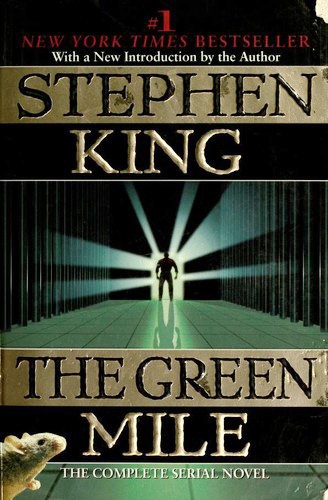
The Green Mile
by Stephen King
★ Top 5 book of 1996 · #2 on Best Books of 1996
Paul Edgecombe supervises a death row block and meets John Coffey, an inmate with strange powers to heal and to feel what others feel. First released as a six-part serial, it blends everyday prison life with magical realism.
Best for: Readers who like magical realism set against the world of death row
The Green Mile is #2 on BookWard's Best Books of 1996, out of 39 1996 books that cleared our data bar.
What The Green Mile is about
In 1996, an old man named Paul Edgecombe, living in the Georgia Pines nursing home, sets down the story of 1932, when he supervised death row at Cold Mountain Penitentiary. The prison's green linoleum floor gave the block its nickname, The Green Mile. Paul and his guards live alongside men waiting to die: Eduard Delacroix, who teaches tricks to a mouse named Mr. Jingles, and the dangerous William Wharton. Among the staff is Percy Wetmore, a cruel guard the others must put up with because of his connections to the Governor's wife.
Then comes John Coffey, a huge, gentle, simple-minded man convicted of killing two young girls. Paul comes to see that John has a remarkable gift for healing, and that he feels other people's thoughts and pain. First released in six volumes, this blend of magical realism and prison drama is suspenseful, sentimental and haunting. It looks hard at justice, cruelty and compassion, and will suit readers who like their stories moving as well as tense.
The Green Mile on the Best Books of 1996
The Green Mile came out in 1996. Of the 39 books first published in 1996 that met BookWard's data bar, it ranks #2 on our Best Books of 1996 list.
Why it made the list: 1,874 readers have shelved it on Open Library; readers rate it 4.3 out of 5 (113 ratings); 84 are reading it right now. The list ranks each year’s books on how many readers have picked them up, how highly readers rate them, and how many are reading them right now.
It earns Reader favorite and being read right now.
Nearby on the 1996 list
- A Game of Thrones George R. R. Martin, #1
- Forbidden Knowledge Roger Shattuck, #3
- Fight Club Chuck Palahniuk, #4
See all Best Books of 1996 Best books by year
More years: Best Books of 1995 Best Books of 1997.
The numbers behind it
- Readers: 1,549 want to read it, 84 are reading it now and 241 have read it, according to Open Library.
- Ratings: 4.3 out of 5 from 113 Open Library ratings.
| Signal | This book (0 to 100) | Weight |
|---|---|---|
| Reach | 97 | 55% |
| Reader love | 95 | 25% |
| Being read right now | 97 | 20% |
Questions about The Green Mile
When was The Green Mile published?
The Green Mile by Stephen King was first published in 1996.
Was The Green Mile one of the best books of 1996?
The Green Mile is #2 on BookWard's Best Books of 1996, out of 39 1996 books that cleared our data bar. 1,874 readers have shelved it on Open Library; readers rate it 4.3 out of 5 (113 ratings); 84 are reading it right now.
Why is The Green Mile on the Best Books of 1996 list?
1,874 readers have shelved it on Open Library; readers rate it 4.3 out of 5 (113 ratings); 84 are reading it right now.
More of the best books of 1996
- A Game of Thrones George R. R. Martin, #1
- Forbidden Knowledge Roger Shattuck, #3
- Fight Club Chuck Palahniuk, #4
- Push Sapphire, #5
- Neverwhere Neil Gaiman, #6
- Infinite Jest David Foster Wallace, #7
See the full Best Books of 1996, the Top 100, or new books on Rising.
How we know
This page uses public data: Open Library reader counts and ratings, and Wikipedia page views for recent years. The description is paraphrased from real source text. Rankings reflect reading interest, not quality or sales, and can be affected by data gaps. Lists update monthly.
Best suited to adult and mature teen readers.
Depends on the edition you pick.
Stephen King's death row serial, tender and terrible in turns. 59% taste match
 BookWard’s take
Stephen King's death row serial, tender and terrible in turns
Paul Edgecombe, an old man in a nursing home, sets down what happened on death row in 1932, where the floor's green linoleum gave the block its name. The Green Mile is a magical realist story that begins with a mystery: John Coffey, a huge inmate with inexplicable healing and empathetic gifts. It was originally published as a six-volume serial, and you can feel that in the pace, which keeps moving without a sagging middle. Character depth is the draw, from the guards to the inmates, and a petty sadist among them gives the book real menace. The tone runs warm, though the book earns its darkness more than it leans on shock. The ending resolves cleanly, which will satisfy readers who want closure.
A full novel that began as six serial volumes, longer than BookWard's taste for tight reads, though the installments keep it moving.
Serial publication shaped it into short, driving installments, so it moves briskly and fits BookWard's pace.
The prison setting is known territory, but the mix of death row and miraculous healing feels distinctive.
King's prose is conversational and plain, built for momentum rather than ornament.
Events matter, but the pull comes from the people on the block more than from plot mechanics.
Hope flickers through Coffey's gifts, yet the setting is a place of death, so it lands in the middle.
The alternation between 1932 and an old man writing in 1996 is a modest, effective frame.
There is some gallows humor among the guards, but the book is mostly serious.
See all 50 dialsEvery position, side by side with this book
Where it lines up
- Character depthBookWard 8 · book 8
- EndingBookWard 8 · book 8
- Story or ideasBookWard 3 · book 3
Where it pulls apart
- LengthBookWard 1 · book 6
- Familiar tropesBookWard 10 · book 5
- Internal logicBookWard 10 · book 7
A full novel that began as six serial volumes, longer than BookWard's taste for tight reads, though the installments keep it moving.
A death row supervisor looking back from a nursing home sets up a pull that arrives early, which BookWard rewards.
Death row and a gentle giant are familiar ground, though the magical realist framing gives them a fresh angle.
The healing gifts are accepted on their own terms and the prison routines hold together, close to what BookWard wants.
Serial publication shaped it into short, driving installments, so it moves briskly and fits BookWard's pace.
The prison setting is known territory, but the mix of death row and miraculous healing feels distinctive.
Guards, inmates and the narrator are drawn with real texture, which BookWard values highly.
The story resolves its central threads and gives the reader a settled close, in line with BookWard.
It leans warm and tender in places, a touch more sentimental than BookWard's preference for restraint.
The darkness has a purpose in the story, though some moments are built to hit hard.
King's first-person narrator has a plainspoken, unmistakable voice that carries the whole book.
This is storytelling first, with its moral questions emerging through events rather than argument.
Paul is a looking-back narrator, so he explains more than a purely scene-driven book, though he also shows.
Written in installments, it keeps each stretch purposeful, so the middle holds up well.
King's prose is conversational and plain, built for momentum rather than ornament.
Events matter, but the pull comes from the people on the block more than from plot mechanics.
Hope flickers through Coffey's gifts, yet the setting is a place of death, so it lands in the middle.
The alternation between 1932 and an old man writing in 1996 is a modest, effective frame.
There is some gallows humor among the guards, but the book is mostly serious.
The prose is accessible and the plot clear, so it reads easily despite its length.
Everything comes through Paul's first-person account, one narrator throughout.
It moves between 1932 and the narrator's present, though the main story runs in order.
Magical realism: a mostly real prison with one inexplicable element at its center.
A handful of prisoners and guards, each distinct, keep the cast manageable.
The action stays within one cell block and one year, a deliberately intimate canvas.
Paul's reflections and the events on the block share the story fairly evenly.
Conversations among guards and inmates carry a large share of the storytelling.
Romance is a minor thread, with the story centered on the prison and its inmates.
A 1930s Georgia death row is a distinct, unfamiliar place for most readers.
Set largely in 1932, with a framing present of 1996, so it looks to the past.
Its place in the BBC's Big Read poll of best-loved novels suggests lasting appeal.
Paul is a sincere narrator telling his own story as honestly as he can.
Questions of justice and mercy are not tidy, though the book leans toward clear sympathies.
King renders the block, its green floor and its inhabitants with vivid, concrete detail.
Review written by BookWard, dial version 1, November 2026.
Who is The Green Mile right for?
Best suited to adult and mature teen readers. It includes executions, violence, a crime against children, and racial injustice.
The prose is accessible and the plot clear, so it reads easily despite its length.
Book CompanionThe Green Mile: ideas, characters, themes
An old man recounts the year an extraordinary inmate arrived on death row and changed how he saw justice and mercy.
- A framed memoir. Paul writes from a nursing home in 1996, looking back on 1932.
- The Green Mile. The block takes its nickname from the color of its linoleum floor.
- John Coffey. A very tall inmate convicted of killing two girls, who shows unexplained healing and empathy.
- The guards. Paul and his colleagues carry out their duties while one cruel guard makes everything harder.
- Serial origins. It first appeared in six volumes before being collected as one novel.
Characters
Paul Edgecombe
Narrator and block supervisor
He tells the story as an old man, recalling his time running the death row block.
John Coffey
Inmate
A huge man convicted of a terrible crime who displays strange healing and empathetic abilities.
Percy Wetmore
Guard
A sadistic guard protected by family connections, resented by the others.
Eduard Delacroix
Inmate
A Cajun prisoner who befriends a mouse and teaches it tricks.
William Wharton
Inmate
An unhinged multiple murderer determined to cause as much trouble as he can.
Themes
Whether the system punishes fairly and what compassion demands.
How people react to something that cannot be explained.
What happens when someone shielded by connections abuses those in their care.
The weight of events an old man cannot stop revisiting.
Discussion questions
- How does the nursing home frame change the way you read the 1932 story?
- What does the book suggest about who deserves mercy?
- Why might King have given Percy such strong protection from consequences?
- How does the magical element work alongside the realistic prison setting?
- What did the serial format do for the book's rhythm and suspense?
Personalize your Book Companion
This is the general edition. In BookWard, the Companion is written for you: your reading profile, your notes, and spoiler-safe to the page you are on.
Buy, listen or borrow The Green Mile
Each link opens a search for this book on that store, in a new tab.
Read on a device
Borrow
Reviews and community
If you liked The Green Mile
Four King novellas, one for each season, with horror held back
JunieErin Crosby EckstineA grieving enslaved girl, a sister's spirit, and a plantation's secrets
The Kite RunnerKhaled HosseiniA boy's betrayal in Kabul, and the long road back
Bag of BonesStephen KingA grieving novelist, a haunted lake house, and a long slow dread
Find your own best books
Add what you have read, rate it, and BookWard will recommend what to read next.
Free to start. No credit card needed.