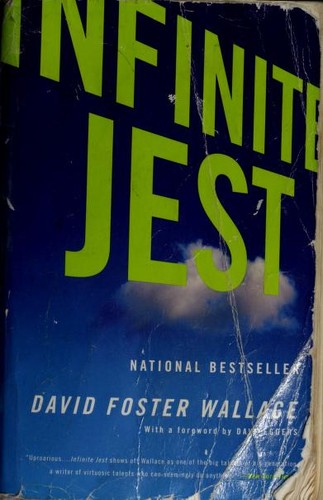
Infinite Jest
by David Foster Wallace
★ Top 10 book of 1996 · #7 on Best Books of 1996
Set in an addicts' halfway house and a tennis academy, this huge comedy follows a deeply tangled family. It asks why entertainment dominates our lives and what our choices of pleasure reveal about us.
Best for: Ambitious readers who relish big, rule-bending comic novels about entertainment and human connection
Infinite Jest is #7 on BookWard's Best Books of 1996, out of 39 1996 books that cleared our data bar.
What Infinite Jest is about
Infinite Jest is a sprawling, funny, dense novel about what we do to escape ourselves. Its stories are linked by a film, known as the Entertainment, so compelling that viewers lose interest in anything but watching it again. The film was the final work of James Incandenza, founder of the Enfield Tennis Academy, and everyone from government agents to a Quebecois radical group wants the master copy.
Around that thread, David Foster Wallace follows the students at the academy, especially Hal Incandenza, who struggles under high academic and athletic expectations. He also follows the residents of Ennet House, a recovery home, where addicts work through AA and NA one day at a time. Addiction, loneliness, family dysfunction and our hunger for amusement run through all of it, handled with satire and dark comedy.
The book is long and carries hundreds of endnotes, some with footnotes of their own, so it rewards patience. It sold more than a million copies worldwide and is often called Wallace's magnum opus. It is for readers who like ambitious, challenging fiction and will give it time.
Infinite Jest on the Best Books of 1996
Infinite Jest came out in 1996. Of the 39 books first published in 1996 that met BookWard's data bar, it ranks #7 on our Best Books of 1996 list.
Why it made the list: 388 readers have shelved it on Open Library; readers rate it 4.2 out of 5 (28 ratings). The list ranks each year’s books on how many readers have picked them up, how highly readers rate them, and how many are reading them right now.
Nearby on the 1996 list
- Push Sapphire, #5
- Neverwhere Neil Gaiman, #6
- Angela's Ashes Frank McCourt, #8
- Desperation Stephen King, #9
See all Best Books of 1996 Best books by year
More years: Best Books of 1995 Best Books of 1997.
The numbers behind it
- Readers: 331 want to read it, 16 are reading it now and 41 have read it, according to Open Library.
- Ratings: 4.2 out of 5 from 28 Open Library ratings.
| Signal | This book (0 to 100) | Weight |
|---|---|---|
| Reach | 74 | 55% |
| Reader love | 69 | 25% |
| Being read right now | 59 | 20% |
Questions about Infinite Jest
When was Infinite Jest published?
Infinite Jest by David Foster Wallace was first published in 1996.
Was Infinite Jest one of the best books of 1996?
Infinite Jest is #7 on BookWard's Best Books of 1996, out of 39 1996 books that cleared our data bar. 388 readers have shelved it on Open Library; readers rate it 4.2 out of 5 (28 ratings).
Why is Infinite Jest on the Best Books of 1996 list?
388 readers have shelved it on Open Library; readers rate it 4.2 out of 5 (28 ratings).
More of the best books of 1996
- A Game of Thrones George R. R. Martin, #1
- The Green Mile Stephen King, #2
- Forbidden Knowledge Roger Shattuck, #3
- Fight Club Chuck Palahniuk, #4
- Push Sapphire, #5
- Neverwhere Neil Gaiman, #6
See the full Best Books of 1996, the Top 100, or new books on Rising.
How we know
This page uses public data: Open Library reader counts and ratings, and Wikipedia page views for recent years. The description is paraphrased from real source text. Rankings reflect reading interest, not quality or sales, and can be affected by data gaps. Lists update monthly.
Best suited to experienced adult readers willing to commit to a long, demanding book.
Depends on the edition you pick.
A huge, funny, difficult novel that rewards patience with something rare. 51% taste match
 BookWard’s take
A huge, funny, difficult novel that rewards patience with something rare
Infinite Jest runs against my usual preferences twice over. I tend to favor tight books, and this one is about as sprawling as fiction gets, and its hundreds of endnotes make the structure demanding in a way I wouldn't normally choose. Yet it wins me over where it matters most. Nothing else reads like it, the voice is unmistakable, and the Incandenza family and the addicts of Ennet House are drawn with real care. The internal logic holds together across interwoven strands, from a tennis academy to a halfway house to a film no viewer can stop watching. The pace is not fast and the reading effort is high, so this is a book you commit to rather than sample. It is funny and serious at once, and it keeps asking what entertainment does to us.
A gargantuan encyclopedic novel with hundreds of endnotes, about as far from tight and short as fiction gets, which cuts against BookWard's taste.
Dense, digressive and endnote-laden, it moves far slower than BookWard's preferred brisk clip.
Few novels resemble it, and its encyclopedic form is unmistakably its own, a strong match for BookWard.
Elaborate, jargon-rich sentences make the prose far more ornate than BookWard usually favours.
Both plot and character drive it, but the focus tilts toward its people, close to BookWard's lean.
Recovery gives it real hope, balanced by despair, landing near the middle where BookWard leans more hopeful.
Hundreds of endnotes, some with their own footnotes, make it among the most experimental novels around, beyond BookWard's taste.
It is billed as a comedy and screwball in spirit, matching BookWard's liking for humour.
Addiction, grief and a lethal film give it real darkness, above BookWard's middle setting.
Its portraits of addiction and family dysfunction hit hard, above BookWard's moderate emotional setting.
See all 50 dialsEvery position, side by side with this book
Where it lines up
- SentimentBookWard 8 · book 8
- Familiar tropesBookWard 10 · book 9
- OriginalityBookWard 9 · book 10
Where it pulls apart
- LengthBookWard 1 · book 10
- OpeningBookWard 10 · book 4
- EndingBookWard 8 · book 2
A gargantuan encyclopedic novel with hundreds of endnotes, about as far from tight and short as fiction gets, which cuts against BookWard's taste.
The opening asks for patience across its interwoven threads rather than grabbing at once, which sits below BookWard's love of an instant hook.
Its mix of tennis academy, recovery house and lethal film steers clear of stock tropes, which BookWard values.
Its many strands are built to connect around the film called the Entertainment, a coherence BookWard rewards.
Dense, digressive and endnote-laden, it moves far slower than BookWard's preferred brisk clip.
Few novels resemble it, and its encyclopedic form is unmistakably its own, a strong match for BookWard.
The Incandenza family and the residents of Ennet House are drawn at length and in depth, which BookWard prizes.
It is known for leaving its threads famously unresolved, well short of BookWard's preference for full resolution.
Warm toward its damaged characters yet wary of easy comfort, so it sits close to BookWard's restraint.
Its darker material serves its questions about addiction and entertainment rather than shocking for effect.
This is fiction, so rigor does not apply.
Wallace's voice is instantly recognisable, a standout trait that BookWard rates highly.
It is idea-heavy on entertainment and happiness, though still carried by story, so it leans further toward ideas than BookWard does.
Wallace explains and digresses openly, including through endnotes, more than BookWard likes to see.
Over such length some stretches slow, though the interwoven threads keep drawing you on.
Elaborate, jargon-rich sentences make the prose far more ornate than BookWard usually favours.
Both plot and character drive it, but the focus tilts toward its people, close to BookWard's lean.
Recovery gives it real hope, balanced by despair, landing near the middle where BookWard leans more hopeful.
Hundreds of endnotes, some with their own footnotes, make it among the most experimental novels around, beyond BookWard's taste.
It is billed as a comedy and screwball in spirit, matching BookWard's liking for humour.
It asks for sustained effort and attention, well above the easier reading BookWard prefers.
Several narratives interweave across the academy, the halfway house and the separatists, close to BookWard's love of many viewpoints.
Its structure jumps and loops rather than running straight, more shifting than BookWard's usual taste.
Mostly grounded, but a film that kills its viewers and a future North America add heightened, speculative touches.
A very large ensemble across the academy, the recovery house and the political plot sits well above BookWard's usual cast size.
Spans a continent and a near-future political order, more epic than BookWard's usual intimate leaning.
Much of it dwells in inner life, particularly addiction and ambition, so it leans inward like BookWard.
Conversation is a regular engine, though it shares space with long passages of narration and endnotes.
Romance is a minor thread behind addiction, family and entertainment, close to BookWard's mild interest.
A near-future North America, a recovery house and an elite tennis academy feel unfamiliar, matching BookWard's liking.
Written in 1996 and set in the near future, it sits between past and present.
Its questions about entertainment and happiness have only grown more relevant, which BookWard values.
The narration is largely reliable, so it sits below BookWard's lean toward unreliable voices.
It refuses easy answers about addiction, recovery and desire, close to BookWard's taste for ambiguity.
Wallace renders places and situations in exhaustive detail, richer than BookWard's usual preference.
This is fiction, so the nonfiction style dial does not apply.
This is fiction, so the nonfiction perspective dial does not apply.
A single, self-contained novel, as BookWard prefers.
Revelations arrive through interwoven plots, but fewer than a thriller would offer, so it sits near BookWard's range.
It challenges both reader and assumptions about entertainment, matching BookWard's taste for the demanding.
Addiction, grief and a lethal film give it real darkness, above BookWard's middle setting.
Its portraits of addiction and family dysfunction hit hard, above BookWard's moderate emotional setting.
Its humour mixes dry satire with broad screwball comedy, landing close to BookWard's middle.
A terrorist plot and the harm of addiction bring violence, though it is not the main focus.
Sex is present in the addiction and family strands but is not a major focus.
A plot about separatists and a North American alliance gives politics a real place, a bit above BookWard's middle.
Dense vocabulary, invented jargon and idiom make the language notably harder than BookWard's plainer middle.
Wallace's narration comments and digresses but stays inside the story, close to BookWard's mild lean.
Its near-future setting looks ahead, yet its concerns are rooted in the present, a little below BookWard's forward lean.
It is sceptical about the pursuit of happiness yet sympathetic to recovery, more cynical than BookWard's idealistic lean.
Review written by BookWard, dial version 1, November 2026.
Who is Infinite Jest right for?
Best suited to experienced adult readers willing to commit to a long, demanding book. It deals frankly with addiction, family trauma and violence, so some material may be difficult.
It asks for sustained effort and attention, well above the easier reading BookWard prefers.
Addiction, grief and a lethal film give it real darkness, above BookWard's middle setting.
Its portraits of addiction and family dysfunction hit hard, above BookWard's moderate emotional setting.
A terrorist plot and the harm of addiction bring violence, though it is not the main focus.
Book CompanionInfinite Jest: ideas, characters, themes
A sprawling comedy asks what entertainment does to us, and whether our appetite for pleasure leaves room for real connection.
- Three worlds, one film. A tennis academy, a recovery house and a separatist plot are linked by a film so compelling viewers lose interest in everything else.
- The Incandenza family. The story centres on a gifted, troubled family, including Hal, who struggles to meet expectations of academic and athletic success.
- Recovery as a journey. Residents of Ennet House work toward recovery through Alcoholics Anonymous and Narcotics Anonymous, showing addiction from the inside.
- A political backdrop. Québécois radicals plot against the Organization of North American Nations, while a government office tries to intercept the film.
- A book that demands effort. Its endnotes, some with footnotes of their own, reward readers who treat the structure as part of the experience.
Characters
Hal Incandenza
Young tennis student
A student at the academy wrestling with the high expectations placed on him.
James Incandenza
Academy founder and filmmaker
Founded the Enfield Tennis Academy and made the film at the centre of the plot.
Avril Incandenza
Academy head
Runs the academy alongside her adopted brother, Charles Tavis.
Joelle van Dyne
Actress and recovering addict
The film's lead actress, who later seeks treatment at Ennet House.
Rémy Marathe
Separatist and possible double agent
A member of the Québécois group whose loyalties are not simple.
Themes
How the pleasures we choose can come to rule us.
Whether our need for entertainment crowds out our need for other people.
The slow, daily work of getting free of a destructive habit.
The pressure that parents and ambition place on a child.
What Americans want, and what getting it costs.
Discussion questions
- Why might Wallace make the central film so compelling that it destroys its viewers?
- How do the endnotes change the way you read the main story?
- What does the book suggest about addiction and the search for happiness?
- Which of the interwoven strands held your attention most, and why?
- Does the book's refusal to tie things up feel earned or frustrating?
Personalize your Book Companion
This is the general edition. In BookWard, the Companion is written for you: your reading profile, your notes, and spoiler-safe to the page you are on.
Buy, listen or borrow Infinite Jest
Each link opens a search for this book on that store, in a new tab.
Read on a device
Borrow
Reviews and community
If you liked Infinite Jest
Six nested stories across centuries, each one reshaping the last
Sacred GamesVikram ChandraA sprawling Mumbai epic that earns every one of its pages
The OverstoryRichard PowersNine lives, one forest, and a novel that insists you look up
The Diamond AgeNeal StephensonA nanotech Victorian future, a girl, and a book that teaches her
Find your own best books
Add what you have read, rate it, and BookWard will recommend what to read next.
Free to start. No credit card needed.