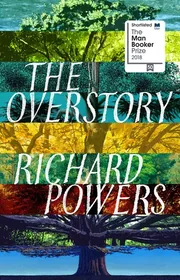
The Overstory
by Richard Powers, Richard Powers · 2018
Best suited to adult and mature teen readers comfortable with long, serious literary fiction.
531 pages, about 8.5 to 12.5 hours.
Nine lives, one forest, and a novel that insists you look up. 49% taste match
The story
The Overstory is a novel by Richard Powers, first published in 2018 and filed under literary and general fiction. It is an American work of political fiction centered on forests, conservation and environmental activism.
The story follows nine Americans, each brought into contact with trees through very different experiences. Their individual stories begin in places and eras as varied as nineteenth-century New York and the Vietnam War, and they converge in the Pacific Northwest during the Timber Wars of the late twentieth century. Among them are a pilot who survives a fall, an artist who inherits a family archive of photographs of a single chestnut tree, and a scientist who discovers that trees communicate. Together they join an effort to protect some of the last stands of untouched forest on the continent. The narrative is built in a non-linear form, and the book looks at how people relate to the natural world and what is at stake when forests are destroyed. The median print edition runs 531 pages.
Themes
treesforestconservationenvironmentactivismForest conservationForests and forestryNew York Times bestseller
- Want to read 216
- Reading now 1
- Read 52
Most people shelving it are saving it for later.
Of 269 readers who put it on a shelf, 80% want to read it, 0% are reading it now, 19% have finished it and 0% stopped before the end.
By the numbers
- The median edition runs 531 pages. Counting about 275 words a page and an adult reading pace of 250 words a minute, that is about 9.7 hours of reading.
- Open Library tracks 19 editions from 13 publishers, the earliest dated 2018 and the latest 2024.
- On reader demand it ranks in the top 2% of the recent books in our catalog (6,647 of them).
- Libraries shelve it under Dewey 813.6 and Library of Congress class PS-3566.00000000.O92 O94 2018b.
 BookWard’s take
Nine lives, one forest, and a novel that insists you look up
The Overstory is a big, serious novel that asks you to care about trees as much as the people who love them. Powers builds it in concentric rings: nine separate lives, each touched by a tree, that gradually draw together around the Timber Wars of the Pacific Northwest. The appeal lies in its originality and its voice. Few novels are shaped like this, and the prose has a distinctive, almost scientific wonder. This is a book driven more by ideas than by plot, which runs against my own leaning, and at 531 pages it is far longer than the tight, short novels I tend to prefer. Still, it rewards patience with real intellectual reach, though readers wanting a fast hook may find the opening movements deliberate.
At 531 pages it is a long, sprawling book, well beyond BookWard's preference for tight and short.
The slow, concentric build favors accumulation over speed, so it moves more gradually than BookWard's brisk taste.
A novel built from nine tree-touched lives converging on a forest struggle is a genuinely uncommon shape, which BookWard prizes.
The language is lyrical and heavily textured, richer and more ornate than the plainer prose BookWard leans toward.
It balances individual lives against a gathering plot, with character origins carrying much of the weight.
It carries real grief over forest loss yet also a stubborn faith that people can still act, landing mid-scale.
Its ringed, interlocking design and non-linear arrangement are far more experimental than BookWard's conventional-leaning taste.
The tone is earnest and elegiac, with little comedy, leaving it well on the serious side.
Loss, destruction and conflict give it a serious edge, though it is not relentlessly bleak.
It builds toward real emotional force around loss and devotion, more intense than BookWard's restrained preference.
See all 50 dialsEvery position, side by side with this book
Where it lines up
- OriginalityBookWard 9 · book 9
- Authorial voiceBookWard 9 · book 9
- Character depthBookWard 8 · book 7
Where it pulls apart
- LengthBookWard 1 · book 9
- OpeningBookWard 10 · book 4
- Story or ideasBookWard 3 · book 8
At 531 pages it is a long, sprawling book, well beyond BookWard's preference for tight and short.
It opens with separate, patient fable-like portraits rather than a single gripping incident, slower than the instant hook BookWard likes.
Its premise of people summoned by trees and its interlocking structure avoid stock plots, which BookWard rewards.
Its lives and eras interlock with deliberate care, and the activist storyline follows a coherent cause and effect.
The slow, concentric build favors accumulation over speed, so it moves more gradually than BookWard's brisk taste.
A novel built from nine tree-touched lives converging on a forest struggle is a genuinely uncommon shape, which BookWard prizes.
Nine distinct people each get a full origin story, though the sheer number spreads the depth thinner than a single portrait would.
The converging storylines drive toward the forest conflict, giving a sense of arrival, though not every thread is neatly tied.
Powers writes with real feeling for trees and people, leaning warm without becoming saccharine, a little more sentimental than BookWard prefers.
The darker turns come from the weight of loss and conflict in the story rather than from shocks used for effect.
The tree science, including how trees communicate, is woven in with evident research, though it serves a novel rather than a treatise.
Powers has a recognizable, reverent, scientifically curious voice that sets the book apart, and BookWard loves that.
The book is driven by a big idea about the living world and our place in it, more so than by plot alone.
Much of the thinking about trees and ecology is explained outright, which sits further toward telling than BookWard prefers.
With this many separate origin stories, the middle can feel like it stretches before the threads converge.
The language is lyrical and heavily textured, richer and more ornate than the plainer prose BookWard leans toward.
It balances individual lives against a gathering plot, with character origins carrying much of the weight.
It carries real grief over forest loss yet also a stubborn faith that people can still act, landing mid-scale.
Its ringed, interlocking design and non-linear arrangement are far more experimental than BookWard's conventional-leaning taste.
The tone is earnest and elegiac, with little comedy, leaving it well on the serious side.
The structure, density of ideas and sheer length ask for sustained attention, making it more demanding than BookWard's usual reading.
Nine lives each take their turn, so the book draws on many viewpoints, more than BookWard typically seeks.
The stories begin in different eras and shift across time before converging, well past BookWard's linear lean.
It stays rooted in the real world, though a few touches of the uncanny add a sense of mystery.
Nine central people plus those around them make for a large cast, bigger than BookWard's usual small-cast taste.
It spans centuries and a whole continent's forests, with stakes that reach far beyond any single household.
It balances the characters' interior awakenings with outward action like the Timber Wars protests.
Scenes carry conversation, but the book leans more on narration and reflection than on talk.
Romance is a minor strand, secondary to the characters' bond with trees and the forest cause.
The settings range widely, from familiar American places to forest worlds most readers rarely see up close.
It runs from the nineteenth century into the late twentieth and beyond, reaching toward the present but not rooted there.
Its subject of forests and humanity's place in nature feels durable and likely to keep its force.
The narration is a clear authorial presence rather than a character with something to hide.
It argues plainly for protecting forests, though its characters' choices raise real moral complexity.
The book dwells on trees, light and landscape in rich detail, far fuller than BookWard's sparser leaning.
It is a standalone novel with no sequel needed to complete its story.
Its pleasures come more from slow convergence and revelation than from a run of surprises.
It challenges how readers see their relationship with the natural world, pushing rather than soothing.
Loss, destruction and conflict give it a serious edge, though it is not relentlessly bleak.
It builds toward real emotional force around loss and devotion, more intense than BookWard's restrained preference.
Conflict and a few harsh moments appear, but violence is not the book's main texture.
Sexual content is minor and not a focus of the story.
Environmental activism is central to the story, putting politics front and center, well beyond BookWard's middle ground.
The language is dense and image-laden in places but not written in dialect, so it reads as moderately demanding.
It argues for a cause with conviction, so the narration is far from neutral.
It mourns what has been lost while pressing urgently on what we do next, balancing backward and forward.
Its characters act on a conviction that effort matters, leaning idealistic despite the grief around them.
Review written by BookWard, dial version 1, November 2026.
Who is The Overstory right for?
Best suited to adult and mature teen readers comfortable with long, serious literary fiction. It deals with war, death and conflict over forest protection.
The structure, density of ideas and sheer length ask for sustained attention, making it more demanding than BookWard's usual reading.
Loss, destruction and conflict give it a serious edge, though it is not relentlessly bleak.
It builds toward real emotional force around loss and devotion, more intense than BookWard's restrained preference.
Conflict and a few harsh moments appear, but violence is not the book's main texture.
Book CompanionThe Overstory: ideas, characters, themes
Nine very different people are each changed by an encounter with trees, and their paths converge in a fight to protect some of the last untouched forest.
- Structure as argument. The book is arranged like the rings of a tree, with separate lives gradually interlocking, so its form echoes its subject.
- Many origins, one cause. Each character is drawn toward trees through a different experience, from war to inheritance to scientific discovery.
- The hidden world of trees. The novel presents a vast, slow, interconnected world alongside ours that most people barely notice.
- Place and time. Stories begin in settings as varied as nineteenth-century New York and the Vietnam War before reaching the Pacific Northwest.
- Activism at the center. The characters' last stand to save remaining virgin forest during the Timber Wars gives the book its political drive.
Characters
The Air Force loadmaster
One of the nine
A Vietnam War airman shot from the sky and saved by falling into a banyan.
The artist
One of the nine
Inherits a century of photographic portraits of a single doomed American chestnut.
The undergraduate
One of the nine
A hard-partying student in the late 1980s who electrocutes herself, dies, and is sent back into life.
The scientist
One of the nine
A hearing- and speech-impaired researcher who discovers that trees communicate with one another.
Themes
How people relate to, depend on and harm the living world around them.
What individuals are willing to risk to defend forests under threat.
The idea that lives, like trees, are bound together in ways hard to see.
The contrast between the slow lives of trees and the short span of human attention.
The grief of watching irreplaceable things disappear.
Discussion questions
- Why might the author structure the book like the rings of a tree, and does the form work for you?
- Which of the nine stories drew you in most, and why?
- How does the book change the way you think about trees and forests?
- Is activism, as shown here, portrayed as effective, necessary or something more complicated?
- What does the novel suggest about the gap between human time and tree time?
Personalize your Book Companion
This is the general edition. In BookWard, the Companion is written for you: your reading profile, your notes, and spoiler-safe to the page you are on.
Buy, listen or borrow The Overstory
Each link opens a search for this book on that store, in a new tab.
Read on a device
Borrow
Reviews and community
If you liked The Overstory
Four lives, one ocean, and a game that ate the world
CasteIsabel WilkersonA big idea about American hierarchy, argued through real lives
Is a River Alive?Robert MacfarlaneA lyrical argument that rivers deserve to be treated as living beings
Cloud AtlasDavid MitchellSix nested stories across centuries, each one reshaping the last
Sources: Open Library.
Track The Overstory and find your next favorite
Add it to your shelf, rate what you have read, and BookWard will recommend what fits you.
Free to start. No credit card needed.