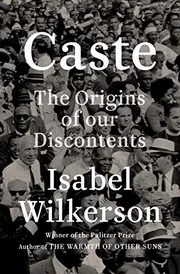
Caste
by Isabel Wilkerson, Antonio Francisco Rodríguez Esteban · 2020
It suits mature teens and adults who are ready for a serious look at history and power.
496 pages, about 8 to 11.5 hours.
A big idea about American hierarchy, argued through real lives. 57% taste match
What it covers
Caste is a work of nonfiction by Isabel Wilkerson, first published in 2020 and running to about 496 pages. It sits at the meeting point of history, social science, and psychology, and it looks at the United States through the idea of caste: a ranked order of human groups in which the central question is power, meaning who holds it and who does not.
Wilkerson draws on research and on the stories of real individuals to trace how this ranking has shaped American life across the nation's history and into the present. Among the people she writes about are Martin Luther King, Jr., the baseball pitcher Satchel Paige, a father and his young son, and the author herself. She sets the American case beside the caste systems of India and Nazi Germany, and describes eight pillars that such systems share, including divine will, bloodlines, and stigma. The book treats caste as something that works alongside race and class while operating as a separate force in how people live, behave, and relate to one another.
Readers interested in race relations, social stratification, and the history of power in America will find the subject set out in narrative form.
In the haunted summer of 2016, an unaccustomed heat wave struck the Siberian tundra on the edge of what the ancients once called the End of the Land.
Setting
United States
Themes
social sciencespowerrace relationssocial stratificationethnicityCasteSocial classesPower (social sciences)
- Want to read 171
- Reading now 6
- Read 28
Most people shelving it are saving it for later.
Of 205 readers who put it on a shelf, 83% want to read it, 3% are reading it now, 14% have finished it and 0% stopped before the end.
By the numbers
- The median edition runs 496 pages. Counting about 275 words a page and an adult reading pace of 250 words a minute, that is about 9.1 hours of reading.
- Open Library tracks 17 editions from 12 publishers, the earliest dated 2020 and the latest 2023, across 3 languages.
- On reader demand it ranks in the top 4% of the recent books in our catalog (6,647 of them).
- Libraries shelve it under Dewey 305.5122 and Library of Congress class HT-0725.00000000.U6 W55 2020eb.
 BookWard’s take
A big idea about American hierarchy, argued through real lives
Wilkerson reframes American race relations through the lens of caste, setting the United States beside India and Nazi Germany and naming eight pillars these systems share. What stands out is how original the argument is. It is built on serious research and a distinctive way of seeing, and the voice is unmistakably hers. The people she follows (Satchel Paige, a father and his young son, Wilkerson herself) carry the ideas, which gives the book real emotional weight. It is more driven by ideas than by story, and the content is demanding and challenging. At 496 pages it is long, but the human stories keep it moving and stop the middle from sagging. A serious, restrained book with a hopeful turn at the end.
At 496 pages it is a substantial read, well beyond BookWard's preference for tight and short.
Real-life stories keep the argument moving, though a book this size is not fast.
Treating caste as a force separate from race and class is a distinctive take on familiar history.
The writing is polished and vivid but serves the argument rather than showing off.
Ideas and argument drive the book more than any individual's arc, though people anchor it.
It ends by pointing toward common humanity, but the weight of the history is heavy.
The eight-pillar organization is clear and conventional for serious nonfiction.
This is a serious subject treated seriously, with little room for humor.
It deals with the cruelty of caste and its costs, including Nazi Germany.
The stories carry real emotional force, held in check by an analytical frame.
See all 50 dialsEvery position, side by side with this book
Where it lines up
- OriginalityBookWard 9 · book 9
- Familiar tropesBookWard 10 · book 9
- Character depthBookWard 8 · book 7
Where it pulls apart
- LengthBookWard 1 · book 7
- Story or ideasBookWard 3 · book 8
- ExpositionBookWard 2 · book 7
At 496 pages it is a substantial read, well beyond BookWard's preference for tight and short.
It opens on a striking idea about an unseen system, which pulls readers in quickly.
Applying caste to America and comparing it with India and Nazi Germany is a fresh frame, which BookWard values.
The argument is built on eight named pillars that shape the case, which suits BookWard's taste for tight reasoning.
Real-life stories keep the argument moving, though a book this size is not fast.
Treating caste as a force separate from race and class is a distinctive take on familiar history.
Real people such as Satchel Paige and a father with his toddler son give the ideas human weight.
It points forward toward common humanity, closing the argument rather than leaving it open.
It is serious and analytical in tone, and it uses human stories without tipping into sentimentality.
The darkness comes from documented history, such as Nazi study of American systems, not shock for effect.
Deeply researched and structured around named pillars, which is the kind of rigor BookWard rewards.
Wilkerson writes with a clear, recognisable authority and a gift for striking images.
The book is led by its central idea, with stories used as evidence, leaning away from BookWard's story preference.
It states its framework and pillars outright, more explaining than showing, which is less to BookWard's taste.
Individual stories and a clear structure keep the long middle from stalling.
The writing is polished and vivid but serves the argument rather than showing off.
Ideas and argument drive the book more than any individual's arc, though people anchor it.
It ends by pointing toward common humanity, but the weight of the history is heavy.
The eight-pillar organization is clear and conventional for serious nonfiction.
This is a serious subject treated seriously, with little room for humor.
Heavy material and a sizable length make it a committed read, though the prose is clear.
It moves between Wilkerson's own voice and many real lives and historical systems.
It ranges across American history, Nazi Germany, India and the present rather than running in a line.
Entirely grounded in history and lived experience.
Many real individuals appear across the book, including King, Paige and ordinary families.
The scope covers a nation's history and compares three societies, which is epic in reach.
It focuses on systems, history and events more than on inner thought, though personal experience appears.
As analytical nonfiction it relies on narration, with little dialogue.
Romance is not part of this book.
It deals with the familiar setting of the United States and brings fresh light to it.
It reaches from history to the present day, framed by the concerns of 2020.
Its argument about hierarchy and power is likely to stay relevant as long as those systems do.
The author speaks plainly and directly, with no unreliability.
Wilkerson argues for a clear moral position, though she treats caste as about power rather than feelings or morality.
Scenes and stories are drawn with vivid, concrete detail.
It blends narrative storytelling with analysis, leaning more toward argument than pure story.
Wilkerson includes her own experience, so the stance is partly personal rather than fully detached.
A complete standalone book.
It reveals historical connections that surprise, but it is argument rather than plot.
It asks readers to see familiar history in an uncomfortable and unsettling new way.
It deals with the cruelty of caste and its costs, including Nazi Germany.
The stories carry real emotional force, held in check by an analytical frame.
Humor plays almost no role here.
It addresses historical violence and persecution, though mostly through analysis.
Sexual content is minimal.
The subject is power and hierarchy in America, which puts politics at the center.
The prose is accessible, though some of the concepts are dense.
Wilkerson argues a clear thesis with conviction rather than staying neutral.
It reads history closely but turns toward how America might move beyond caste.
It ends with hope in common humanity, even after a hard look at the past.
Review written by BookWard, dial version 1, November 2026.
Who is Caste right for?
It suits mature teens and adults who are ready for a serious look at history and power. It discusses persecution, racism and Nazi Germany, which may be hard to read.
Heavy material and a sizable length make it a committed read, though the prose is clear.
It deals with the cruelty of caste and its costs, including Nazi Germany.
The stories carry real emotional force, held in check by an analytical frame.
It addresses historical violence and persecution, though mostly through analysis.
Book CompanionCaste: ideas, characters, themes
Wilkerson argues that America has a hidden caste system, a rigid hierarchy of human rankings about power, that works alongside race and class and shapes daily life and the nation's fate.
- Caste is about power. The hierarchy of caste is not about feelings or morality but about which groups hold power and which do not.
- Three systems compared. She links the caste systems of America, India and Nazi Germany to show how they share a common logic.
- Eight pillars. Wilkerson names eight pillars that underlie caste systems across civilizations, including divine will, bloodlines and stigma.
- The Nazis studied America. She documents how the Nazis studied racial systems in America as they planned to cast out the Jews.
- The cost of caste. The book describes health costs such as depression and shorter life expectancy, and effects on culture and politics, and it points toward common humanity.
Characters
Isabel Wilkerson
Author and narrator
She includes her own experience of caste as part of the evidence.
Martin Luther King, Jr.
Civil rights leader
One of the real people whose experience shows how caste works.
Satchel Paige
Baseball pitcher
His story is used to show how caste shaped a life in public view.
A single father and his toddler son
Ordinary family
Their story shows how caste is felt in everyday moments.
Themes
How rankings of human groups decide who has power and who does not.
The case that caste is a separate force beyond race and class.
How being assigned a place carries a social cost for those on the bottom.
How hierarchy affects depression and life expectancy.
The hope of moving past artificial and destructive separations.
Discussion questions
- Does the idea of caste change how you understand race in America?
- Which of the eight pillars felt most familiar from your own experience?
- Why compare America to India and Nazi Germany, and does the comparison hold?
- How do the personal stories change the force of the argument?
- What would it take to move toward the common humanity the book describes?
Personalize your Book Companion
This is the general edition. In BookWard, the Companion is written for you: your reading profile, your notes, and spoiler-safe to the page you are on.
Buy, listen or borrow Caste
Each link opens a search for this book on that store, in a new tab.
Read on a device
Borrow
Reviews and community
If you liked Caste
A sweeping, art-filled history of African Americans from Africa to hip-hop
The OverstoryRichard PowersNine lives, one forest, and a novel that insists you look up
Black in BluesImani PerryA meditation on Blackness, told through one color
FramedJohn GrishamTen true wrongful-conviction cases, told with a novelist's drive
Sources: Open Library.
Track Caste and find your next favorite
Add it to your shelf, rate what you have read, and BookWard will recommend what fits you.
Free to start. No credit card needed.