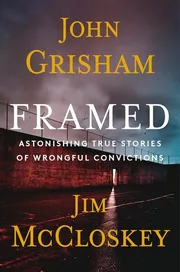
Framed
by John Grisham, Jim McCloskey · 2024
Suits mature teens and adults interested in justice and law.
357 pages, about 5.5 to 8.5 hours.
Ten true wrongful-conviction cases, told with a novelist's drive. 64% taste match
What it covers
Framed is a work of nonfiction by John Grisham, first published in 2024, that collects ten true accounts of Americans who were convicted of crimes they did not commit. It falls within history and politics, with a focus on the criminal justice system and the problem of judicial error in the United States. The author co-wrote it with Jim McCloskey of Centurion Ministries, an organization devoted to freeing the wrongly convicted, and either Grisham or McCloskey narrates each case.
Each account follows a person who lost years of life to prison while the actual offenders stayed free, and the long effort to win exoneration. The book looks at how such convictions come about, including racism, misconduct, flawed testimony, and corruption in the courts, and why they prove so hard to overturn. The cases are set in communities across the country, among them Norfolk, Conroe, Rankin County, Hinesville, Chester, Dellwood, Clifton, New Iberia, Tyler, and Corsicana, and they span the years from 1976 to 2024. The book runs to roughly 357 pages and has appeared in six editions.
Setting
Norfolk (Va.)Conroe (Tex.)Rankin County (Miss.)Hinesville (Ga.)Chester (Pa.)
Period
1976-2024
Themes
Judicial error -- United StatesCriminal justiceAdministration -- United States
By the numbers
- The median edition runs 357 pages. Counting about 275 words a page and an adult reading pace of 250 words a minute, that is about 6.5 hours of reading.
- Open Library tracks 6 editions from 3 publishers, the earliest dated 2024 and the latest 2025.
- On reader demand it ranks in the top 35% of the recent releases books in our catalog (1,627 of them).
- Libraries shelve it under Dewey 345.0122 and Library of Congress class HV-7419.30000000.
 BookWard’s take
Ten true wrongful-conviction cases, told with a novelist's drive
Framed collects ten true accounts of Americans convicted of crimes they did not commit, each told by John Grisham or Jim McCloskey of Centurion Ministries. It reads like a case file with a thriller's instincts. The pacing works well here: each account is a self-contained fight for exoneration, so momentum resets with every chapter and no sagging middle builds up. The research is thorough, examining racism, misconduct, flawed testimony and corruption in specific communities from 1976 to 2024. The endings resolve naturally case by case, though the larger problem stays open. The mood is mixed: these stories are bleak in what was lost, hopeful in the freedom won. The book is driven by ideas and explains outright in places, where I would have preferred more scene.
At 357 pages across ten cases, it is substantial but divided into digestible accounts rather than one long haul.
Ten separate fights for exoneration keep things moving, with the dramatic momentum of the author's thriller background.
The subject is well covered, but a ten-case collection from a famed novelist and an exoneration advocate offers a distinct angle.
Clear, direct, thriller-paced prose serves the material rather than decorating it.
Plot-like legal battles drive the accounts, though the wrongly convicted people anchor them emotionally.
The cases end in freedom, but the book dwells on years stolen and a system that resists correction.
Ten separate accounts make a mild departure from a single narrative, but the form stays straightforward.
Wrongful imprisonment is serious ground, and the book keeps a grave tone throughout.
Years lost to prison and failures by officials make the subject matter heavy.
The human cost of stolen decades and the relief of release carry real weight.
See all 50 dialsEvery position, side by side with this book
Where it lines up
- PaceBookWard 8 · book 8
- EndingBookWard 8 · book 8
- Sagging middleBookWard 8 · book 8
Where it pulls apart
- LengthBookWard 1 · book 4
- ExpositionBookWard 2 · book 6
- OpeningBookWard 10 · book 8
At 357 pages across ten cases, it is substantial but divided into digestible accounts rather than one long haul.
True stories avoid invented formula, though the wrongful-conviction narrative has familiar beats that sit slightly below BookWard's bar.
Real events are laid out through evidence and legal process, so each case follows a coherent chain of cause and consequence.
Ten separate fights for exoneration keep things moving, with the dramatic momentum of the author's thriller background.
The subject is well covered, but a ten-case collection from a famed novelist and an exoneration advocate offers a distinct angle.
Ten people share the space, so each is drawn through their ordeal rather than explored at novelistic depth.
Each case reaches a clear outcome in freedom or exoneration, even as the wider system problem stays unresolved.
The stories invite strong feeling, and the telling leans on injustice and relief more than on strict restraint.
The darkness is the documented reality of lost decades and failed courts, not shock added for effect.
It is described as impeccably researched and grounded in real cases, though it is not a formal academic study.
Grisham's storytelling style is recognizable, and his co-author McCloskey brings a distinct insider perspective.
Narrative cases carry the book, but the argument about systemic failure shapes its purpose, putting it between story and idea.
Because it explains how convictions go wrong, it states causes outright more than BookWard's love of showing in scene.
The case-by-case structure restarts tension regularly, which keeps the middle from sagging.
Clear, direct, thriller-paced prose serves the material rather than decorating it.
Plot-like legal battles drive the accounts, though the wrongly convicted people anchor them emotionally.
The cases end in freedom, but the book dwells on years stolen and a system that resists correction.
Ten separate accounts make a mild departure from a single narrative, but the form stays straightforward.
Wrongful imprisonment is serious ground, and the book keeps a grave tone throughout.
The prose and the stories are accessible, though the legal detail asks for steady attention.
Grisham and McCloskey alternate as narrators across ten different cases and communities.
These are documented real-world events with nothing speculative about them.
Ten cases bring ten sets of defendants, lawyers, witnesses and officials, a sizable cast overall.
Individual lives anchor each account, yet together they speak to a nationwide system.
Legal action and investigation dominate, with the inner toll of imprisonment present but secondary.
As nonfiction, it relies more on narration and reconstruction than on extended exchanges.
Romance is not a concern here, apart from the strain on families and relationships.
The courtrooms and small American towns are recognizable, but the legal machinery may be new to many readers.
The cases run from 1976 to 2024, bringing the book close to the present.
Wrongful conviction remains a live issue, which gives the book lasting relevance.
Nonfiction accounts told by Grisham or McCloskey are direct and reliable.
The book takes a clear stand against the injustices it documents.
Place and circumstance are sketched with enough detail to ground each case without lingering.
Each chapter reads as a told story, with analysis of what went wrong woven in.
McCloskey's involvement and Grisham's stated passion for justice give the book an engaged, personal tone.
It is a standalone collection and needs no prior reading.
True cases carry reversals in evidence and verdicts, but the premise of innocence is known from the start.
It confronts uncomfortable facts about racism, misconduct and corruption in American courts.
Years lost to prison and failures by officials make the subject matter heavy.
The human cost of stolen decades and the relief of release carry real weight.
There is little humor, and what lightness exists is incidental to the grave subject.
Sexual content is not a feature of the book.
Criminal justice, race and institutional failure are the whole point of the project.
The authors openly argue that the system fails the innocent.
It looks back at past injustices while pressing for change going forward.
The work rests on the belief that persistence can win freedom, balanced against a clear view of the system's flaws.
Review written by BookWard, dial version 1, November 2026.
Who is Framed right for?
Suits mature teens and adults interested in justice and law. It deals with imprisonment, racism and the underlying crimes, which may be upsetting.
The prose and the stories are accessible, though the legal detail asks for steady attention.
Years lost to prison and failures by officials make the subject matter heavy.
The human cost of stolen decades and the relief of release carry real weight.
Book CompanionFramed: ideas, characters, themes
Ten true cases show how innocent people get convicted, and how hard it is to undo even an obvious error.
- Ten cases, one pattern. Each account follows a person who lost years to prison while the guilty parties stayed free.
- How convictions go wrong. The book examines racism, misconduct, flawed testimony and corruption as recurring causes.
- The presumption of innocence. Once someone is found guilty, there is very little room left to prove doubt.
- Two storytellers. John Grisham or Jim McCloskey recounts each fight for exoneration.
- A national spread. Cases span communities from Norfolk to Corsicana and years from 1976 to 2024.
Characters
John Grisham
Author and narrator
Best-selling novelist who brings a passion for justice to the telling of several cases.
Jim McCloskey
Co-author and narrator
Founder-figure of Centurion Ministries, the first organization dedicated to exonerating the wrongly convicted.
Themes
Innocent people found guilty and the lives lost as a result.
How bias shapes who is charged, tried and believed.
The role of corruption and flawed testimony in producing false verdicts.
Years of effort needed to win freedom once the verdict is in.
A founding principle that weakens after a guilty verdict.
Discussion questions
- Why is it so hard to overturn a conviction once it has been entered?
- Which cause of wrongful conviction in the book seems most preventable, and how?
- How does hearing each case from Grisham or McCloskey change how you read it?
- What responsibility do communities have when a verdict later proves wrong?
- What should happen to those who contributed to a false conviction?
Personalize your Book Companion
This is the general edition. In BookWard, the Companion is written for you: your reading profile, your notes, and spoiler-safe to the page you are on.
Buy, listen or borrow Framed
Each link opens a search for this book on that store, in a new tab.
Read on a device
Borrow
Reviews and community
If you liked Framed
Grisham's true-crime exposé of a small-town wrongful conviction in Oklahoma
RefugeeAlan GratzThree child refugees, three eras, one relentless race to safety
The Immortal Life of Henrietta LacksRebecca SklootA cell line changed medicine; the woman behind it was forgotten
CasteIsabel WilkersonA big idea about American hierarchy, argued through real lives
Sources: Open Library.
Track Framed and find your next favorite
Add it to your shelf, rate what you have read, and BookWard will recommend what fits you.
Free to start. No credit card needed.