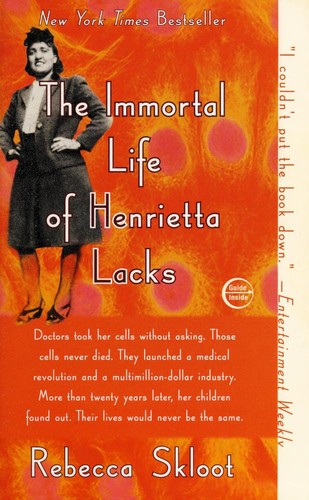
The Immortal Life of Henrietta Lacks
by Rebecca Skloot
★ Top 10 book of 2010 · #8 on Best Books of 2010
Henrietta Lacks's cells, taken without her knowledge in 1951, became a cornerstone of medical research while she and her family remained overlooked. The book explores the ethics, race, and science tied to her legacy and her descendants' struggles.
Best for: Readers curious about medical history, bioethics, and the human stories behind scientific breakthroughs
The Immortal Life of Henrietta Lacks is #8 on BookWard's Best Books of 2010, out of 43 2010 books that cleared our data bar.
What The Immortal Life of Henrietta Lacks is about
In 1951, cells were taken from a woman named Henrietta Lacks without her knowledge. Those cells, known to researchers as HeLa, went on to help bring about the polio vaccine, cloning, gene mapping and in vitro fertilization. They have been traded by the billions. Yet Lacks herself, a poor Black tobacco farmer, is barely known, and her own family has struggled to afford health insurance.
Rebecca Skloot follows the trail from the segregated ward of Johns Hopkins Hospital in the 1950s to Lacks's hometown of Clover, Virginia, and on to East Baltimore today. Along the way she places one family's story inside the wider history of experiments carried out on African Americans and the rise of bioethics. At its heart is Lacks's daughter, who has spent her life wanting to know the mother she never met. A warm, probing read for anyone curious about medicine, consent and who benefits from scientific progress.
The Immortal Life of Henrietta Lacks on the Best Books of 2010
The Immortal Life of Henrietta Lacks came out in 2010. Of the 43 books first published in 2010 that met BookWard's data bar, it ranks #8 on our Best Books of 2010 list.
Why it made the list: 701 readers have shelved it on Open Library; readers rate it 4.2 out of 5 (49 ratings); 40 are reading it right now. The list ranks each year’s books on how many readers have picked them up, how highly readers rate them, and how many are reading them right now.
Nearby on the 2010 list
- The Red Pyramid Rick Riordan, #6
- The Immortals of Meluha Amish Tripathi, #7
- Mockingjay Suzanne Collins, #9
- The Compound Effect Darren Hardy, #10
See all Best Books of 2010 Best books by year
More years: Best Books of 2009 Best Books of 2011.
The numbers behind it
- Readers: 582 want to read it, 40 are reading it now and 78 have read it, according to Open Library.
- Ratings: 4.2 out of 5 from 49 Open Library ratings.
| Signal | This book (0 to 100) | Weight |
|---|---|---|
| Reach | 74 | 55% |
| Reader love | 77 | 25% |
| Being read right now | 72 | 20% |
Questions about The Immortal Life of Henrietta Lacks
When was The Immortal Life of Henrietta Lacks published?
The Immortal Life of Henrietta Lacks by Rebecca Skloot was first published in 2010.
Was The Immortal Life of Henrietta Lacks one of the best books of 2010?
The Immortal Life of Henrietta Lacks is #8 on BookWard's Best Books of 2010, out of 43 2010 books that cleared our data bar. 701 readers have shelved it on Open Library; readers rate it 4.2 out of 5 (49 ratings); 40 are reading it right now.
Why is The Immortal Life of Henrietta Lacks on the Best Books of 2010 list?
701 readers have shelved it on Open Library; readers rate it 4.2 out of 5 (49 ratings); 40 are reading it right now.
More of the best books of 2010
- The Lost Hero Rick Riordan, #1
- The Way of Kings Brandon Sanderson, #2
- Divergent Veronica Roth, #3
- The Personal MBA Josh Kaufman, #4
- It's Not Summer Without You Jenny Han, #5
- The Red Pyramid Rick Riordan, #6
See the full Best Books of 2010, the Top 100, or new books on Rising.
How we know
This page uses public data: Open Library reader counts and ratings, and Wikipedia page views for recent years. The description is paraphrased from real source text. Rankings reflect reading interest, not quality or sales, and can be affected by data gaps. Lists update monthly.
Best for adult and older teen readers who can handle serious themes.
Depends on the edition you pick.
A cell line changed medicine; the woman behind it was forgotten. 65% taste match
 BookWard’s take
A cell line changed medicine; the woman behind it was forgotten
Rebecca Skloot follows the HeLa cells taken from Henrietta Lacks in 1951 and the family left to wonder who she was. It is narrative nonfiction that reads like a story: the opening hooks at once, and the pace stays brisk across hospitals, laboratories, and a Virginia hometown. It holds up on rigor, too, since the science, law, and history are laid out in scene rather than lectured, which is the better way to teach this kind of material. The characters are the draw, especially the daughter who spends years chasing a mother she never knew. The book also earns its moral ambiguity, leaving questions of consent, race, and ownership open instead of preaching a verdict. It stays fairly controlled throughout, though it can lean toward the emotional.
A full-length narrative nonfiction work that covers science, family, and law, so it runs longer than BookWard's taste for tight books.
It moves briskly between hospital, laboratory, and family scenes, close to BookWard's fast preference.
Pairing a medical-history investigation with a family's search for answers is a distinctive approach, in line with BookWard.
The writing is clear and plain, in service of the story, close to BookWard's lean preference.
The drive comes from the family's search for the woman behind the cells, leaning character-driven like BookWard.
It balances injustice and neglect against hints of recognition and understanding, sitting mid-scale and a bit darker than BookWard.
It weaves past and present tracks together, a little more varied than a conventional narrative, near BookWard's middle position.
The subject is serious and humor is rare, so it sits far from BookWard's lighter preference.
The subject includes exploitation and illness, a little darker than BookWard's mid-point.
The family's loss and search carry real feeling, slightly more intense than BookWard's preference.
See all 50 dialsEvery position, side by side with this book
Where it lines up
- OriginalityBookWard 9 · book 9
- PaceBookWard 8 · book 7
- Character depthBookWard 8 · book 9
Where it pulls apart
- LengthBookWard 1 · book 6
- OpeningBookWard 10 · book 8
- Familiar tropesBookWard 10 · book 8
A full-length narrative nonfiction work that covers science, family, and law, so it runs longer than BookWard's taste for tight books.
It avoids the standard science-triumph story by centering a forgotten woman and her family, which BookWard values.
The book builds its account of the cells, the labs, and the legal fights in a clear, traceable order, close to BookWard's standard.
It moves briskly between hospital, laboratory, and family scenes, close to BookWard's fast preference.
Pairing a medical-history investigation with a family's search for answers is a distinctive approach, in line with BookWard.
Henrietta's daughter and wider family are drawn with real depth, matching what BookWard looks for in character.
It touches real feeling around the family, but mostly keeps a measured tone, a touch warmer than BookWard's restraint.
The dark episodes come from documented history and serve the story rather than shocking for effect, which BookWard respects.
It rests on research into the science, the law, and the history of experimentation, close to BookWard's rigor bar.
Skloot's personal investigation gives the book a recognizable voice, in line with BookWard's taste.
The ideas about consent and ownership are carried by a story of people, so it sits more story-led than ideas-led, near BookWard.
Science and ethics are mostly shown through scenes and encounters rather than explained at length, which BookWard prefers.
The mix of lab history and family search keeps momentum steady throughout, near BookWard's preference.
The writing is clear and plain, in service of the story, close to BookWard's lean preference.
The drive comes from the family's search for the woman behind the cells, leaning character-driven like BookWard.
It balances injustice and neglect against hints of recognition and understanding, sitting mid-scale and a bit darker than BookWard.
It weaves past and present tracks together, a little more varied than a conventional narrative, near BookWard's middle position.
The subject is serious and humor is rare, so it sits far from BookWard's lighter preference.
It is accessible to general readers despite the science, matching BookWard's easy-to-moderate preference.
The story draws on the author, the family, scientists, and doctors, giving it many viewpoints, matching BookWard.
It moves between the 1950s and the present, so the timeline shifts more than linear, near BookWard's middle position.
It is entirely grounded in real events, more so than BookWard's mid-point.
Family members, doctors, and scientists make for a wide cast, a bit larger than BookWard's preference.
It stretches across decades and a field of science but stays anchored in one family, so it sits slightly above BookWard's middle.
The book balances the family's inner struggles with outward events like lab history, leaning slightly inward like BookWard.
Conversations with family and researchers appear regularly but do not dominate, a bit lighter than BookWard's preference.
Romance is not a feature of the story, below BookWard's mid-point.
Medical labs and a Virginia hometown are new territory for many readers, close to BookWard's unfamiliar-leaning taste.
It spans the 1950s through the early 2000s, leaning slightly past rather than present, near BookWard.
Questions about consent, race, and medicine keep it relevant, matching BookWard's staying-power taste.
The author narrates her own investigation openly, so she reads as reliable, far from BookWard's unreliable-leaning preference.
It leaves questions of ownership and consent open to argument rather than giving a verdict, matching BookWard.
Scenes of hospitals, labs, and homes are drawn with fair detail, a touch richer than BookWard's middle.
It reads as narrative nonfiction rather than analysis, more story-first than BookWard's mid-point.
The author appears in the book as she pursues the story, giving it a personal perspective, more than BookWard's middle.
It stands alone, matching BookWard's standalone-leaning preference.
Revelations about the cells and the family arrive along the way, somewhat fewer than BookWard's taste.
It raises uncomfortable questions about race, medicine, and ownership of the body, matching BookWard.
The subject includes exploitation and illness, a little darker than BookWard's mid-point.
The family's loss and search carry real feeling, slightly more intense than BookWard's preference.
Humor is rare and subdued, on the dry side of BookWard's middle.
Violence is not a feature, though medical and historical abuses are described, below BookWard's mid-point.
Sexual content is minimal, below BookWard's mid-point.
Race, medicine, and bioethics sit close to the center of the book, more political than BookWard's middle.
The language is accessible, plain, with voices of family members rendered as spoken, close to BookWard's mid-point.
The author does take positions on the ethical issues but mostly lets facts and people carry the story, near BookWard.
It looks back to the origin of the cells while raising questions for the future, near BookWard's middle.
It argues for recognition and fairness without naivety, sitting in BookWard's slightly idealistic range.
Review written by BookWard, dial version 1, November 2026.
Who is The Immortal Life of Henrietta Lacks right for?
Best for adult and older teen readers who can handle serious themes. It deals with medical exploitation, racism, illness, and death.
It is accessible to general readers despite the science, matching BookWard's easy-to-moderate preference.
The subject includes exploitation and illness, a little darker than BookWard's mid-point.
The family's loss and search carry real feeling, slightly more intense than BookWard's preference.
Violence is not a feature, though medical and historical abuses are described, below BookWard's mid-point.
Book CompanionThe Immortal Life of Henrietta Lacks: ideas, characters, themes
The cells of Henrietta Lacks, taken without her knowledge in 1951, became a pillar of modern medicine, while she and her family were left unrecognized.
- The cells taken in 1951. Henrietta Lacks, a poor Black tobacco farmer, had her cells taken without her knowledge, and they became known as HeLa.
- A medical tool used worldwide. HeLa cells helped develop the polio vaccine, cloning, gene mapping, and in vitro fertilization.
- Bought and sold by the billions. The cells were traded as a commodity while Henrietta remained virtually unknown and her family could not afford health insurance.
- A family searching for answers. Her daughter is consumed with questions about the mother she never knew, giving the book its emotional core.
- Ethics, race, and ownership. The book links the story to the history of experimentation on African Americans, the birth of bioethics, and legal battles over who controls the body's materials.
Characters
Henrietta Lacks
The woman whose cells became HeLa
A poor Black tobacco farmer whose cells were taken without her knowledge in 1951.
Rebecca Skloot
Author and investigator
The writer who follows the story from laboratories to Henrietta's family.
Henrietta's daughter
The family's seeker of answers
She is consumed with questions about the mother she never knew.
Themes
Who has the right to decide what happens to a person's body and its materials.
How the history of experimentation on African Americans shapes the story.
Whether people control the stuff they are made of once it leaves them.
How a person can shape the world yet remain unknown to it.
How descendants carry and search for the story of those who came before.
Discussion questions
- Should Henrietta's cells have been taken without her knowledge, and does the answer change with the era?
- How does the book balance scientific achievement against what the family endured?
- Why do you think the author keeps herself in the story as she investigates?
- Who should benefit when a person's cells become valuable to medicine?
- What does the daughter's search say about how families live with a legacy they did not choose?
Personalize your Book Companion
This is the general edition. In BookWard, the Companion is written for you: your reading profile, your notes, and spoiler-safe to the page you are on.
Buy, listen or borrow The Immortal Life of Henrietta Lacks
Each link opens a search for this book on that store, in a new tab.
Read on a device
Borrow
Reviews and community
If you liked The Immortal Life of Henrietta Lacks
A child's illness becomes a study of two worlds colliding
FlashlightSusan ChoiA family wrecked by one night on a breakwater
EvictedMatthew DesmondEight Milwaukee households, and the profit made from their rent
Tomorrow, and Tomorrow, and TomorrowGabrielle ZevinA thirty-year friendship told through the games two people build
Find your own best books
Add what you have read, rate it, and BookWard will recommend what to read next.
Free to start. No credit card needed.