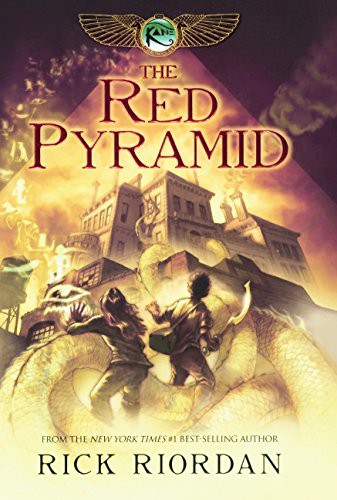
The Red Pyramid
by Rick Riordan
★ Top 10 book of 2010 · #6 on Best Books of 2010
After their mother's death, siblings Carter and Sadie have drifted apart, until their Egyptologist father's British Museum experiment frees the god Set. Then the pair race across the globe to stop Set and uncover their family's ties to an ancient secret order.
Best for: Readers who like Egyptian mythology adventures with siblings on a global quest
The Red Pyramid is #6 on BookWard's Best Books of 2010, out of 43 2010 books that cleared our data bar.
What The Red Pyramid is about
Since their mother died, Carter and Sadie Kane have drifted apart. Sadie has grown up with their grandparents in London, while Carter has crisscrossed the globe with their father, the Egyptologist Dr. Julius Kane. When he gathers them at the British Museum for a so-called research experiment, things go badly wrong. The Egyptian god Set is set loose, their father is sent into oblivion, and the siblings have to run. Egypt's gods are waking up, and Set, the most dangerous of them, has fixed on the Kane family. Carter and Sadie set off across the world to stop him, and along the way they learn what their family has really been part of: a secret order dating back to the pharaohs. Rick Riordan keeps the tone quick and funny, and the story suits young readers who like myth, magic and sibling banter.
The Red Pyramid on the Best Books of 2010
The Red Pyramid came out in 2010. Of the 43 books first published in 2010 that met BookWard's data bar, it ranks #6 on our Best Books of 2010 list.
Why it made the list: 739 readers have shelved it on Open Library; readers rate it 4.2 out of 5 (53 ratings); 49 are reading it right now. The list ranks each year’s books on how many readers have picked them up, how highly readers rate them, and how many are reading them right now.
Nearby on the 2010 list
- The Personal MBA Josh Kaufman, #4
- It's Not Summer Without You Jenny Han, #5
- The Immortals of Meluha Amish Tripathi, #7
- The Immortal Life of Henrietta Lacks Rebecca Skloot, #8
See all Best Books of 2010 Best books by year
More years: Best Books of 2009 Best Books of 2011.
The numbers behind it
- Readers: 567 want to read it, 49 are reading it now and 123 have read it, according to Open Library.
- Ratings: 4.2 out of 5 from 53 Open Library ratings.
| Signal | This book (0 to 100) | Weight |
|---|---|---|
| Reach | 77 | 55% |
| Reader love | 79 | 25% |
| Being read right now | 77 | 20% |
Questions about The Red Pyramid
When was The Red Pyramid published?
The Red Pyramid by Rick Riordan was first published in 2010.
Was The Red Pyramid one of the best books of 2010?
The Red Pyramid is #6 on BookWard's Best Books of 2010, out of 43 2010 books that cleared our data bar. 739 readers have shelved it on Open Library; readers rate it 4.2 out of 5 (53 ratings); 49 are reading it right now.
Why is The Red Pyramid on the Best Books of 2010 list?
739 readers have shelved it on Open Library; readers rate it 4.2 out of 5 (53 ratings); 49 are reading it right now.
More of the best books of 2010
- The Lost Hero Rick Riordan, #1
- The Way of Kings Brandon Sanderson, #2
- Divergent Veronica Roth, #3
- The Personal MBA Josh Kaufman, #4
- It's Not Summer Without You Jenny Han, #5
- The Immortals of Meluha Amish Tripathi, #7
See the full Best Books of 2010, the Top 100, or new books on Rising.
How we know
This page uses public data: Open Library reader counts and ratings, and Wikipedia page views for recent years. The description is paraphrased from real source text. Rankings reflect reading interest, not quality or sales, and can be affected by data gaps. Lists update monthly.
It suits upper middle-grade and young teen readers who enjoy mythology and humor.
Depends on the edition you pick.
Egyptian gods wake up and a London sibling pair runs. 52% taste match
 BookWard’s take
Egyptian gods wake up and a London sibling pair runs
The Red Pyramid is a quick, adventure-first middle-grade fantasy in which Carter and Sadie Kane flee across the globe after their father's experiment at the British Museum unleashes the god Set. It opens on that night, so the hook is immediate, and the pace stays brisk. The two siblings narrate in alternating voices, which gives it a lively sense of perspective and a distinct narrative personality, along with plenty of humor. Familiar tropes are part of the deal here: a chosen-kid quest, secret orders, and mythology repackaged for a modern reader. If you prize originality and deep characterization over well-worn tropes, expect fun rather than depth. It is easy to read, with exposition that often explains the myths outright, and it is the start of a series.
Chases, escapes and travel keep it moving quickly, matching BookWard's preference for speed.
Egyptian myth in a modern setting is a fresh angle, though the overall adventure framework is familiar.
The prose is plain, conversational and quick, built for clarity rather than ornament.
Events drive the book more than inner change, with the quest dictating what happens next.
Despite loss and danger, the tone leans toward adventure, friendship and the chance to set things right.
It alternates between two narrators, a mild twist on an otherwise conventional adventure structure.
Sibling banter and sarcastic asides make humor a major part of the reading experience.
There is peril, loss and menace, but the tone stays lively and suitable for younger readers.
Grief and family tension add feeling, but the tone stays brisk and playful.
See all 50 dialsEvery position, side by side with this book
Where it lines up
- Story or ideasBookWard 3 · book 3
- OpeningBookWard 10 · book 9
- PaceBookWard 8 · book 9
Where it pulls apart
- Familiar tropesBookWard 10 · book 4
- LengthBookWard 1 · book 5
- Internal logicBookWard 10 · book 6
A museum experiment goes wrong early and sends the siblings running, which matches BookWard's liking for stories that grab you at once.
A quest, a secret order and a pair of chosen kids are well-worn shapes, though the Egyptian setting freshens them.
The mythology runs on its own consistent rules for magic and gods, though it favors fun over strict rigor.
Chases, escapes and travel keep it moving quickly, matching BookWard's preference for speed.
Egyptian myth in a modern setting is a fresh angle, though the overall adventure framework is familiar.
Carter and Sadie have distinct personalities and a family wound, but the story favors momentum over deep interiority.
The central threat is answered, though the book is built to lead into more, so it resolves less fully than BookWard prefers.
The siblings' grief over their mother is present but handled with jokes and action rather than heavy sentiment.
The danger is real and the stakes are high, and the darker moments serve the plot rather than existing for effect.
This is a novel, so the nonfiction rigor dial does not apply.
Two sibling narrators with sharply different attitudes give the book a strong, recognizable voice.
The book is firmly story-led, using Egyptian myth as the engine of an adventure rather than as a vehicle for argument.
The myths and rules of magic are often explained outright by the narrators, far from BookWard's preference for showing in scene.
The travel-and-quest structure keeps new locations and threats coming, so the middle stays energetic.
The prose is plain, conversational and quick, built for clarity rather than ornament.
Events drive the book more than inner change, with the quest dictating what happens next.
Despite loss and danger, the tone leans toward adventure, friendship and the chance to set things right.
It alternates between two narrators, a mild twist on an otherwise conventional adventure structure.
Sibling banter and sarcastic asides make humor a major part of the reading experience.
It reads easily and is aimed at younger readers, so it asks little effort.
The story is told by two siblings, giving it more than one perspective but not a wide spread.
The story moves forward in a largely linear way, following the siblings from the museum onward.
Gods, magic and mythic creatures are central, placing the book at the fantastical end.
The siblings anchor the book, supported by a fair number of gods, allies and enemies.
The threat of a waking pantheon of gods and a worldwide chase gives it a large canvas.
Action, travel and confrontation dominate over reflection.
Banter between the siblings and exchanges with gods and guides make dialogue a prominent feature.
Romance is not a focus; the story centers on family and the quest.
Ancient Egyptian mythology set against a modern world offers a setting that is fresh to many readers.
It is set in the present day, with ancient myth intruding on modern life.
Myth gives it durable appeal, though its breezy modern voice ties it somewhat to its era.
The sibling narrators speak plainly about events and generally can be taken at their word.
Heroes and villains are fairly clearly drawn, with Set cast as the clear threat.
Locations and mythic beings are described vividly but briefly, in service of the action.
This is a novel, so the nonfiction style dial does not apply.
This is a novel, so the nonfiction perspective dial does not apply.
It opens a series of Kane Chronicles adventures and is built to continue.
Revelations about the family's past and the gods keep surprises coming at a steady clip.
It is a comfortable, entertaining read that does not push the reader hard.
There is peril, loss and menace, but the tone stays lively and suitable for younger readers.
Grief and family tension add feeling, but the tone stays brisk and playful.
The jokes are sarcastic and broad, fitting a teen sibling voice.
Magical battles and dangerous confrontations occur, kept at an age-appropriate level.
Sexual content is essentially absent from this younger-audience book.
Political themes are not a feature of this myth-driven adventure.
The language is plain and accessible throughout.
The narrators are opinionated and quick with commentary on people and events.
It reaches back to ancient myth but concerns itself with what the siblings do next.
Family, loyalty and courage are treated as worth fighting for.
Review written by BookWard, dial version 1, November 2026.
Who is The Red Pyramid right for?
It suits upper middle-grade and young teen readers who enjoy mythology and humor. It includes peril, magical combat and a parent's loss, handled in an age-appropriate way.
It reads easily and is aimed at younger readers, so it asks little effort.
There is peril, loss and menace, but the tone stays lively and suitable for younger readers.
Grief and family tension add feeling, but the tone stays brisk and playful.
Magical battles and dangerous confrontations occur, kept at an age-appropriate level.
Book CompanionThe Red Pyramid: ideas, characters, themes
Two estranged siblings must learn to work together when their father's experiment frees the Egyptian god Set and drags them into an ancient magical order.
- The opening experiment. Their father brings Carter and Sadie to the British Museum for a research experiment that goes badly wrong.
- A family reunited by crisis. The siblings have lived apart since their mother's death, and the danger forces them back together.
- Gods awaken. They learn that the gods of Egypt are waking, and that Set is the worst of them.
- A journey across the globe. The quest takes them to many places as they chase the truth about their family.
- A secret order. They discover links between their family and an order that has existed since the time of the pharaohs.
Characters
Carter Kane
Co-narrator and elder sibling
He has traveled the world with his father, Dr. Julius Kane.
Sadie Kane
Co-narrator and younger sibling
She has lived with her grandparents in London.
Dr. Julius Kane
Their father
A brilliant Egyptologist whose experiment sets events in motion.
Set
Antagonist
The Egyptian god unleashed at the museum, who has his sights on the Kanes.
Themes
How grief and distance can be repaired through shared danger.
Ancient gods intruding on present-day life.
The shadow of their mother's death over the siblings.
What a family's hidden past passes on to its children.
Two very different people learning to rely on each other.
Discussion questions
- How do Carter and Sadie's different upbringings shape the way they see the world?
- What does the story gain from having two narrators?
- Why might ancient myth work well in a modern setting?
- How does the siblings' grief shape what they do?
- Which parts of the quest felt familiar, and which felt new?
Personalize your Book Companion
This is the general edition. In BookWard, the Companion is written for you: your reading profile, your notes, and spoiler-safe to the page you are on.
Buy, listen or borrow The Red Pyramid
Each link opens a search for this book on that store, in a new tab.
Read on a device
Borrow
Reviews and community
If you liked The Red Pyramid
Two wisecracking siblings race to wake a sleeping sun god
The Lost HeroRick RiordanA fast, funny mythology adventure that opens with an amnesiac hero
Aru Shah and the End of TimeRoshani ChokshiA fib lights a lamp and frees a demon
The Sword of SummerRick RiordanNorse myth meets a homeless Boston teen, fast and funny
Find your own best books
Add what you have read, rate it, and BookWard will recommend what to read next.
Free to start. No credit card needed.