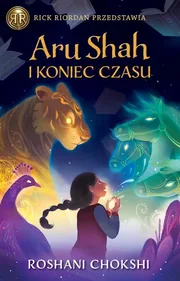
Aru Shah and the End of Time
by Roshani Chokshi, Roshani Chokshi · 2017
It suits middle-grade readers and anyone who enjoys myth-based adventure.
368 pages, about 6 to 8.5 hours.
A fib lights a lamp and frees a demon. 54% taste match
The story
Aru Shah and the End of Time is a middle-grade fantasy adventure by Roshani Chokshi, first published in 2017 and the opening book of the Pandava Quintet. It was released under the Rick Riordan Presents imprint and runs to about 368 pages. The story draws on Hindu mythology and the epic poem the Mahabharata, blending supernatural action with a contemporary school setting.
Aru Shah is twelve years old and lives in the Museum of Ancient Indian Art and Culture, where her mother works as an archaeologist. Aru tends to bend the truth to impress her classmates. When three of them challenge her claim that a lamp in the museum is cursed, she lights it, and a demon known as the Sleeper is set loose. Her mother and schoolmates are frozen in time, and Aru must seek out the reincarnations of the five Pandava brothers and travel through the Kingdom of Death to set things right. Honesty, curses and blessings, and demons all figure in the plot. The book suits readers of children's fantasy who enjoy myth-based quests and stories that begin in an everyday, familiar place.
The problem with growing up around highly dangerous things is that after a while you just get used to them.
Characters
Aru Shah
Setting
India
Themes
HonestyAction & AdventureBlessing and cursingAntiquitiesFantasy & MagicMuseumsSupernaturalAsian
- Want to read 76
- Reading now 9
- Read 13
Most people shelving it are saving it for later.
Of 98 readers who put it on a shelf, 78% want to read it, 9% are reading it now, 13% have finished it and 0% stopped before the end.
By the numbers
- The median edition runs 368 pages. Counting about 275 words a page and an adult reading pace of 250 words a minute, that is about 6.7 hours of reading.
- Open Library tracks 24 editions from 16 publishers, the earliest dated 2017 and the latest 2022, across 5 languages.
- On reader demand it ranks in the top 10% of the recent books in our catalog (6,647 of them).
- Libraries shelve it under Dewey 741.5 and Library of Congress class PZ-0007.00000000.C54 A.
 BookWard’s take
A fib lights a lamp and frees a demon
This is a quick, funny, myth-soaked quest that starts in a museum and ends up in the Kingdom of Death. The opening is a strong one: Aru's lie, the lamp and the frozen classmates arrive early, and the story barely pauses for breath. The pace stays brisk, and the tone leans funny, with a twelve-year-old narrator in Spider-Man pajamas puncturing the grandeur. The chosen-child quest is a well-worn shape, so it leans on familiar tropes, though the Mahabharata material makes it feel fresher than the structure suggests. It reads easily and the darkness is gentle, so it will feel lighter than the books I usually reach for, but the energy and the clear stakes make it a smooth, rewarding ride. It opens the Pandava Quintet.
At 368 pages it is a mid-length middle-grade novel, longer than BookWard's tight ideal but brisk for its genre.
The action moves quickly from museum to Kingdom of Death, matching BookWard's taste for speed.
Drawing on the Mahabharata gives it a fresher footing than much Western-leaning middle-grade fantasy.
The writing is clear and playful rather than ornate, built to be read quickly.
Events and quest steps drive things, though Aru's flaws shape the choices she makes.
It is an optimistic adventure about a kid rising to meet a world-sized problem.
The journey follows a conventional quest line with no formal experiments.
Humor runs throughout, from Aru's Spider-Man pajamas to her fibs and quips.
Demons and death appear but are handled gently for a middle-grade audience.
Feelings about belonging and her mother run warm but not overwhelming.
See all 50 dialsEvery position, side by side with this book
Where it lines up
- PaceBookWard 8 · book 8
- Story or ideasBookWard 3 · book 3
- OpeningBookWard 10 · book 9
Where it pulls apart
- Familiar tropesBookWard 10 · book 5
- Internal logicBookWard 10 · book 6
- LengthBookWard 1 · book 4
At 368 pages it is a mid-length middle-grade novel, longer than BookWard's tight ideal but brisk for its genre.
Aru's lie and the cursed lamp set the plot moving almost at once, which is exactly what BookWard wants from an opening.
A chosen-child quest has a familiar shape, though the Hindu mythology keeps it from feeling stock, a middling fit for BookWard.
The magic and the reincarnated Pandava premise follow clear rules for a children's fantasy, though not airtight.
The action moves quickly from museum to Kingdom of Death, matching BookWard's taste for speed.
Drawing on the Mahabharata gives it a fresher footing than much Western-leaning middle-grade fantasy.
Aru's habit of stretching the truth gives her real texture, though the wider cast is drawn lighter.
It resolves its main threat while leaving room for the next book in the series.
It carries warmth and a clear moral about honesty, leaning somewhat sentimental compared with BookWard's restraint.
Its dangers feel earned by the story and pitched gently for young readers, never shock for its own sake.
Not applicable to a work of fiction.
Aru's wry, self-aware narration gives the book a distinct comic personality.
This is firmly story-led, driven by quest and adventure rather than argument.
Myth and backstory get explained along the way, as middle-grade fantasy often does, a bit more than BookWard prefers.
The quest structure keeps new challenges coming, so momentum mostly holds through the middle.
The writing is clear and playful rather than ornate, built to be read quickly.
Events and quest steps drive things, though Aru's flaws shape the choices she makes.
It is an optimistic adventure about a kid rising to meet a world-sized problem.
The journey follows a conventional quest line with no formal experiments.
Humor runs throughout, from Aru's Spider-Man pajamas to her fibs and quips.
It is an easy, accessible read aimed at middle-grade readers.
The story follows Aru's perspective, keeping the viewpoint tight and single.
The story moves forward in a straight line from lamp-lighting to the quest.
Gods, demons and the Kingdom of Death make this thoroughly fantastical, though it begins in a museum.
Aru, her classmates, the Pandava reincarnations and mythic figures make for a moderately sized cast.
The stakes grow from a school dare to the fate of the world, giving it an epic reach.
Action and quest events dominate, with Aru's thoughts a lighter thread.
Banter between Aru and her companions carries a fair share of the story.
Romance plays no real part in this middle-grade adventure.
A mythic realm drawn from Hindu epic sits beside a familiar modern setting, mixing known and unfamiliar.
It is set in the present day, in a contemporary school and museum.
Rooted in the ancient Mahabharata, the story has lasting appeal, though its voice is distinctly modern.
Aru lies, but the narration itself is straightforward and trustworthy about events.
The lesson about honesty and consequence is clear and sincerely held.
Mythic places and creatures get vivid, colorful treatment without slowing the pace.
Not applicable to a work of fiction.
Not applicable to a work of fiction.
It opens the Pandava Quintet, so it is a first volume in a longer run.
Reveals about identity and the Pandava link keep surprises coming at a moderate clip.
It is a comfortable, confidence-building read pitched at younger readers.
Demons and death appear but are handled gently for a middle-grade audience.
Feelings about belonging and her mother run warm but not overwhelming.
The jokes lean broad and playful, aimed squarely at young readers.
There is fantasy peril and confrontation, kept light and age-appropriate.
No sexual content appears in this children's novel.
Politics is essentially absent from this adventure.
The language is plain and fully accessible to its young audience.
Aru's narration is full of attitude, opinion and wisecracks.
It reaches back to ancient myth while staying anchored in a modern-day story.
It leans idealistic, trusting courage and honesty to carry a kid through.
Review written by BookWard, dial version 1, November 2026.
Who is Aru Shah and the End of Time right for?
It suits middle-grade readers and anyone who enjoys myth-based adventure. It includes demons, a frozen mother and fantasy peril, all handled in a light, age-appropriate way.
It is an easy, accessible read aimed at middle-grade readers.
Demons and death appear but are handled gently for a middle-grade audience.
Feelings about belonging and her mother run warm but not overwhelming.
There is fantasy peril and confrontation, kept light and age-appropriate.
Book CompanionAru Shah and the End of Time: ideas, characters, themes
A girl who lies to fit in lights a cursed lamp and must find the Pandava reincarnations to undo the harm.
- The Lie That Starts It. Aru's habit of stretching the truth to impress classmates leads her to light the Lamp of Bharata.
- The Sleeper Unleashed. Lighting the lamp frees a demon whose duty is to awaken the God of Destruction.
- Frozen in Time. Her classmates and her mother are frozen, which raises the stakes into something personal.
- Finding the Pandavas. Aru must find the reincarnations of the five legendary Pandava brothers from the Mahabharata.
- Through the Kingdom of Death. The quest takes her into a mythic realm far from her museum home.
Characters
Aru Shah
Protagonist
A twelve-year-old who lives in the museum and bends the truth to fit in.
The Sleeper
Antagonist
An ancient demon freed by the lamp, tied to awakening the God of Destruction.
Aru's mother
Frozen loved one
An archaeologist away on a trip whose safety drives Aru's quest.
Themes
Lying has real consequences and truth matters, even when it is hard.
Aru's fibs come from wanting to fit in with her classmates.
The story connects a modern kid to the Hindu epic tradition.
Aru must face and fix the harm her choice caused.
An ordinary girl steps up to face a cosmic threat.
Discussion questions
- Why does Aru feel she has to stretch the truth, and what would you do in her place?
- How does lighting the lamp change the meaning of a small lie?
- What does the story gain by using the Mahabharata as its mythic backbone?
- How does Aru grow from the start of the book to the end?
- Which parts of the quest felt most surprising, and why?
Personalize your Book Companion
This is the general edition. In BookWard, the Companion is written for you: your reading profile, your notes, and spoiler-safe to the page you are on.
Buy, listen or borrow Aru Shah and the End of Time
Each link opens a search for this book on that store, in a new tab.
Read on a device
Borrow
Reviews and community
If you liked Aru Shah and the End of Time
Two wisecracking siblings race to wake a sleeping sun god
The Sea of MonstersRick RiordanA brisk, funny quest that mostly delivers on its promise
The Lightning ThiefRick RiordanA fast, funny Greek-myth quest that hooks in chapter one
Wrath of the Triple GoddessRick RiordanPercy house-sits for a goddess, and the pets escape
Sources: Open Library.
Track Aru Shah and the End of Time and find your next favorite
Add it to your shelf, rate what you have read, and BookWard will recommend what fits you.
Free to start. No credit card needed.