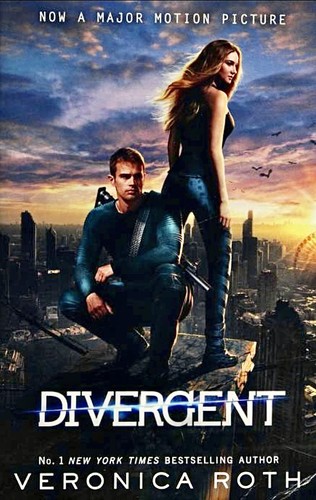
Divergent
by Veronica Roth
★ Top 5 book of 2010 · #3 on Best Books of 2010
The first in a dystopian trilogy, this fast-moving story is told by Tris, a determined heroine. It mixes action, romance, humour and brutal moments, with short chapters that make it easy to read in bursts.
Best for: Young adult readers who like quick, action-packed dystopian stories with romance
Divergent is #3 on BookWard's Best Books of 2010, out of 43 2010 books that cleared our data bar.
What Divergent is about
In a future Chicago, society is divided into five factions, each defining its members by temperament and values. Beatrice Prior, who later goes by Tris, is born into Abnegation but transfers into Dauntless. There she faces an initiation that includes some brutal scenes, and she keeps a dangerous secret: she is Divergent, meaning her nature does not fit a single faction. If the leaders of Erudite and Dauntless discover this, Divergent people are in danger of being killed.
Tris tells the story herself, in short chapters that keep the pace quick and tense. It is the first of a trilogy with Insurgent and Allegiant, and the related book Four offers Tobias's perspective. It was also made into a movie in 2014. Readers who enjoy dystopian stories about choosing who you are, rather than who you are told to be, will find a lot here.
Divergent on the Best Books of 2010
Divergent came out in 2010. Of the 43 books first published in 2010 that met BookWard's data bar, it ranks #3 on our Best Books of 2010 list.
Why it made the list: 2,194 readers have shelved it on Open Library; readers rate it 4 out of 5 (217 ratings); 122 are reading it right now. The list ranks each year’s books on how many readers have picked them up, how highly readers rate them, and how many are reading them right now.
It earns Being read right now.
Nearby on the 2010 list
- The Lost Hero Rick Riordan, #1
- The Way of Kings Brandon Sanderson, #2
- The Personal MBA Josh Kaufman, #4
- It's Not Summer Without You Jenny Han, #5
See all Best Books of 2010 Best books by year
More years: Best Books of 2009 Best Books of 2011.
The numbers behind it
- Readers: 1,704 want to read it, 122 are reading it now and 368 have read it, according to Open Library.
- Ratings: 4 out of 5 from 217 Open Library ratings.
| Signal | This book (0 to 100) | Weight |
|---|---|---|
| Reach | 98 | 55% |
| Reader love | 58 | 25% |
| Being read right now | 98 | 20% |
Questions about Divergent
When was Divergent published?
Divergent by Veronica Roth was first published in 2010.
Was Divergent one of the best books of 2010?
Divergent is #3 on BookWard's Best Books of 2010, out of 43 2010 books that cleared our data bar. 2,194 readers have shelved it on Open Library; readers rate it 4 out of 5 (217 ratings); 122 are reading it right now.
Why is Divergent on the Best Books of 2010 list?
2,194 readers have shelved it on Open Library; readers rate it 4 out of 5 (217 ratings); 122 are reading it right now.
More of the best books of 2010
- The Lost Hero Rick Riordan, #1
- The Way of Kings Brandon Sanderson, #2
- The Personal MBA Josh Kaufman, #4
- It's Not Summer Without You Jenny Han, #5
- The Red Pyramid Rick Riordan, #6
- The Immortals of Meluha Amish Tripathi, #7
See the full Best Books of 2010, the Top 100, or new books on Rising.
How we know
This page uses public data: Open Library reader counts and ratings, and Wikipedia page views for recent years. The description is paraphrased from real source text. Rankings reflect reading interest, not quality or sales, and can be affected by data gaps. Lists update monthly.
Best suited to teens and adults who enjoy fast YA dystopias.
Depends on the edition you pick.
A fast YA dystopia where one choice shapes everything. 45% taste match
 BookWard’s take
A fast YA dystopia where one choice shapes everything
Divergent drops Beatrice Prior into a Chicago split into five factions, each built around a single virtue, and asks what happens to someone who doesn't fit one box. It opens strongly: the choosing ceremony arrives early and the book rarely lets up. The pace is quick and the chapters are short, though I push back on how familiar it all feels, since the chosen-one-in-a-sorted-society frame is well worn. The internal logic is looser than I'd like; the faction system is easier to enjoy than to believe. Tris is decently drawn, a heroine who doubts herself and grows, and the romance runs alongside the action. The violence is real during initiation. It is a propulsive, readable start to a trilogy, more satisfying as a ride than as worldbuilding.
A mid-length YA novel built from short chapters; BookWard prefers tighter, though it moves briskly enough.
Short chapters and steady action keep it moving, which matches BookWard's liking for speed.
The faction concept has a hook of its own, but the shape of the story is well trodden.
Plain, functional sentences that favor momentum over ornament, near BookWard's lean preference.
Plot drives it, with Tris's inner growth running alongside rather than leading.
Grim stakes and real losses, with a thread of resilience that keeps it from tipping bleak.
Told straight through in one voice and one timeline, with no structural experiment.
Mostly serious, with occasional lighter moments among the recruits.
Real brutality and loss appear, within a YA frame that stays contained.
Fear, loyalty and attachment are felt strongly, sometimes at high intensity.
See all 50 dialsEvery position, side by side with this book
Where it lines up
- PaceBookWard 8 · book 8
- Story or ideasBookWard 3 · book 4
- OpeningBookWard 10 · book 8
Where it pulls apart
- Familiar tropesBookWard 10 · book 3
- Internal logicBookWard 10 · book 4
- OriginalityBookWard 9 · book 4
A mid-length YA novel built from short chapters; BookWard prefers tighter, though it moves briskly enough.
The faction choice puts the central question in front of you early, close to BookWard's taste for immediate grip.
A chosen outsider in a sorted dystopia is familiar YA ground, short of the freshness BookWard wants.
The five-faction premise is easier to enjoy than to believe, and BookWard wants tighter rules.
Short chapters and steady action keep it moving, which matches BookWard's liking for speed.
The faction concept has a hook of its own, but the shape of the story is well trodden.
Tris is drawn with self-doubt and growth, though supporting characters lean toward their factions' types.
It resolves its main conflict while clearly setting up the next book, so closure is partial.
Romance and loyalty are played fairly openly, warmer than BookWard's restrained preference.
The brutal initiation scenes serve the story but also lean on intensity for effect.
A clear, accessible first-person voice with a recognisable YA register rather than a standout one.
Story-led: the ideas about identity and virtue are carried by plot and action.
The faction system is explained to the reader fairly directly, more than BookWard likes.
Training sequences run on a little, but the stakes keep the middle from drifting badly.
Plain, functional sentences that favor momentum over ornament, near BookWard's lean preference.
Plot drives it, with Tris's inner growth running alongside rather than leading.
Grim stakes and real losses, with a thread of resilience that keeps it from tipping bleak.
Told straight through in one voice and one timeline, with no structural experiment.
Mostly serious, with occasional lighter moments among the recruits.
Easy to read in short chapters, lighter than BookWard's slightly demanding middle.
A single narrator, Tris, carries the whole book.
The story moves forward in order without time jumps.
Grounded in a believable near-future Chicago, with the strangeness coming from society rather than magic.
A modest core group of recruits and instructors, a mid-sized cast.
The stakes widen toward the city, but the story stays tied to one girl's journey.
Action and training scenes dominate, with Tris's thoughts as commentary.
Plenty of conversation among recruits drives scenes and relationships.
A romance with a fellow Dauntless member is a notable strand, though not the whole story.
A future setting, so it speaks to present-day ideas without being set in them.
Tied to the early-2010s YA dystopian wave, though its identity themes endure.
Tris tells it straight and plainly, with no sign of hidden agendas in the telling.
Good and bad sides are fairly clear, with the troubling factions easy to read.
Scenes are described clearly enough to picture, without lingering over detail.
Opens a trilogy and ends with the larger story clearly still unresolved.
Revelations about the factions and Tris's nature land at a steady clip.
Gentle ideas about conformity, delivered in an entertaining, accessible way.
Real brutality and loss appear, within a YA frame that stays contained.
Fear, loyalty and attachment are felt strongly, sometimes at high intensity.
What humor there is stays light and situational.
Initiation involves genuine physical violence and combat on the page.
Romance stays chaste and low-key, with little sexual content.
A society-wide system of control sits at the centre, but the book does not preach.
Plain contemporary language that anyone can follow.
Tris's perspective colours the telling, with fairly clear leanings on faction ideology.
Set in the future and pushing toward changing that world.
Tris's drive to be braver and more honest points toward a hopeful ideal.
Review written by BookWard, dial version 1, November 2026.
Who is Divergent right for?
Best suited to teens and adults who enjoy fast YA dystopias. It contains brutal scenes, especially during initiation, and themes of violence and control.
Easy to read in short chapters, lighter than BookWard's slightly demanding middle.
Real brutality and loss appear, within a YA frame that stays contained.
Fear, loyalty and attachment are felt strongly, sometimes at high intensity.
Initiation involves genuine physical violence and combat on the page.
Book CompanionDivergent: ideas, characters, themes
A teenager in a society that sorts people by a single virtue discovers she doesn't fit any one faction, and that this makes her dangerous.
- A society sorted by virtue. The city is divided into five factions, each built around a single quality, and members are defined by that affiliation.
- The choosing moment. Beatrice Prior must decide where she belongs, a choice that shapes her whole life and sets the story in motion.
- Initiation as a trial. After she transfers into Dauntless, training becomes the testing ground for her courage and resolve.
- Divergence as a secret. Tris learns her nature includes aspects of all five factions, which marks her as a threat that must stay hidden.
- A trilogy opener. The book sets up a larger conflict that continues in Insurgent and Allegiant.
Characters
Beatrice (Tris) Prior
Narrator and protagonist
Born into Abnegation, she transfers to Dauntless and must hide that she is Divergent.
Tobias (Four)
Love interest
A male character who becomes central to Tris's story and later gets his own perspective in companion stories.
Themes
Who you are versus the box a society puts you in.
What a system gains and loses by sorting everyone into types.
What bravery costs and what it demands of a person.
How one decision can define a life, and whether it should.
How a society trades independent will for the promise of order.
Discussion questions
- Which faction would you choose, and why?
- Is Tris's self-doubt a weakness or part of what makes her strong?
- Does sorting people by one virtue make a society safer or more dangerous?
- How does the initiation test what the factions really value?
- What would it mean to belong to no single group?
Personalize your Book Companion
This is the general edition. In BookWard, the Companion is written for you: your reading profile, your notes, and spoiler-safe to the page you are on.
Buy, listen or borrow Divergent
Each link opens a search for this book on that store, in a new tab.
Read on a device
Borrow
Reviews and community
If you liked Divergent
A fast, factional war story that trades hooks for sequel stakes
The Darkest MindsAlexandra BrackenA fast YA dystopia with a hooked-in-chapter-one premise
Red QueenVictoria AveyardA Red girl, a Silver crown, and a rebellion brewing
Glass SwordVictoria AveyardFast, bloody YA sequel where Mare builds a rebel army
Find your own best books
Add what you have read, rate it, and BookWard will recommend what to read next.
Free to start. No credit card needed.