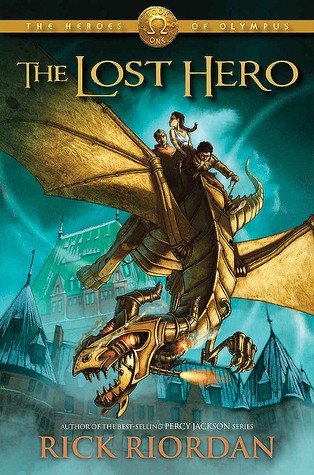
The Lost Hero
by Rick Riordan
★ Most-read book of 2010 · #1 on Best Books of 2010
Jason wakes on a school bus with no memory, beside a girlfriend he cannot recall. Along with Piper and Leo, he is swept to Camp Half-Blood, where monsters, a curse and a missing camper await.
Best for: Middle-grade and young readers who love mythology-flavoured adventure and monsters
The Lost Hero is #1 on BookWard's Best Books of 2010, out of 43 2010 books that cleared our data bar.
What The Lost Hero is about
Jason Grace wakes on a school bus with no memory of who he is, sitting between two near strangers, Piper McLean and Leo Valdez. On a field trip to the Grand Canyon, a classmate turns into a storm spirit and attacks, and their teacher Coach Hedge turns out to be a satyr. Annabeth Chase brings the three to Camp Half-Blood, where each learns which god is their parent. They are soon sent on a quest to rescue Hera, while enemies take orders from Gaea, the goddess of the Earth.
The story opens a new series that follows the Percy Jackson books. Piper also carries a private worry: her father has gone missing, and her nightmares show him in danger. Readers who enjoy mythology, friendship, and a lively, funny adventure will feel at home here.
The Lost Hero on the Best Books of 2010
The Lost Hero came out in 2010. Of the 43 books first published in 2010 that met BookWard's data bar, it ranks #1 on our Best Books of 2010 list.
Why it made the list: 2,458 readers have shelved it on Open Library; readers rate it 4.4 out of 5 (174 ratings); 187 are reading it right now. The list ranks each year’s books on how many readers have picked them up, how highly readers rate them, and how many are reading them right now.
It earns Most-read of 2010 and reader favorite and being read right now.
Nearby on the 2010 list
- The Way of Kings Brandon Sanderson, #2
- Divergent Veronica Roth, #3
See all Best Books of 2010 Best books by year
More years: Best Books of 2009 Best Books of 2011.
The numbers behind it
- Readers: 1,874 want to read it, 187 are reading it now and 395 have read it, according to Open Library.
- Ratings: 4.4 out of 5 from 174 Open Library ratings.
| Signal | This book (0 to 100) | Weight |
|---|---|---|
| Reach | 100 | 55% |
| Reader love | 98 | 25% |
| Being read right now | 100 | 20% |
Questions about The Lost Hero
When was The Lost Hero published?
The Lost Hero by Rick Riordan was first published in 2010.
Was The Lost Hero one of the best books of 2010?
The Lost Hero is #1 on BookWard's Best Books of 2010, out of 43 2010 books that cleared our data bar. 2,458 readers have shelved it on Open Library; readers rate it 4.4 out of 5 (174 ratings); 187 are reading it right now.
Why is The Lost Hero on the Best Books of 2010 list?
2,458 readers have shelved it on Open Library; readers rate it 4.4 out of 5 (174 ratings); 187 are reading it right now.
More of the best books of 2010
- The Way of Kings Brandon Sanderson, #2
- Divergent Veronica Roth, #3
- The Personal MBA Josh Kaufman, #4
- It's Not Summer Without You Jenny Han, #5
- The Red Pyramid Rick Riordan, #6
- The Immortals of Meluha Amish Tripathi, #7
See the full Best Books of 2010, the Top 100, or new books on Rising.
How we know
This page uses public data: Open Library reader counts and ratings, and Wikipedia page views for recent years. The description is paraphrased from real source text. Rankings reflect reading interest, not quality or sales, and can be affected by data gaps. Lists update monthly.
It suits middle grade readers and up who enjoy fast fantasy and mythology.
Depends on the edition you pick.
A fast, funny mythology adventure that opens with an amnesiac hero. 55% taste match
 BookWard’s take
A fast, funny mythology adventure that opens with an amnesiac hero
The Lost Hero drops Jason Grace onto a school bus with no memory, then keeps moving. The hook is its strongest suit: a field trip, a storm spirit and a satyr coach in trouble all arrive within the first chapters. The pace stays high and the middle rarely sags, though some action sequences run long. Originality is mixed. The Greco-Roman setting is well worn, but the amnesia setup and the rotating third-person viewpoints of Jason, Piper and Leo give it a fresh shape. The tone is light and funny, and the familiar tropes are all present (chosen kids, a quest, a camp), while the reading effort stays low. It rewards a taste for momentum far more than a taste for restraint or for stories that sidestep their genre's habits.
A mid-length middle grade adventure, not tight and not sprawling; BookWard prefers shorter, so it sits a little off taste.
Chases, fights and reveals keep it moving quickly, close to BookWard's fast-paced preference.
Greek and Roman myth in a modern setting is familiar ground, lifted by the amnesia setup and rotating heroes.
Plain, clear, middle grade prose with little ornament, a bit plainer than BookWard's middle.
Events and quest structure drive the book more than inner change, leaning plot-driven.
Friendship and courage win out over the threats, giving a mostly hopeful outlook.
A conventional quest structure, with only the shifting viewpoints adding variety.
Wisecracks and Leo's humor keep the tone light and often funny.
Monsters and danger are present but handled for a young audience.
Loss, guilt and loyalty land with moderate feeling, not overwhelming intensity.
See all 50 dialsEvery position, side by side with this book
Where it lines up
- PaceBookWard 8 · book 8
- Story or ideasBookWard 3 · book 3
- OpeningBookWard 10 · book 9
Where it pulls apart
- Familiar tropesBookWard 10 · book 4
- LengthBookWard 1 · book 5
- Internal logicBookWard 10 · book 6
A mid-length middle grade adventure, not tight and not sprawling; BookWard prefers shorter, so it sits a little off taste.
A bus, a lost memory and a storm spirit attack arrive almost immediately, which matches BookWard's love of instant hooks.
Chosen demigods, a camp and a quest lean on familiar fantasy tropes, short of BookWard's tropes-avoided preference.
The mythology and powers follow workable rules, though the plot leans on convenience at moments.
Chases, fights and reveals keep it moving quickly, close to BookWard's fast-paced preference.
Greek and Roman myth in a modern setting is familiar ground, lifted by the amnesia setup and rotating heroes.
Jason, Piper and Leo each carry a secret or wound, though they stay within middle grade types.
The book resolves its main quest while clearly setting up the next volume, so closure is partial.
Warmth and friendship are present but kept light rather than syrupy.
Dangers and reveals are there for stakes, with modest darkness suited to young readers.
Riordan's breezy, jokey narration is recognizable, though less sharply individual than BookWard prefers.
This is story-led, built on quests and encounters, which is where BookWard also sits.
Mythology and camp rules get explained fairly directly to orient the reader, more than BookWard likes.
Quest stops and set pieces keep the middle active, though some action scenes stretch.
Plain, clear, middle grade prose with little ornament, a bit plainer than BookWard's middle.
Events and quest structure drive the book more than inner change, leaning plot-driven.
Friendship and courage win out over the threats, giving a mostly hopeful outlook.
A conventional quest structure, with only the shifting viewpoints adding variety.
Wisecracks and Leo's humor keep the tone light and often funny.
Easy to read at speed, with clear stakes and plain language.
Third-person narration rotates among Jason, Piper and Leo, a first for this series.
The story moves forward chronologically, with Jason's lost past as the only gap.
Gods, monsters, satyrs and flying chariots make this fully fantastical.
Three leads plus a camp full of demigods, satyrs and gods make a fairly large cast.
A personal quest set against a cosmic threat from Gaea gives it a wider-than-intimate scale.
Action, quests and fights dominate over reflection.
Banter among the leads and gods carries a good share of the scenes.
Piper and Jason's relationship is a thread, not the core of the story.
A hidden mythological camp is unfamiliar to the characters and fresh to new readers.
A contemporary setting, with school buses and field trips, anchors the myth in the present.
Myth gives it staying power, though the style is tied to its era of middle grade fantasy.
A straightforward third-person narrator, with no sign of unreliability beyond Jason's lost memory.
Heroes and villains are fairly clearly drawn, with little moral ambiguity.
Settings are sketched efficiently, with attention going to action over lush detail.
The first book in The Heroes of Olympus, and a sequel series to Percy Jackson.
Hidden parentage, memory mysteries and reveals keep surprises frequent.
It's a comfortable, entertaining read that doesn't push the reader hard.
Monsters and danger are present but handled for a young audience.
Loss, guilt and loyalty land with moderate feeling, not overwhelming intensity.
Jokes lean broad and playful, with some dry moments.
Monster fights and battles occur regularly, in a kid-friendly register.
Essentially absent, apart from light crush and romance elements.
Divine and camp politics matter to the plot, but real-world politics don't appear.
Plain, accessible language throughout.
The narration has some attitude and humor but mostly stays with the characters.
A prophecy-driven quest for the future, grounded in ancient myth.
Loyalty, friendship and bravery are treated as worth fighting for.
Review written by BookWard, dial version 1, November 2026.
Who is The Lost Hero right for?
It suits middle grade readers and up who enjoy fast fantasy and mythology. It contains monster fights and some peril, plus themes of grief and a parent's death, all handled gently.
Easy to read at speed, with clear stakes and plain language.
Monsters and danger are present but handled for a young audience.
Loss, guilt and loyalty land with moderate feeling, not overwhelming intensity.
Monster fights and battles occur regularly, in a kid-friendly register.
Book CompanionThe Lost Hero: ideas, characters, themes
Three young demigods with scrambled pasts must rescue the queen of the gods from an ancient earth-goddess.
- A hero with no past. Jason wakes with no memory, so the reader learns the world as he does.
- Three viewpoints. The narration rotates among Jason, Piper and Leo, widening the story beyond a single hero.
- Camp Half-Blood returns. The setting from the earlier Percy Jackson series becomes the base for a new group of demigods.
- A rescue quest. Hera is held captive by Gaea, and the trio is sent to free her.
- Secrets and guilt. Leo hides his fire power out of grief over his mother's death, a thread that deepens his character.
Characters
Jason Grace
Amnesiac son of Zeus
He wakes with no memory but surprising powers, and is marked as Hera's champion.
Piper McLean
Daughter of Aphrodite
She carries the worry of her missing father while her supposed boyfriend doesn't know her.
Leo Valdez
Son of Hephaestus
A gifted tinkerer who can conjure fire and hides it out of guilt.
Annabeth Chase
Camp Half-Blood demigod
She arrives to rescue the trio, hoping to find her missing boyfriend Percy.
Themes
Who you are when you cannot remember who you were.
Trust built between three kids thrown together by chance.
Leo's hidden fire and his mother's death show how loss shapes behavior.
Being claimed by a god parent changes how each kid sees themselves.
Accepting a quest you did not ask for.
Discussion questions
- How does Jason's memory loss change the way you read the opening?
- Why might Leo hide his fire ability, and was that a good choice?
- What does splitting the story among three viewpoints add compared with a single narrator?
- Which myth elements felt fresh, and which felt familiar?
- How does this book stand apart from the Percy Jackson series it follows?
Personalize your Book Companion
This is the general edition. In BookWard, the Companion is written for you: your reading profile, your notes, and spoiler-safe to the page you are on.
Buy, listen or borrow The Lost Hero
Each link opens a search for this book on that store, in a new tab.
Read on a device
Borrow
Reviews and community
If you liked The Lost Hero
Egyptian gods wake up and a London sibling pair runs
The Throne of FireRick RiordanTwo wisecracking siblings race to wake a sleeping sun god
Artemis Fowl and the Arctic IncidentEoin ColferA fast, clever fairy-crime caper with a frozen Russian heist
The Wild ZoneRick RiordanA night run through forbidden woods at Camp Half-Blood
Find your own best books
Add what you have read, rate it, and BookWard will recommend what to read next.
Free to start. No credit card needed.