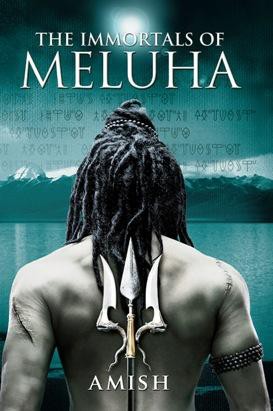
The Immortals of Meluha
by Amish Tripathi
★ Top 10 book of 2010 · #7 on Best Books of 2010
Set in 1900 BC in the land of Meluha, an empire founded by Lord Ram, this novel shows the Suryavanshis facing a dying river and terrorist attacks. Tibetan immigrant Shiva may be the hero of legend, but will he accept that destiny?
Best for: Readers who enjoy ancient-India settings and tales of legendary heroes and destiny
The Immortals of Meluha is #7 on BookWard's Best Books of 2010, out of 43 2010 books that cleared our data bar.
What The Immortals of Meluha is about
The land of Meluha is a near perfect empire, founded centuries earlier by Lord Ram and ruled by the Suryavanshis. But its great river, the Saraswati, is drying to extinction, and enemies called the Chandravanshis, allied with the cursed Nagas, keep attacking. Into this troubled place comes Shiva, chief of the Guna tribe in Tibet, who accepts King Daksha's invitation to bring his people to a better future.
After Shiva's throat turns blue, the Meluhans proclaim him their fabled saviour, the Neelkanth. He also falls in love with Princess Sati, Daksha's daughter, whose status as a Vikarma, an untouchable, complicates everything. Amish Tripathi wrote this as his first novel. It will suit readers who enjoy epic, mythic adventure and Indian mythology reimagined.
The Immortals of Meluha on the Best Books of 2010
The Immortals of Meluha came out in 2010. Of the 43 books first published in 2010 that met BookWard's data bar, it ranks #7 on our Best Books of 2010 list.
Why it made the list: 1,380 readers have shelved it on Open Library; readers rate it 3.8 out of 5 (42 ratings); 112 are reading it right now. The list ranks each year’s books on how many readers have picked them up, how highly readers rate them, and how many are reading them right now.
It earns Being read right now.
Nearby on the 2010 list
- It's Not Summer Without You Jenny Han, #5
- The Red Pyramid Rick Riordan, #6
- The Immortal Life of Henrietta Lacks Rebecca Skloot, #8
- Mockingjay Suzanne Collins, #9
See all Best Books of 2010 Best books by year
More years: Best Books of 2009 Best Books of 2011.
The numbers behind it
- Readers: 1,223 want to read it, 112 are reading it now and 45 have read it, according to Open Library.
- Ratings: 3.8 out of 5 from 42 Open Library ratings.
| Signal | This book (0 to 100) | Weight |
|---|---|---|
| Reach | 93 | 55% |
| Reader love | 19 | 25% |
| Being read right now | 95 | 20% |
Questions about The Immortals of Meluha
When was The Immortals of Meluha published?
The Immortals of Meluha by Amish Tripathi was first published in 2010.
Was The Immortals of Meluha one of the best books of 2010?
The Immortals of Meluha is #7 on BookWard's Best Books of 2010, out of 43 2010 books that cleared our data bar. 1,380 readers have shelved it on Open Library; readers rate it 3.8 out of 5 (42 ratings); 112 are reading it right now.
Why is The Immortals of Meluha on the Best Books of 2010 list?
1,380 readers have shelved it on Open Library; readers rate it 3.8 out of 5 (42 ratings); 112 are reading it right now.
More of the best books of 2010
- The Lost Hero Rick Riordan, #1
- The Way of Kings Brandon Sanderson, #2
- Divergent Veronica Roth, #3
- The Personal MBA Josh Kaufman, #4
- It's Not Summer Without You Jenny Han, #5
- The Red Pyramid Rick Riordan, #6
See the full Best Books of 2010, the Top 100, or new books on Rising.
How we know
This page uses public data: Open Library reader counts and ratings, and Wikipedia page views for recent years. The description is paraphrased from real source text. Rankings reflect reading interest, not quality or sales, and can be affected by data gaps. Lists update monthly.
It suits teens and adults who enjoy fast epic fantasy and Indian mythology.
Depends on the edition you pick.
Shiva as a Tibetan chief, reimagined as myth rooted in history. 45% taste match
 BookWard’s take
Shiva as a Tibetan chief, reimagined as myth rooted in history
Amish Tripathi's debut asks a bold question: what if the gods were once ordinary people whose deeds made them divine? Shiva arrives in Meluha as a tribal chief looking for peace, and the empire declares him its fabled saviour. The premise is the book's real strength, and it is strikingly original, recasting familiar Hindu mythology as a Bronze Age adventure. The hook is strong too, as the story moves quickly from migration to prophecy. Where it works less well for me is in the exposition: ideas about society and destiny are often spoken aloud rather than discovered in scene. The prose stays plain and accessible, and the pace is brisk, though some Indian reviewers noted that the writing loses focus in places. It is also the first of a trilogy, so the ending points onward.
Events move steadily from migration to prophecy to war, close to BookWard's preference for momentum.
Treating gods as once-human figures and setting myth in 1900 BC is a distinctive premise that BookWard values.
The prose is plain and direct, keeping the page easy to move through, close to BookWard's slightly plain leaning.
Plot and Shiva's choices share the load, landing near the middle rather than clearly character-driven.
The story centres on a leader trying to build a better future for his people, leaning hopeful, close to BookWard.
It follows a straightforward, conventional narrative arc, a little more traditional than BookWard's mild lean toward experiment.
The tone is earnest and serious, with little humor, which is more solemn than BookWard's taste.
War, terror attacks and social exclusion give it weight without being relentlessly grim, matching BookWard's middle.
Love, loyalty and duty are played with feeling, landing close to BookWard's moderate intensity.
See all 50 dialsEvery position, side by side with this book
Where it lines up
- PaceBookWard 8 · book 7
- OriginalityBookWard 9 · book 8
- OpeningBookWard 10 · book 8
Where it pulls apart
- LengthBookWard 1 · book 6
- Familiar tropesBookWard 10 · book 5
- Internal logicBookWard 10 · book 6
Shiva's arrival in Meluha and the quick naming of him as the saviour pulls you in early, which suits BookWard well.
A chosen-one prophecy is a familiar frame, though the Bronze Age retelling of myth gives it a fresh angle.
The world and its rules hold together on the whole, though some conveniences fall short of BookWard's airtight standard.
Events move steadily from migration to prophecy to war, close to BookWard's preference for momentum.
Treating gods as once-human figures and setting myth in 1900 BC is a distinctive premise that BookWard values.
Shiva and Sati carry real choices and consequences, though secondary figures lean toward types, a little under BookWard's bar.
As the opening of a trilogy it resolves its own conflict but leaves the larger story open, short of BookWard's full closure.
Romance and destiny are played with open feeling rather than restraint, so it sits on the warmer side for BookWard.
Darkness comes through war and social cruelty, mostly in service of the plot rather than for effect.
This is a novel, so the nonfiction rigor dial does not apply.
The storytelling is clear and accessible but not strongly stamped with a personal style, which falls below BookWard's taste.
It is story-led, but driven by a central idea about gods once being human, sitting a bit more toward ideas than BookWard.
Characters often explain society, rules and philosophy outright, which runs against BookWard's preference for showing in scene.
Some Indian reviewers noted the writing loses focus at points, so the middle is less sustained than BookWard likes.
The prose is plain and direct, keeping the page easy to move through, close to BookWard's slightly plain leaning.
Plot and Shiva's choices share the load, landing near the middle rather than clearly character-driven.
The story centres on a leader trying to build a better future for his people, leaning hopeful, close to BookWard.
It follows a straightforward, conventional narrative arc, a little more traditional than BookWard's mild lean toward experiment.
The tone is earnest and serious, with little humor, which is more solemn than BookWard's taste.
It reads easily despite the mythology and unfamiliar names, an easy read that suits BookWard's moderate effort level.
Events unfold in a linear sequence, more straightforward than BookWard's slight lean toward shifting time.
Myth, prophecy and a cursed race add fantasy, but the setting stays rooted in a historical frame, a bit above BookWard.
Tribes, kings, doctors and warriors make a bigger cast than BookWard's smaller-cast preference.
An empire's survival, a drying river and a looming war make this large in scope, more epic than BookWard.
Action, politics and war lead the story, more outward than BookWard's balanced taste.
Conversation carries much of the worldbuilding and drama, close to BookWard's lean toward dialogue.
Shiva's courtship of Sati is a significant strand of the story, more prominent than BookWard's usual balance.
A Bronze Age empire built on Hindu myth is unfamiliar territory for many readers, in line with BookWard.
It is set around 1900 BC, as far from the present day as a novel gets, unlike BookWard's present-leaning taste.
Its myth-based themes of destiny and choice carry well beyond the moment, near BookWard's staying-power taste.
The narration is straightforward and trustworthy, unlike BookWard's lean toward unreliable narrators.
Meluha is cast as near perfect against its enemies, so the moral lines are fairly clear, less ambiguous than BookWard.
Cities, customs and the empire are described in some detail, a bit richer than BookWard's middle position.
This is a novel, so the nonfiction style dial does not apply.
This is a novel, so the nonfiction perspective dial does not apply.
This is the first of the Shiva Trilogy and of the wider Amishverse, so it sits firmly at the series end.
Prophecy, hidden truths and reversals of allegiance add surprises, near BookWard's taste for them.
The story mostly entertains and affirms, with some questions about caste and destiny, lighter than BookWard's challenge.
War, terror attacks and social exclusion give it weight without being relentlessly grim, matching BookWard's middle.
Love, loyalty and duty are played with feeling, landing close to BookWard's moderate intensity.
Humor is sparse and light, so it sits on the drier side of BookWard's middle position.
War and attacks are part of the plot, sitting somewhat above BookWard's middle position.
The romance is central but the content is restrained, sitting below BookWard's middle position.
Governance, caste and the fate of an empire are central to the plot, above BookWard's middle position.
The language is plain, with unfamiliar names and terms the main hurdle, well below BookWard's middle position.
The story carries a clear point of view on duty, destiny and social rules, close to BookWard.
It looks back to ancient myth while asking how a society might change, near BookWard's middle position.
Shiva's urge to dissolve unjust rules points toward idealism, matching BookWard's lean.
Review written by BookWard, dial version 1, November 2026.
Who is The Immortals of Meluha right for?
It suits teens and adults who enjoy fast epic fantasy and Indian mythology. It contains war, terror attacks and social cruelty, with a romance handled without explicit content.
It reads easily despite the mythology and unfamiliar names, an easy read that suits BookWard's moderate effort level.
War, terror attacks and social exclusion give it weight without being relentlessly grim, matching BookWard's middle.
Love, loyalty and duty are played with feeling, landing close to BookWard's moderate intensity.
War and attacks are part of the plot, sitting somewhat above BookWard's middle position.
Book CompanionThe Immortals of Meluha: ideas, characters, themes
A Tibetan tribal chief, Shiva, is hailed as the saviour of the empire of Meluha and must decide what kind of hero he wants to be.
- A myth set in history. The novel places its story around 1900 BC in a land it calls Meluha, rooted in the idea that gods were once human.
- A near perfect empire in crisis. Meluha was created by Lord Ram, yet its river Saraswati is drying and enemies press in.
- The arrival of Shiva. Shiva leads the Guna tribe from Tibet seeking peace, and his blue throat marks him out.
- The legend of the Neelkanth. The Meluhans believe in a fabled saviour who will appear when evil reaches epic proportions.
- Love and the Vikarma rule. Shiva's bond with Sati challenges a rule that treats people as untouchable for sins of past lives.
Characters
Shiva
Protagonist
Chief of the Guna tribe, declared the Neelkanth by the Meluhans.
Sati
Love interest
Daughter of Daksha and a Vikarma, treated as untouchable.
Daksha
King of Meluha
The ruler who invites the Tibetan tribes to his empire.
Ayurvati
Chief of Medicine
The Meluhan doctor who discovers Shiva's blue throat.
Nandi
Shiva's comrade
A companion who travels with Shiva and stays by his side.
Themes
Whether a person is bound by prophecy or shaped by their own decisions.
The idea that divinity is earned through deeds rather than born.
How a society can label people untouchable and what it costs to challenge that.
The pull between obligations to a people and bonds with an individual.
How a society defines its enemies and whether those lines hold.
Discussion questions
- Does Shiva choose his role as the saviour, or does the prophecy choose him?
- How does the novel's idea that gods were once human change how you read the myth?
- What does the Vikarma rule suggest about fairness in a society that seems perfect?
- Is Meluha as near perfect as its people claim?
- How did the Nagas and Chandravanshis shape your sympathies as the story went on?
Personalize your Book Companion
This is the general edition. In BookWard, the Companion is written for you: your reading profile, your notes, and spoiler-safe to the page you are on.
Buy, listen or borrow The Immortals of Meluha
Each link opens a search for this book on that store, in a new tab.
Read on a device
Borrow
Reviews and community
If you liked The Immortals of Meluha
Shiva's quest for a Naga warrior, wrapped in epic mythological adventure
DragonquestAnne McCaffreyPern's second Threadfall: dragons, politics, and a planet to save
Throne of GlassSarah J. MaasA prison-to-palace assassin contest that moves fast and trades on familiar bones
Siege and StormLeigh BardugoAlina's hidden power meets a bigger, hungrier world in book two
Find your own best books
Add what you have read, rate it, and BookWard will recommend what to read next.
Free to start. No credit card needed.