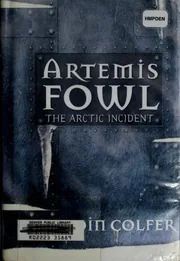
Artemis Fowl and the Arctic Incident
by Eoin Colfer · 2001
This suits confident younger readers and up, roughly the middle-grade to early teen range.
320 pages, about 5 to 7.5 hours.
A fast, clever fairy-crime caper with a frozen Russian heist. 61% taste match
About the book
Artemis Fowl and the Arctic Incident is the second novel in Eoin Colfer's Artemis Fowl series, a children's fantasy that blends magic and fairy folk with elements of science fiction. It was first published in 2001 and follows Artemis Fowl and the Arctic Incident's predecessor, Artemis Fowl, with The Eternity Code coming after it.
The story centres on Artemis Fowl II, a young criminal mastermind who travels to the frozen Russian city of Murmansk. His father, Artemis Fowl Senior, is believed to be held by a ruthless gang of blackmailers, and Artemis sets out to find him. Along the way he relies on some unusual allies and, as ever, a carefully prepared plan. Holly Short, Julius Root, Foaly, Domovoi Butler and Juliet Butler appear among the cast, and the action moves between Murmansk, Ireland, England and Fowl Manor in the present day.
Themes of kidnapping, family loyalty and the bond between fathers and sons and between mothers and sons run through the book, which is narrated in the third person and typically runs to around 320 pages. Many editions have been printed.
THE loss of her husband had had a profound effect on Angeline Fowl.
Characters
Artemis FowlArtemis Fowl IIArtemis Fowl SeniorCaptain Holly ShortDomovoi ButlerFoaly
Setting
MurmanskRussiaIrelandEnglandFowl Manor
Themes
SecuestroMothers and sonsKidnappingMagicMagiaPadre e hijosFairiesFathers and sons
- Want to read 123
- Reading now 8
- Read 52
Most people shelving it are saving it for later.
Of 183 readers who put it on a shelf, 67% want to read it, 4% are reading it now, 28% have finished it and 0% stopped before the end.
By the numbers
- The median edition runs 320 pages. Counting about 275 words a page and an adult reading pace of 250 words a minute, that is about 5.9 hours of reading.
- Open Library tracks 50 editions from 42 publishers, the earliest dated 2001 and the latest 2020, across 8 languages.
- On reader demand it ranks in the top 5% of the modern books in our catalog (15,152 of them).
- Libraries shelve it under Dewey [Fic] and Library of Congress class PR-6103.00000000.O445 A78 2002.
 BookWard’s take
A fast, clever fairy-crime caper with a frozen Russian heist
The Arctic Incident is a sequel that moves, and I like that about it. It takes Artemis Fowl II, a twelve-year-old criminal mastermind, to Murmansk in search of his father, and it keeps the plans coming. The pace is quick and the hook is strong: the stakes are set early and the chapters rarely idle. The internal logic is a real strength, since Artemis's schemes and the fairy technology are built to click together. Where I part company with it is the sentiment and the familiar tropes. The family reunion thread is warmer than I would choose, and the genre furniture is easy to recognise. Still, as a series entry that is simple to enter and quick to finish, it delivers exactly what it promises, with a good dose of dry wit.
At around 320 pages it is compact for a fantasy adventure, though not as lean as BookWard's strongest preference.
Action moves between Murmansk, Ireland, England and Fowl Manor at a brisk clip, close to BookWard's own fast preference.
Fairies mixed with high-tech crime and a villainous-leaning hero feel distinctive, if built on well-worn fantasy ground.
The language is clear and brisk, built for momentum rather than ornament.
Events and schemes carry the book, with character growth running as a lighter undercurrent.
Cleverness, loyalty and family bonds win out, leaving a mostly upbeat outlook despite the peril.
The book follows a conventional adventure shape, with the third-person narration shifting between characters.
Artemis's cool arrogance and the fairy characters' banter keep the tone lively and often funny.
See all 50 dialsEvery position, side by side with this book
Where it lines up
- EndingBookWard 8 · book 8
- Story or ideasBookWard 3 · book 3
- PaceBookWard 8 · book 9
Where it pulls apart
- Familiar tropesBookWard 10 · book 5
- LengthBookWard 1 · book 3
- OpeningBookWard 10 · book 8
At around 320 pages it is compact for a fantasy adventure, though not as lean as BookWard's strongest preference.
The search for Artemis's father gives the story momentum from the start, which suits BookWard's love of an immediate pull.
Fairy folk, goblin trouble and a child genius are familiar ingredients, though the criminal-mastermind lead freshens them somewhat.
Artemis's plans and the fairy technology are built to interlock, which is the kind of tight cause and effect BookWard rewards.
Action moves between Murmansk, Ireland, England and Fowl Manor at a brisk clip, close to BookWard's own fast preference.
Fairies mixed with high-tech crime and a villainous-leaning hero feel distinctive, if built on well-worn fantasy ground.
Artemis and Holly Short are sharply drawn for the genre, though they are defined more by function than by inner depth.
The central rescue storyline resolves cleanly, which fits BookWard's liking for conclusions that actually conclude.
The father and son and mother and son threads bring real warmth, a bit softer than BookWard's restrained taste.
Danger and darkness serve the plot rather than existing for effect, which BookWard appreciates.
The wry, confident narration has a recognisable personality without being wholly unlike other comic adventure writers.
This is firmly story-led, driven by schemes, chases and rescues rather than by an argument or idea.
Some fairy-world background gets explained outright, though plenty also comes through action, landing in the middle of the range.
The multi-location plot keeps escalating, so the middle holds up well for a book written for younger readers.
The language is clear and brisk, built for momentum rather than ornament.
Events and schemes carry the book, with character growth running as a lighter undercurrent.
Cleverness, loyalty and family bonds win out, leaving a mostly upbeat outlook despite the peril.
The book follows a conventional adventure shape, with the third-person narration shifting between characters.
Artemis's cool arrogance and the fairy characters' banter keep the tone lively and often funny.
Written for young readers, it is an easy, accessible read that never asks much patience.
Third-person narration switches back and forth between characters, so the reader sees more than any one of them does.
Fairies and magic sit alongside technology, so the world is clearly fantastical.
Artemis, the Butlers, Holly Short, Foaly and Julius Root make a mid-sized ensemble that stays manageable.
The stakes are personal, a rescued father, though the fairy world gives the plot a broader backdrop.
The emphasis is on plans, journeys and confrontations rather than extended inner reflection.
Conversation and banter carry a good share of the story, balanced with action.
Romance plays no real part; family ties are the emotional core.
A hidden fairy civilisation set against Russia and Ireland gives an unfamiliar setting to explore.
The story is set in the present day, with technology to match.
Its caper formula and family core should wear well, though the tech gloss ties it somewhat to its era.
The third-person narrator is straightforward, with no sign of unreliability.
Artemis is a crook and the story leans toward clear sides, though his loyalties are not purely tidy.
Descriptions serve the action, with the icy Murmansk setting adding colour but not dominating.
Review written by BookWard, dial version 1, November 2026.
Who is Artemis Fowl and the Arctic Incident right for?
This suits confident younger readers and up, roughly the middle-grade to early teen range. It contains kidnapping, peril and some action violence, but nothing graphic.
Written for young readers, it is an easy, accessible read that never asks much patience.
Book CompanionArtemis Fowl and the Arctic Incident: ideas, characters, themes
A teenage-genius criminal travels to frozen Murmansk to find his captive father, backed by unlikely fairy allies and an elaborate plan.
- A rescue mission. Artemis travels to Murmansk because he believes his father is held by a ruthless blackmailing gang.
- Unusual allies. Artemis does not work alone; he relies on companions who would normally be on the other side.
- Plans within plans. Part of the fun is watching a carefully prepared scheme meet the unpredictable.
- Fairy meets technology. Magic and high-tech science fiction share the same world, giving gadgets a fantastical edge.
- Second in a series. The book follows Artemis Fowl and leads into The Eternity Code, so earlier events inform the setup.
Characters
Artemis Fowl II
Young criminal mastermind
A twelve-year-old planner who travels to Murmansk in search of his father.
Holly Short
Fairy captain
A fairy officer whose path crosses Artemis's in the story.
Domovoi Butler
Artemis's bodyguard
The loyal protector who stays close to Artemis.
Foaly
Fairy ally
Part of the fairy cast, tied to the story's technology and strategy.
Juliet Butler
Butler family member
Appears among the supporting cast alongside Domovoi.
Themes
The pull of father, mother and son bonds drives the central rescue.
Plans and wits matter as much as muscle in solving problems.
Former rivals can become partners when the situation demands it.
A hostage plot sets the stakes and shapes the characters' choices.
Discussion questions
- How far would you go to rescue a family member, and does Artemis go too far?
- Is Artemis a hero, a villain, or something in between?
- What makes the unlikely allies work together despite their differences?
- How does mixing magic with technology change the feel of the story?
- Did the plans feel believable, and where would you have done things differently?
Personalize your Book Companion
This is the general edition. In BookWard, the Companion is written for you: your reading profile, your notes, and spoiler-safe to the page you are on.
Buy, listen or borrow Artemis Fowl and the Arctic Incident
Each link opens a search for this book on that store, in a new tab.
Read on a device
Borrow
Reviews and community
If you liked Artemis Fowl and the Arctic Incident
A teenage criminal genius, fairy tech, and a heist with a ticking clock
The Lost HeroRick RiordanA fast, funny mythology adventure that opens with an amnesiac hero
The Wild ZoneRick RiordanA night run through forbidden woods at Camp Half-Blood
The Throne of FireRick RiordanTwo wisecracking siblings race to wake a sleeping sun god
Sources: Open Library.
Track Artemis Fowl and the Arctic Incident and find your next favorite
Add it to your shelf, rate what you have read, and BookWard will recommend what fits you.
Free to start. No credit card needed.