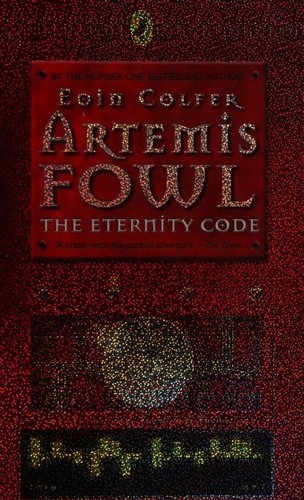
Artemis Fowl and the Eternity Code
by Eoin Colfer
★ Top 25 book of 2003 · #18 on Best Books of 2003
After Artemis uses stolen fairy technology to build a powerful microcomputer, a dangerous American businessman snatches it. Artemis, Juliet, Mulch and the fairies join forces to get it back.
Best for: Young readers who like clever, fast-moving fantasy adventures.
Artemis Fowl and the Eternity Code is #18 on BookWard's Best Books of 2003, out of 52 2003 books that cleared our data bar.
What Artemis Fowl and the Eternity Code is about
Artemis Fowl is thirteen, a criminal mastermind, and rarely the one being outwitted. In this third adventure he has built a supercomputer called the C Cube out of stolen fairy LEPrecon helmets, and it proves to be his undoing. Chicago businessman Jon Spiro ambushes him in London and takes the Cube, and Artemis's loyal bodyguard Butler is shot in the process.
When fairy technology flares up and shuts down equipment in Haven city, Captain Holly Short is sent to London by Commander Root. Soon an uneasy partnership forms between the boy and the fairy world. Butler's sister Juliet and the dwarf Mulch Diggums join a plan to win the Cube back from Spiro's Chicago office, with Foaly the centaur supplying technical know-how. Witty, quick and mischievous, the story weighs cunning against loyalty and asks what technology costs the people who wield it. It suits readers who like their heists clever and their heroes a little morally slippery.
Artemis Fowl and the Eternity Code on the Best Books of 2003
Artemis Fowl and the Eternity Code came out in 2003. Of the 52 books first published in 2003 that met BookWard's data bar, it ranks #18 on our Best Books of 2003 list.
Why it made the list: 334 readers have shelved it on Open Library; readers rate it 4.2 out of 5 (25 ratings). The list ranks each year’s books on how many readers have picked them up, how highly readers rate them, and how many are reading them right now.
Nearby on the 2003 list
- The Five People You Meet in Heaven Mitch Albom, #16
- Women Who Think Too Much Susan Nolen-Hoeksema, #17
- Quattro Topi Nella Giungla Nera Elisabetta Dami, #19
- Oryx and Crake Margaret Atwood, #20
See all Best Books of 2003 Best books by year
More years: Best Books of 2002 Best Books of 2004.
The numbers behind it
- Readers: 246 want to read it, 12 are reading it now and 76 have read it, according to Open Library.
- Ratings: 4.2 out of 5 from 25 Open Library ratings.
| Signal | This book (0 to 100) | Weight |
|---|---|---|
| Reach | 60 | 55% |
| Reader love | 71 | 25% |
| Being read right now | 46 | 20% |
Questions about Artemis Fowl and the Eternity Code
When was Artemis Fowl and the Eternity Code published?
Artemis Fowl and the Eternity Code by Eoin Colfer was first published in 2003.
Was Artemis Fowl and the Eternity Code one of the best books of 2003?
Artemis Fowl and the Eternity Code is #18 on BookWard's Best Books of 2003, out of 52 2003 books that cleared our data bar. 334 readers have shelved it on Open Library; readers rate it 4.2 out of 5 (25 ratings).
Why is Artemis Fowl and the Eternity Code on the Best Books of 2003 list?
334 readers have shelved it on Open Library; readers rate it 4.2 out of 5 (25 ratings).
More of the best books of 2003
- Harry Potter and the Order of the Phoenix J. K. Rowling, #1
- Into the Wild Erin Hunter, #2
- The Kite Runner Khaled Hosseini, #3
- Don't Let the Pigeon Drive the Bus! Mo Willems, #4
- A Short History of Nearly Everything Bill Bryson, #5
- The Da Vinci Code Dan Brown, #6
See the full Best Books of 2003, the Top 100, or new books on Rising.
How we know
This page uses public data: Open Library reader counts and ratings, and Wikipedia page views for recent years. The description is paraphrased from real source text. Rankings reflect reading interest, not quality or sales, and can be affected by data gaps. Lists update monthly.
Best for readers around 9 to 13 who enjoy fast, funny fantasy.
Depends on the edition you pick.
A teenage criminal genius, fairy tech, and a heist with a ticking clock. 65% taste match
 BookWard’s take
A teenage criminal genius, fairy tech, and a heist with a ticking clock
The third Artemis Fowl book starts with its own plan already in motion: Artemis shows off the C Cube, and Jon Spiro promptly outwits him. That reversal is the book's best hook, and the pace stays quick from there. The logic is the real draw. Artemis schemes in layers, and Colfer keeps the rules of fairy magic and technology consistent enough that the heists feel earned rather than convenient. It relies on familiar fairy-tale furniture less than most children's fantasy does, and the comedy comes mainly from Mulch Diggums and Foaly. The hook, the logic and the pace all work well, though the book is tied to its series and lighter on emotional depth than I'd ideally want. Character depth is serviceable rather than deep, though Butler's injury gives the story real stakes.
A brisk children's adventure that stays compact, which sits close to BookWard's preference for tight books.
Heist deadlines and a 48-hour countdown keep scenes moving quickly, matching BookWard's taste for speed.
A criminal-mastermind kid paired with fairy technology is distinctive, though the series framework is established by this third book.
Plain, quick and comic prose in service of the story, not ornate.
Plot machinery drives events more than character change does.
Cleverness and loyalty win through, giving the book a generally upbeat outlook.
A conventional adventure told in order, with cutaways between Artemis and the fairies.
Mulch, Foaly and Artemis's deadpan arrogance supply frequent humour.
Gunplay and a near-fatal injury appear, but the tone stays lighthearted for younger readers.
Feelings surface around Butler's near-death, though the book stays brisk.
See all 50 dialsEvery position, side by side with this book
Where it lines up
- PaceBookWard 8 · book 8
- EndingBookWard 8 · book 8
- Authorial voiceBookWard 9 · book 8
Where it pulls apart
- Familiar tropesBookWard 10 · book 6
- LengthBookWard 1 · book 3
- OpeningBookWard 10 · book 8
A brisk children's adventure that stays compact, which sits close to BookWard's preference for tight books.
Artemis's plan goes wrong almost immediately when Spiro steals the Cube, pulling the reader straight in, as BookWard likes.
Fairy-tech and heist mechanics are fresher than standard fantasy, though the child-genius and gadget-heavy setup is well worn.
Artemis's multi-step schemes and the fairy tech rules hold together tightly, which BookWard rewards.
Heist deadlines and a 48-hour countdown keep scenes moving quickly, matching BookWard's taste for speed.
A criminal-mastermind kid paired with fairy technology is distinctive, though the series framework is established by this third book.
Artemis, Butler and Holly are clearly drawn, but the breezy tone keeps them shallower than BookWard prefers.
Warmth around Butler and Juliet appears, but the book is mostly brisk and wry rather than sentimental.
Butler being shot early gives real stakes that serve the plot rather than existing for effect.
Colfer's wry, jokey narration is recognisable, and BookWard values a distinctive voice.
The story is led by schemes and set pieces, more than by arguments or ideas.
Gadgets and fairy rules get explained in places, though much of it plays out through action and banter.
The heist structure keeps momentum steady, with little slack between set pieces.
Plain, quick and comic prose in service of the story, not ornate.
Plot machinery drives events more than character change does.
Cleverness and loyalty win through, giving the book a generally upbeat outlook.
A conventional adventure told in order, with cutaways between Artemis and the fairies.
Mulch, Foaly and Artemis's deadpan arrogance supply frequent humour.
An easy read aimed at younger readers, with short chapters and clear stakes.
The story shifts between Artemis's camp, the LEP and Spiro's side, giving several vantage points.
Events unfold in a straight line, including a countdown that keeps time simple.
Fairy cities, magic and centaur engineers place it firmly in fantasy, sharing space with modern London and Chicago.
Artemis, Butler, Juliet, Holly, Root, Foaly, Mulch and Spiro's crew make for a moderately sized ensemble.
The stakes are a stolen device and a fairy secret, mid-sized rather than world-ending.
Action and scheming dominate over interior reflection.
Banter and sparring between characters carries much of the humour and plot.
Romance barely registers in a story about heists and rescues.
Underground fairy society and its technology make the setting unfamiliar, set against recognisable cities.
A present-day story with fairy technology layered over modern business and crime.
The adventure is evergreen, though the gadget details date lightly.
A clear third-person narrator with no sign of unreliability.
Artemis is a criminal protagonist, but right and wrong remain fairly legible.
Description is functional and quick, with more attention to gadgets than scenery.
It is the third book in a long series and depends on prior events and characters.
Reversals and counter-schemes run through the heist plotting, which BookWard enjoys.
A comfortable, entertaining read that rarely pushes the reader.
Gunplay and a near-fatal injury appear, but the tone stays lighthearted for younger readers.
Feelings surface around Butler's near-death, though the book stays brisk.
Mostly dry wit and comic characters, with occasional slapstick, giving a middle humour register.
Shootings and scuffles occur, handled in an age-appropriate manner.
No sexual content appears in this children's adventure.
Corporate greed and fairy secrecy are plot devices, not political commentary.
Plain, accessible language with occasional invented fairy terms.
The narrator's wry asides add some attitude without lecturing.
Mostly forward-moving, driven by the next scheme, with gentle ties to the series' past.
Cynical scheming and loyal friendship sit side by side, landing in the middle.
Review written by BookWard, dial version 1, November 2026.
Who is Artemis Fowl and the Eternity Code right for?
Best for readers around 9 to 13 who enjoy fast, funny fantasy. It includes gunplay, a near-fatal injury and some criminal scheming, all treated lightly.
An easy read aimed at younger readers, with short chapters and clear stakes.
Gunplay and a near-fatal injury appear, but the tone stays lighthearted for younger readers.
Feelings surface around Butler's near-death, though the book stays brisk.
Shootings and scuffles occur, handled in an age-appropriate manner.
Book CompanionArtemis Fowl and the Eternity Code: ideas, characters, themes
A teenage criminal mastermind and his fairy rivals race to retrieve a stolen supercomputer built from fairy technology.
- The theft. Artemis's demonstration of the C Cube to Jon Spiro goes wrong when Spiro ambushes him and takes it.
- Butler's injury. Butler is shot, and fairy magic with cryogenics saves him but ages him roughly fifteen years.
- Haven shutdown. The Cube's operation detects fairy technology underground, disrupting equipment in Haven and bringing Holly to London.
- An uneasy alliance. Artemis reveals the Cube to Holly and Foaly, and the fairies and the Fowl household reluctantly cooperate.
- The ticking clock. Commander Root gives 48 hours before sending in Retrieval, forcing Artemis to plan a retrieval from Spiro's Chicago office.
Characters
Artemis Fowl II
Teenage criminal mastermind
A 13-year-old schemer who built the C Cube and must now win it back.
Butler
Artemis's bodyguard
Shot early in the story and revived at a cost to his age.
Holly Short
LEPrecon captain
Sent to London to investigate the disturbance and ends up aiding Artemis.
Jon Spiro
Chicago businessman and antagonist
The man who ambushes Artemis and steals the C Cube.
Mulch Diggums
Dwarf employed by Spiro's mob
Sent to Fowl Manor to break the Cube's Eternity Code.
Themes
Plans and wits repeatedly matter more than strength.
Bonds among Artemis, Butler and Juliet drive the choices.
A device that outstrips human tech becomes valuable and dangerous.
Former enemies must trust each other to get a result.
Both fairy and human worlds depend on keeping their secrets hidden.
Discussion questions
- Is Artemis a hero, a villain, or something in between?
- How does Butler's injury change the stakes for Artemis?
- Why do the fairies agree to help Artemis despite their history?
- What makes a heist plot satisfying, and does this one deliver?
- How does the book use humour alongside real danger?
Personalize your Book Companion
This is the general edition. In BookWard, the Companion is written for you: your reading profile, your notes, and spoiler-safe to the page you are on.
Buy, listen or borrow Artemis Fowl and the Eternity Code
Each link opens a search for this book on that store, in a new tab.
Read on a device
Borrow
Reviews and community
If you liked Artemis Fowl and the Eternity Code
A fast, clever fairy-crime caper with a frozen Russian heist
The Lost HeroRick RiordanA fast, funny mythology adventure that opens with an amnesiac hero
The Red PyramidRick RiordanEgyptian gods wake up and a London sibling pair runs
The Throne of FireRick RiordanTwo wisecracking siblings race to wake a sleeping sun god
Find your own best books
Add what you have read, rate it, and BookWard will recommend what to read next.
Free to start. No credit card needed.