
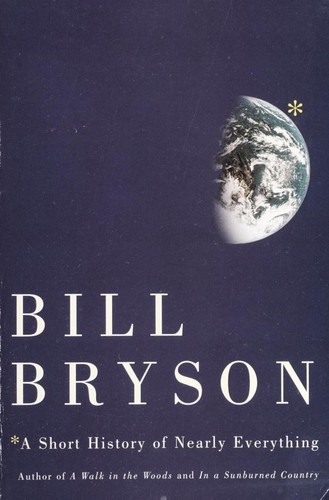
A Short History of Nearly Everything
by Bill Bryson
★ Top 5 book of 2003 · #5 on Best Books of 2003
Bill Bryson's popular science book explains areas of science in easily accessible language that appeals to the general public more than most books on the subject.
Best for: Curious readers who want science explained plainly.
A Short History of Nearly Everything is #5 on BookWard's Best Books of 2003, out of 52 2003 books that cleared our data bar.
What A Short History of Nearly Everything is about
Bill Bryson wrote this book because he was unhappy with how little he knew about the world around him. School science, he felt, never explained the whys, hows and whens, so he set out to find them himself. The result steps away from his travel writing and into science for the general reader, told in plain, easy language.
It starts at the Big Bang and moves through geology, evolution, chemistry, astronomy and particle physics, ending around the discovery of quantum mechanics. Along the way Bryson gives a sense of how vast the universe is and how tiny atoms are, follows life from its first appearance to modern humans, and looks at risks such as meteorite strikes and volcanoes like Krakatoa and Yellowstone. A good share of the book is given to funny stories about the scientists themselves and their odd habits. It suits anyone curious about how the world works who never felt at home in a science class.
A Short History of Nearly Everything on the Best Books of 2003
A Short History of Nearly Everything came out in 2003. Of the 52 books first published in 2003 that met BookWard's data bar, it ranks #5 on our Best Books of 2003 list.
Why it made the list: 1,295 readers have shelved it on Open Library; readers rate it 4.2 out of 5 (101 ratings); 56 are reading it right now. The list ranks each year’s books on how many readers have picked them up, how highly readers rate them, and how many are reading them right now.
Nearby on the 2003 list
- The Kite Runner Khaled Hosseini, #3
- Don't Let the Pigeon Drive the Bus! Mo Willems, #4
- The Da Vinci Code Dan Brown, #6
- The Curious Incident of the Dog in the Night-Time Mark Haddon, #7
See all Best Books of 2003 Best books by year
More years: Best Books of 2002 Best Books of 2004.
The numbers behind it
- Readers: 1,098 want to read it, 56 are reading it now and 141 have read it, according to Open Library.
- Ratings: 4.2 out of 5 from 101 Open Library ratings.
| Signal | This book (0 to 100) | Weight |
|---|---|---|
| Reach | 92 | 55% |
| Reader love | 79 | 25% |
| Being read right now | 88 | 20% |
Questions about A Short History of Nearly Everything
When was A Short History of Nearly Everything published?
A Short History of Nearly Everything by Bill Bryson was first published in 2003.
Was A Short History of Nearly Everything one of the best books of 2003?
A Short History of Nearly Everything is #5 on BookWard's Best Books of 2003, out of 52 2003 books that cleared our data bar. 1,295 readers have shelved it on Open Library; readers rate it 4.2 out of 5 (101 ratings); 56 are reading it right now.
Why is A Short History of Nearly Everything on the Best Books of 2003 list?
1,295 readers have shelved it on Open Library; readers rate it 4.2 out of 5 (101 ratings); 56 are reading it right now.
More of the best books of 2003
- Harry Potter and the Order of the Phoenix J. K. Rowling, #1
- Into the Wild Erin Hunter, #2
- The Kite Runner Khaled Hosseini, #3
- Don't Let the Pigeon Drive the Bus! Mo Willems, #4
- The Da Vinci Code Dan Brown, #6
- The Curious Incident of the Dog in the Night-Time Mark Haddon, #7
See the full Best Books of 2003, the Top 100, or new books on Rising.
How we know
This page uses public data: Open Library reader counts and ratings, and Wikipedia page views for recent years. The description is paraphrased from real source text. Rankings reflect reading interest, not quality or sales, and can be affected by data gaps. Lists update monthly.
Find your own best books
Add what you have read, rate it, and BookWard will recommend what to read next.
Free while in beta. No credit card needed.