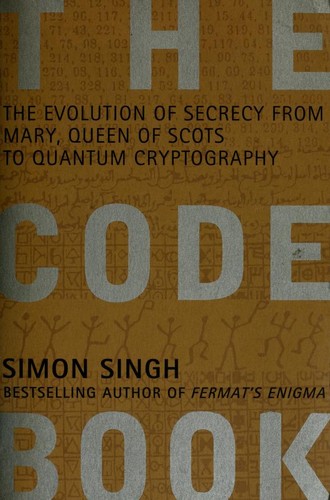
The Code Book
by Simon Singh
★ Top 25 book of 1999 · #14 on Best Books of 1999
Singh traces the story of encryption and how secret codes have shaped wars, nations, and individual lives, from Mary, Queen of Scots to the Navajo Code Talkers. Clear explanations and vivid portraits of codemakers and codebreakers accompany the narrative.
Best for: Curious readers who enjoy history, mathematics, and the hidden world of secrecy
The Code Book is #14 on BookWard's Best Books of 1999, out of 52 1999 books that cleared our data bar.
What The Code Book is about
Simon Singh tells the story of secret writing and its evolution. He shows how codes have shaped wars, governments and ordinary lives. Mary, Queen of Scots is undone by her own cipher, while the Navajo Code Talkers help the Allies in World War II. Singh also explains a surprisingly simple logistical idea that made Internet commerce secure.
He treats secrecy as perhaps the most powerful intellectual weapon ever devised, and he brings in the people who made and broke the hardest codes. The mathematical explanations are clear enough for a curious non-specialist. It will suit anyone who likes history, puzzles or popular science, and anyone who has wondered how private their e-mail really is.
The Code Book on the Best Books of 1999
The Code Book came out in 1999. Of the 52 books first published in 1999 that met BookWard's data bar, it ranks #14 on our Best Books of 1999 list.
Why it made the list: 379 readers have shelved it on Open Library; readers rate it 4.1 out of 5 (44 ratings). The list ranks each year’s books on how many readers have picked them up, how highly readers rate them, and how many are reading them right now.
Nearby on the 1999 list
- Stardust Neil Gaiman, #12
- Artemis Fowl Eoin Colfer, #13
- Monster Walter Dean Myers, #15
- Hearts in Atlantis Stephen King, #16
See all Best Books of 1999 Best books by year
More years: Best Books of 1998 Best Books of 2000.
The numbers behind it
- Readers: 310 want to read it, 13 are reading it now and 56 have read it, according to Open Library.
- Ratings: 4.1 out of 5 from 44 Open Library ratings.
| Signal | This book (0 to 100) | Weight |
|---|---|---|
| Reach | 65 | 55% |
| Reader love | 73 | 25% |
| Being read right now | 56 | 20% |
Questions about The Code Book
When was The Code Book published?
The Code Book by Simon Singh was first published in 1999.
Was The Code Book one of the best books of 1999?
The Code Book is #14 on BookWard's Best Books of 1999, out of 52 1999 books that cleared our data bar. 379 readers have shelved it on Open Library; readers rate it 4.1 out of 5 (44 ratings).
Why is The Code Book on the Best Books of 1999 list?
379 readers have shelved it on Open Library; readers rate it 4.1 out of 5 (44 ratings).
More of the best books of 1999
- Harry Potter and the Prisoner of Azkaban J. K. Rowling, #1
- Wings of Fire A. P. J. Abdul Kalam, #2
- The Perks of Being a Wallflower Stephen Chbosky, #3
- On Writing Stephen King, #4
- The Bad Beginning Lemony Snicket, #5
- The Coldest Winter Ever Sister Souljah, #6
See the full Best Books of 1999, the Top 100, or new books on Rising.
How we know
This page uses public data: Open Library reader counts and ratings, and Wikipedia page views for recent years. The description is paraphrased from real source text. Rankings reflect reading interest, not quality or sales, and can be affected by data gaps. Lists update monthly.
Suits curious teens and adults who enjoy history and puzzles, with no need for advanced mathematics.
Depends on the edition you pick.
A history of secret writing that makes the mathematics approachable. 58% taste match
 BookWard’s take
A history of secret writing that makes the mathematics approachable
Simon Singh follows codemakers and codebreakers from Mary, Queen of Scots to the Navajo Code Talkers to the idea that secured Internet commerce. What pulls you through is how well he turns hard mathematics into story. He explains things outright rather than leaving readers to puzzle them out, which is a choice I don't usually favor, though here the explanations earn their place. The rigor is high, and the book is driven by ideas, carried along by a run of vivid personalities. Singh's voice is distinctive and confident, and the middle never sags, because each chapter hands a new problem to the next. The reading is moderately demanding: the technical passages ask for attention but never lock out a patient reader. It is a clear, rewarding tour of why secrecy has shaped history.
Short episodes and a steady supply of new puzzles keep it moving, slowing only when the mathematics needs space.
The subject is well covered, but linking cryptography to wars, nations and online commerce gives it a distinctive shape.
The language is clear and unadorned, built to explain rather than to dazzle.
A chain of ideas and breakthroughs drives it more than any single person's inner life.
It balances grim wartime stakes with the triumph of human ingenuity, landing mildly positive.
A conventional historical march from early ciphers to the digital age, with no formal experiment.
The tone is engaged and serious, with only occasional lightness.
Wartime stakes and political executions bring some seriousness, but the tone stays measured.
The feeling is intellectual excitement more than heavy emotion.
See all 50 dialsEvery position, side by side with this book
Where it lines up
- SentimentBookWard 8 · book 8
- Internal logicBookWard 10 · book 9
- EndingBookWard 8 · book 7
Where it pulls apart
- LengthBookWard 1 · book 6
- ExpositionBookWard 2 · book 9
- Story or ideasBookWard 3 · book 8
It opens on the stakes of secrecy and a doomed queen's cipher, which pulls a reader in quickly, close to BookWard's preference.
Codes and wartime secrets could be well-worn ground, but the focus on method and mathematics keeps the telling fresh.
Each cipher and each break is explained step by step, so the reasoning holds together, matching BookWard's liking for airtight logic.
Short episodes and a steady supply of new puzzles keep it moving, slowing only when the mathematics needs space.
The subject is well covered, but linking cryptography to wars, nations and online commerce gives it a distinctive shape.
The codemakers and codebreakers are vivid portraits, though the book is organised around ideas rather than deep psychology.
The history arrives at modern public-key encryption and the question of private communication, a satisfying landing point.
The writing is brisk and factual, with no manufactured emotion, which suits BookWard's taste for restraint.
Any darkness comes from real wartime and political stakes, not from effect for its own sake.
Clear technical and mathematical explanations sit alongside the history, which BookWard rewards.
Singh's explanatory voice is warm, confident and recognisable, a strong match for BookWard's appetite for distinct authors.
Its core is the evolution of an intellectual weapon, with personalities carrying the ideas forward, so it leans toward ideas.
Explaining concepts outright is the whole method here; BookWard prefers showing, but this book does it clearly and well.
Each chapter brings a fresh contest between codemakers and codebreakers, so momentum is sustained across the book.
The language is clear and unadorned, built to explain rather than to dazzle.
A chain of ideas and breakthroughs drives it more than any single person's inner life.
It balances grim wartime stakes with the triumph of human ingenuity, landing mildly positive.
A conventional historical march from early ciphers to the digital age, with no formal experiment.
The tone is engaged and serious, with only occasional lightness.
The mathematics asks for focus, but explanations are patient and aimed at a general reader.
It moves among many figures, from monarchs to mathematicians to wartime code talkers.
It runs broadly from past to present, so the timeline is mostly linear.
This is real history and mathematics with nothing invented.
A wide span of eras brings many codemakers, codebreakers and historical figures through.
It ranges across centuries and nations, treating secrecy as a force that shaped wars and commerce.
The focus is on events, methods and breakthroughs more than on inner reflection.
As a history it is almost entirely narration and explanation.
Romance plays no part in the history.
The worlds of cipher rooms, wartime intelligence and mathematics will be unfamiliar to many readers.
It covers centuries but arrives at the Internet age, so it reads as both historical and current.
The history stays sound, though the later chapters on modern encryption reflect the book's own period.
The author guides the reader as a plain, trustworthy presenter of events.
Secrecy and surveillance bring real trade-offs, though the book is more explanatory than judgmental.
Description serves explanation, with enough detail to make people and places clear.
It blends storytelling with technical explanation, sitting nearer the narrative end of nonfiction.
Singh keeps himself largely out of the story and lets the subject lead.
It stands alone as a complete history.
Breaks and reversals in the cipher contest supply regular surprises, though the history itself is known.
It stretches a reader mathematically without being punishing.
Wartime stakes and political executions bring some seriousness, but the tone stays measured.
The feeling is intellectual excitement more than heavy emotion.
Violence appears only as historical background to the stories of war and politics.
Sexual content is not part of this history.
Governments, wars and surveillance appear as historical forces, not as a partisan argument.
The language is plain, though technical terms need some attention.
The author frames events with clear enthusiasm for the subject and steers the reader's interest.
It traces the past but ends with questions about privacy in the digital future.
A quiet faith in human ingenuity runs through it, tempered by the realities of conflict.
Review written by BookWard, dial version 1, November 2026.
Who is The Code Book right for?
Suits curious teens and adults who enjoy history and puzzles, with no need for advanced mathematics. It touches on wartime conflict and political intrigue, handled factually and without graphic detail.
The mathematics asks for focus, but explanations are patient and aimed at a general reader.
Wartime stakes and political executions bring some seriousness, but the tone stays measured.
The feeling is intellectual excitement more than heavy emotion.
Violence appears only as historical background to the stories of war and politics.
Book CompanionThe Code Book: ideas, characters, themes
The contest between those who make codes and those who break them has repeatedly shaped wars, nations and individual lives, and it underlies the secure communication we rely on today.
- Secrecy as a weapon. The book presents codes as a powerful intellectual weapon that can decide the fate of people and nations.
- A trapped queen. Mary, Queen of Scots appears as an early example of someone undone by her own code.
- The Navajo Code Talkers. Their role in helping the Allies win World War II shows how language itself can serve as a cipher.
- Securing Internet commerce. A logistical breakthrough described as incredibly simple made online commerce secure.
- Math made accessible. Clear technical and mathematical explanations let general readers follow how codes are built and broken.
Characters
Mary, Queen of Scots
Historical figure
Trapped by her own code, she stands as an early cautionary example of cipher failure.
The Navajo Code Talkers
Wartime communicators
They helped the Allies win World War II through their use of language as code.
Themes
Who controls information, and how that control shapes history.
The inventive struggle between makers and breakers of codes.
How secure our private communications really are.
How codes quietly influence wars, nations and individual lives.
Discussion questions
- Why does the contest between codemakers and codebreakers keep repeating?
- How does the story of Mary, Queen of Scots show the cost of a weak code?
- What makes the Navajo Code Talkers' approach different from mathematical ciphers?
- How private do you think your own email really is after reading this?
- Does clear explanation of mathematics change how you feel about a technical subject?
Personalize your Book Companion
This is the general edition. In BookWard, the Companion is written for you: your reading profile, your notes, and spoiler-safe to the page you are on.
Buy, listen or borrow The Code Book
Each link opens a search for this book on that store, in a new tab.
Read on a device
Borrow
Reviews and community
If you liked The Code Book
A rigorous, idea-rich rewrite of the Americas before Columbus
I Contain MultitudesEd YongA joyful tour of the microbes that make animals possible
A Short History of Nearly EverythingBill BrysonBryson turns the whole of science into a funny, readable tour
Fast Food NationEric SchlosserA muckraking tour of fast food, from drive-ins to slaughterhouse floors
Find your own best books
Add what you have read, rate it, and BookWard will recommend what to read next.
Free to start. No credit card needed.