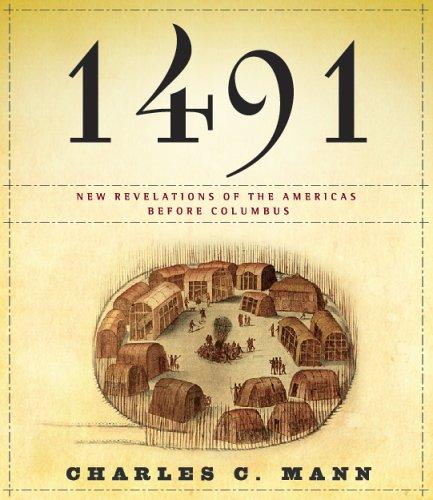
1491
by Charles C. Mann
★ Top 25 book of 2005 · #23 on Best Books of 2005
Charles C. Mann draws on thirty years of archaeological and anthropological research to challenge old ideas about the Americas before Columbus. He argues the continents held huge populations, great cities like Tenochtitlan, and sophisticated achievements such as corn breeding.
Best for: Curious readers eager to rethink what the Americas were like before 1492
1491 is #23 on BookWard's Best Books of 2005, out of 52 2005 books that cleared our data bar.
What 1491 is about
Many of us learned that the ancestors of Native Americans crossed the Bering Strait twelve thousand years ago, lived in small nomadic bands, and tread so lightly that the Americas were essentially wilderness. Charles C. Mann explains why that picture no longer holds. Over the last thirty years, archaeologists and anthropologists have overturned many of those assumptions, and he shows how a new generation of researchers, using novel scientific techniques, reached startling conclusions.
Among them: in 1491 the Americas probably held more people than Europe. Tenochtitlan, the Aztec capital, was far more populous than any European city of its day, with running water, botanical gardens, and spotless streets.
1491 on the Best Books of 2005
1491 came out in 2005. Of the 52 books first published in 2005 that met BookWard's data bar, it ranks #23 on our Best Books of 2005 list.
Why it made the list: 233 readers have shelved it on Open Library; readers rate it 4.3 out of 5 (31 ratings). The list ranks each year’s books on how many readers have picked them up, how highly readers rate them, and how many are reading them right now.
Nearby on the 2005 list
- Creating Black Americans Nell Irvin Painter, #21
- A Piece of Cake Cupcake Brown, #22
- Code Talker Joseph Bruchac, #24
See all Best Books of 2005 Best books by year
More years: Best Books of 2004 Best Books of 2006.
The numbers behind it
- Readers: 174 want to read it, 11 are reading it now and 48 have read it, according to Open Library.
- Ratings: 4.3 out of 5 from 31 Open Library ratings.
| Signal | This book (0 to 100) | Weight |
|---|---|---|
| Reach | 44 | 55% |
| Reader love | 87 | 25% |
| Being read right now | 40 | 20% |
Questions about 1491
When was 1491 published?
1491 by Charles C. Mann was first published in 2005.
Was 1491 one of the best books of 2005?
1491 is #23 on BookWard's Best Books of 2005, out of 52 2005 books that cleared our data bar. 233 readers have shelved it on Open Library; readers rate it 4.3 out of 5 (31 ratings).
Why is 1491 on the Best Books of 2005 list?
233 readers have shelved it on Open Library; readers rate it 4.3 out of 5 (31 ratings).
More of the best books of 2005
- The Lightning Thief Rick Riordan, #1
- Harry Potter and the Half-Blood Prince J. K. Rowling, #2
- The Glass Castle Jeannette Walls, #3
- Looking for Alaska John Green, #4
- Eldest Christopher Paolini, #5
- Freakonomics Steven D. Levitt, #6
See the full Best Books of 2005, the Top 100, or new books on Rising.
How we know
This page uses public data: Open Library reader counts and ratings, and Wikipedia page views for recent years. The description is paraphrased from real source text. Rankings reflect reading interest, not quality or sales, and can be affected by data gaps. Lists update monthly.
Best for mature teens and adults who enjoy dense, idea-led nonfiction.
Depends on the edition you pick.
A rigorous, idea-rich rewrite of the Americas before Columbus. 55% taste match
 BookWard’s take
A rigorous, idea-rich rewrite of the Americas before Columbus
Mann takes the school-textbook picture of a near-empty wilderness and replaces it with evidence from three decades of archaeology and anthropology. The book is driven by ideas rather than story, yet it moves on real narrative energy, which keeps the pace brisk for a work of this size. It is rigorous: claims are tied to the scientists and findings behind them, and competing theories get a fair hearing. It is original, too, since it overturns assumptions most readers carry without noticing. Length is the real cost. The book is long and sprawling, and some chapters carry more detail than they strictly need. Still, Mann's voice is lively and clear, and he writes about heavy material without a lecture's dryness.
A sweeping survey of two continents over millennia, it runs long and wide, which sits against BookWard's taste for tight books.
Mann keeps the narrative moving between sites and theories, though the material is dense, so it runs a little slower than BookWard likes.
Its central claim overturns the textbook view of the pre-Columbian Americas, which is exactly the freshness BookWard prizes.
The writing is clear and plain, built to carry information, which is close to BookWard's mildly plain leaning.
It is driven by ideas and evidence, not character arcs, so it sits far from BookWard's character-driven lean.
It recovers the achievements of lost peoples while recounting devastation, a mixed outlook that sits a little below BookWard.
The structure follows a conventional thematic and chronological survey, close to BookWard's mildly conventional taste.
It is a serious work of history and science with only occasional lightness, so it is more sober than BookWard's tone.
It treats disease, conquest and collapse plainly but not luridly, about as dark as BookWard's middle ground.
The tone is intellectual and measured, with emotion rising mainly around loss, a bit below BookWard's intensity.
See all 50 dialsEvery position, side by side with this book
Where it lines up
- OriginalityBookWard 9 · book 9
- SentimentBookWard 8 · book 8
- Familiar tropesBookWard 10 · book 9
Where it pulls apart
- LengthBookWard 1 · book 8
- Story or ideasBookWard 3 · book 9
- ExpositionBookWard 2 · book 8
A sweeping survey of two continents over millennia, it runs long and wide, which sits against BookWard's taste for tight books.
The opening premise, that the Americas held more people than Europe in 1491, grabs attention fast, close to BookWard's preference.
It sets out to dismantle the standard school account, so it avoids the usual pre-Columbian tropes, matching BookWard.
Arguments are built from archaeological evidence and stepwise reasoning, and the debated points are flagged, which BookWard rewards.
Mann keeps the narrative moving between sites and theories, though the material is dense, so it runs a little slower than BookWard likes.
Its central claim overturns the textbook view of the pre-Columbian Americas, which is exactly the freshness BookWard prizes.
People appear mainly as researchers and peoples in service of the argument, so portraits are thinner than BookWard likes.
Mann treats lost civilizations with respect and keeps sentimentality out of the analysis, in line with BookWard.
The surprises are findings, such as the scale of cities and early agriculture, so the impact is earned rather than staged.
Claims are anchored in the work of named scientists and fields, with disagreements acknowledged, near BookWard's high standard.
Mann's engaged, curious voice makes dense science readable and gives the book a clear personality, matching BookWard.
The book is built around a thesis and the evidence for it rather than a plot, well on the idea-led side compared with BookWard.
Much of the content is explained directly to the reader, which is the opposite of BookWard's preference for showing in scene.
Most sections stay engaging, but a few stretches of technical detail slow the momentum a little, slightly under BookWard's bar.
The writing is clear and plain, built to carry information, which is close to BookWard's mildly plain leaning.
It is driven by ideas and evidence, not character arcs, so it sits far from BookWard's character-driven lean.
It recovers the achievements of lost peoples while recounting devastation, a mixed outlook that sits a little below BookWard.
The structure follows a conventional thematic and chronological survey, close to BookWard's mildly conventional taste.
It is a serious work of history and science with only occasional lightness, so it is more sober than BookWard's tone.
The subject matter and density ask for focus, but the prose is accessible, so it asks a bit more of the reader than BookWard prefers.
Mann weighs many researchers and rival theories across several regions, which suits BookWard's liking for multiple perspectives.
This is grounded nonfiction about real peoples and places, well below BookWard's more imaginative lean.
Many civilizations, scholars and historical figures appear across the book, a far larger cast than BookWard's norm.
It spans two continents and thousands of years, an epic canvas beyond BookWard's more intimate lean.
It concerns societies, landscapes and events more than anyone's inner thoughts, so it leans outward compared with BookWard.
Quoted speech is rare, and the text is mostly exposition, far lighter than BookWard's taste for dialogue.
Romance plays no part in this history of peoples, so it sits at the minor end, as BookWard does.
The pre-Columbian Americas will feel unfamiliar to most readers, which fits BookWard's appetite for new settings.
The subject is the distant past, though the research is recent, so it sits further back than BookWard's present-day lean.
The thesis reshapes how we see history and will stay relevant, though the science will keep evolving, close to BookWard.
Mann is a transparent, evidence-led guide with no unreliable narration, well below BookWard's more unreliable lean.
Judgments about colonization and its toll are mostly clear, though some interpretations stay contested, a little clearer than BookWard.
It describes cities, landscapes and farming systems vividly in places, but mostly explains rather than paints, a bit richer than BookWard.
It tells the story of discoveries and debates, mixing narrative with analysis, a little more story-like than BookWard's analytical lean.
The surprises come as revelations about what the evidence shows, a little fewer than BookWard's liking for twists.
It overturns comfortable assumptions about history and asks readers to rethink them, in line with BookWard's taste for challenge.
It treats disease, conquest and collapse plainly but not luridly, about as dark as BookWard's middle ground.
The tone is intellectual and measured, with emotion rising mainly around loss, a bit below BookWard's intensity.
Humor is light and dry when it appears, drier than BookWard's middle position.
Conquest and epidemic are covered factually without graphic dwelling, a little below BookWard's middle position.
Sexual content is essentially absent from this history, well below BookWard's middle position.
Its subject touches colonization, land and indigenous history, so politics is present but not shouted, a little above BookWard.
The language is plain and clear with some technical terms and names, below BookWard's middle position.
Mann reports competing views but lets his own conclusions show, mildly less opinionated than BookWard's narration.
It looks back at the deep past to reshape the present picture, more backward-looking than BookWard.
It is neither cynical nor starry-eyed, weighing achievement against catastrophe, a little below BookWard's idealistic lean.
Review written by BookWard, dial version 1, November 2026.
Who is 1491 right for?
Best for mature teens and adults who enjoy dense, idea-led nonfiction. It covers conquest, epidemic disease and collapse in plain, factual terms.
The subject matter and density ask for focus, but the prose is accessible, so it asks a bit more of the reader than BookWard prefers.
It treats disease, conquest and collapse plainly but not luridly, about as dark as BookWard's middle ground.
The tone is intellectual and measured, with emotion rising mainly around loss, a bit below BookWard's intensity.
Conquest and epidemic are covered factually without graphic dwelling, a little below BookWard's middle position.
Book Companion1491: ideas, characters, themes
The Americas before 1492 were far more populous, sophisticated and shaped by human hands than the old story of a sparse wilderness allows.
- A crowded hemisphere. Mann presents the case that more people lived in the Americas in 1491 than in Europe.
- Great cities. Tenochtitlan, the Aztec capital, was far larger than any contemporary European city, with running water, botanical gardens and clean streets.
- Early urban life. The earliest cities in the Western Hemisphere were thriving before the Egyptians built the great pyramids.
- Engineered crops. Indians in Mexico developed corn through a breeding process so sophisticated that Science called it perhaps the greatest feat of genetic engineering.
- New science, old assumptions. A newer generation of researchers using novel scientific techniques has overturned long-held ideas about the first Americans and how they lived.
Themes
How accepted accounts of the past can be overturned by new evidence.
The scale and skill of pre-Columbian societies in cities, farming and engineering.
How new techniques and fields reshape what we know about the past.
The idea that the Americas were untouched, set against evidence of human shaping.
Discussion questions
- Which assumption about the pre-Columbian Americas did this book overturn for you?
- How should we weigh evidence when experts disagree about the past?
- Why might the sparse-wilderness picture have lasted so long in schools?
- What does it change to think of corn as an engineered crop?
- How does recovering this history alter the way we view colonization?
Personalize your Book Companion
This is the general edition. In BookWard, the Companion is written for you: your reading profile, your notes, and spoiler-safe to the page you are on.
Buy, listen or borrow 1491
Each link opens a search for this book on that store, in a new tab.
Read on a device
Borrow
Reviews and community
If you liked 1491
A history of secret writing that makes the mathematics approachable
Fast Food NationEric SchlosserA muckraking tour of fast food, from drive-ins to slaughterhouse floors
Guns, Germs, and SteelJared DiamondWhy some societies conquered others, argued from geography, not genes
CollapseJared DiamondDiamond's sweeping case for why societies fail, and how some survive
Find your own best books
Add what you have read, rate it, and BookWard will recommend what to read next.
Free to start. No credit card needed.