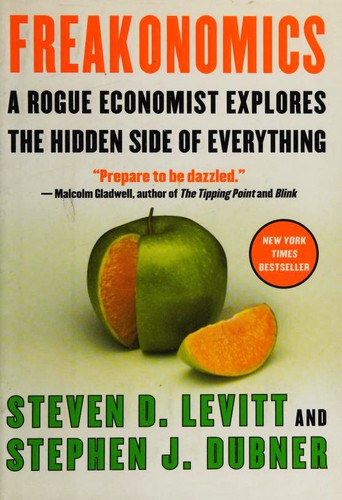
Freakonomics
by Steven D. Levitt
★ Top 10 book of 2005 · #6 on Best Books of 2005
Economist Steven Levitt and journalist Stephen Dubner use data to probe odd everyday questions, from cheating teachers to crime and parenting. Their central idea is that economics is really the study of incentives.
Best for: Curious readers who enjoy surprising, data-driven takes on everyday human behavior
Freakonomics is #6 on BookWard's Best Books of 2005, out of 52 2005 books that cleared our data bar.
What Freakonomics is about
Steven Levitt is a scholar who doesn't fit the usual economist mold, and here he teams up with journalist Stephen J. Dubner to turn his curiosity on everyday puzzles. Their subjects range from cheating and crime to sports and child-rearing. The method is simple: start with a mountain of data and a plain question nobody has thought to ask, then follow the numbers wherever they lead, often to conclusions that upend conventional wisdom.
Some of the questions are delightfully odd. Is a gun or a swimming pool more dangerous? What do schoolteachers and sumo wrestlers have in common? How did legalized abortion affect violent crime? Behind them runs one argument: economics is, at root, the study of incentives. Curious readers who like their ideas witty and approachable, and who enjoy having assumptions gently tested, will find plenty to chew on.
Freakonomics on the Best Books of 2005
Freakonomics came out in 2005. Of the 52 books first published in 2005 that met BookWard's data bar, it ranks #6 on our Best Books of 2005 list.
Why it made the list: 1,414 readers have shelved it on Open Library; readers rate it 3.9 out of 5 (187 ratings); 76 are reading it right now. The list ranks each year’s books on how many readers have picked them up, how highly readers rate them, and how many are reading them right now.
It earns Being read right now.
Nearby on the 2005 list
- Looking for Alaska John Green, #4
- Eldest Christopher Paolini, #5
- A Feast for Crows George R. R. Martin, #7
- Twilight Stephenie Meyer, #8
See all Best Books of 2005 Best books by year
More years: Best Books of 2004 Best Books of 2006.
The numbers behind it
- Readers: 1,108 want to read it, 76 are reading it now and 230 have read it, according to Open Library.
- Ratings: 3.9 out of 5 from 187 Open Library ratings.
| Signal | This book (0 to 100) | Weight |
|---|---|---|
| Reach | 92 | 55% |
| Reader love | 44 | 25% |
| Being read right now | 94 | 20% |
Questions about Freakonomics
When was Freakonomics published?
Freakonomics by Steven D. Levitt was first published in 2005.
Was Freakonomics one of the best books of 2005?
Freakonomics is #6 on BookWard's Best Books of 2005, out of 52 2005 books that cleared our data bar. 1,414 readers have shelved it on Open Library; readers rate it 3.9 out of 5 (187 ratings); 76 are reading it right now.
Why is Freakonomics on the Best Books of 2005 list?
1,414 readers have shelved it on Open Library; readers rate it 3.9 out of 5 (187 ratings); 76 are reading it right now.
More of the best books of 2005
- The Lightning Thief Rick Riordan, #1
- Harry Potter and the Half-Blood Prince J. K. Rowling, #2
- The Glass Castle Jeannette Walls, #3
- Looking for Alaska John Green, #4
- Eldest Christopher Paolini, #5
- A Feast for Crows George R. R. Martin, #7
See the full Best Books of 2005, the Top 100, or new books on Rising.
How we know
This page uses public data: Open Library reader counts and ratings, and Wikipedia page views for recent years. The description is paraphrased from real source text. Rankings reflect reading interest, not quality or sales, and can be affected by data gaps. Lists update monthly.
Suits older teens and adults curious about how the world works.
Depends on the edition you pick.
Economics as detective work, with a sense of humor. 60% taste match
 BookWard’s take
Economics as detective work, with a sense of humor
Freakonomics treats economics as a way of asking odd questions of messy data, from sumo wrestlers to schoolteachers to drug dealers. It hooks at once, because the questions are irresistible and the chapters run short. You get the puzzle fast, and the authors explain their reasoning outright rather than burying it. Where I part ways with the book is on rigor. The method is clever and the claims are bold, but it favors a good story over a full defense of every finding. The voice is distinctive and wry, and it carries the whole thing. This is a book driven by ideas rather than by narrative, and the surprises come from the conclusions, not the plot.
A compact book of short chapters that never overstays, which lines up well with BookWard's liking for tight reads.
Short chapters and a steady stream of new puzzles keep it moving briskly, close to BookWard's preference.
Applying economics to cheating, crime and child-rearing was a fresh angle, which BookWard rewards.
The writing is clean and conversational rather than ornate, a little plainer than BookWard's middle position.
There is no plot to drive it; the pull comes from the questions, so it sits at the plot-and-character-light end.
It is neither grim nor rosy; it treats human behavior with curiosity, with a mild lean toward optimism about understanding it.
A sequence of themed chapters around incentives is conventional in shape, if unusual in subject.
The tone is dry and playful, with wry asides, though it is not a comedy.
Topics include crime, drugs and racism, treated analytically, so the book is not a gentle one.
It is cerebral and cool, not an emotional read.
See all 50 dialsEvery position, side by side with this book
Where it lines up
- PaceBookWard 8 · book 8
- SentimentBookWard 8 · book 8
- Authorial voiceBookWard 9 · book 9
Where it pulls apart
- ExpositionBookWard 2 · book 9
- Story or ideasBookWard 3 · book 9
- Character depthBookWard 8 · book 3
A compact book of short chapters that never overstays, which lines up well with BookWard's liking for tight reads.
Each chapter opens on a startling question, such as what schoolteachers and sumo wrestlers share, so you are pulled in immediately, just as BookWard likes.
It rejects conventional wisdom as a method, so the ideas feel fresh rather than recycled, matching BookWard's taste.
Each argument follows from the data in a clear chain, though a few leaps lean on correlation, so it is a notch below airtight.
Short chapters and a steady stream of new puzzles keep it moving briskly, close to BookWard's preference.
Applying economics to cheating, crime and child-rearing was a fresh angle, which BookWard rewards.
People appear as case studies in service of the argument, so they stay lightly sketched, short of BookWard's appetite for depth.
The book closes by drawing its threads together rather than leaving questions dangling, though less tidily than a novel.
The tone is cool and analytical, with little pull toward tearjerking, which suits BookWard.
Provocative claims are backed by data rather than used for effect alone, though some are plainly meant to startle.
It starts from large datasets and real analysis, but the popular format trades depth of proof for readability, short of BookWard's bar.
The wry, confident, slightly mischievous voice is unmistakable and carries the book, as BookWard prizes.
The engine is the idea behind each question, not a plot, which leans well away from BookWard's story-led tilt.
The authors explain their reasoning and findings outright, which is the opposite of BookWard's show-in-scene preference but suits this kind of book.
Short, self-contained chapters keep energy steady, with only the occasional flatter stretch.
The writing is clean and conversational rather than ornate, a little plainer than BookWard's middle position.
There is no plot to drive it; the pull comes from the questions, so it sits at the plot-and-character-light end.
It is neither grim nor rosy; it treats human behavior with curiosity, with a mild lean toward optimism about understanding it.
A sequence of themed chapters around incentives is conventional in shape, if unusual in subject.
The tone is dry and playful, with wry asides, though it is not a comedy.
It is written for general readers, so it is easy going without much effort needed.
Many individuals and groups appear across chapters, though one authorial voice frames them all.
Chapters move through topics rather than time, with little jumping around in the narrative.
Everything is drawn from real-world data and behavior.
A wide range of figures, from teachers to gang members, pass through the chapters.
It covers society-wide patterns through human-sized stories, landing in the middle.
The focus is on observable behavior and outcomes rather than inner thoughts.
It is exposition-led with little conversation on the page.
Romance is not part of the book.
The subjects are ordinary contemporary life, though some corners such as gangs and sumo may be unfamiliar.
Its examples come from recent decades and read as contemporary, though the data has aged.
The method endures but many specific examples are tied to their moment of publication.
The authors lay out their evidence plainly and stay in a trustworthy expert posture.
It mostly reports what incentives do without scolding, but some topics are left morally open.
Settings are sketched briefly in service of the argument, not painted in detail.
Findings are delivered through stories and anecdotes, though the underlying aim is analysis.
The authors keep a professional distance while still allowing a friendly tone.
A standalone book, though it spawned follow-ups.
Nearly every chapter turns on a conclusion you did not expect.
It pushes you to doubt received wisdom, which is mildly unsettling but rarely heavy.
Topics include crime, drugs and racism, treated analytically, so the book is not a gentle one.
It is cerebral and cool, not an emotional read.
The humor is understated and sly rather than broad.
Violence is discussed as a subject, not depicted in scenes.
Sexual content is minimal.
Charged subjects like abortion and campaign finance come up, though as questions of data rather than advocacy.
The language is plain and accessible throughout.
The authors share frank views and provocative conclusions rather than staying neutral.
It is mostly about explaining present patterns, with some attention to causes in the past.
It leans skeptical of good intentions and neat explanations, with a realist eye on incentives.
Review written by BookWard, dial version 1, November 2026.
Who is Freakonomics right for?
Suits older teens and adults curious about how the world works. It discusses crime, drugs and racism in analytical terms, with little graphic detail.
It is written for general readers, so it is easy going without much effort needed.
Topics include crime, drugs and racism, treated analytically, so the book is not a gentle one.
It is cerebral and cool, not an emotional read.
Violence is discussed as a subject, not depicted in scenes.
Book CompanionFreakonomics: ideas, characters, themes
Economics is, at root, the study of incentives, and looking closely at data can reveal the hidden causes behind everyday behavior.
- Incentives drive behavior. People respond to rewards and penalties, and understanding these explains behavior from cheating to crime.
- Conventional wisdom can be wrong. Common beliefs often fall apart when tested against large amounts of data.
- Ask unusual questions. The book starts from odd, specific puzzles rather than abstract theory.
- Look for hidden connections. It links unlikely subjects, such as schoolteachers and sumo wrestlers, through shared patterns.
- Data over intuition. The authors lean on numbers to test claims that sound plausible but may not hold up.
Themes
The rewards and penalties that shape what people choose to do.
Widely held beliefs that the book tests against evidence.
How people bend rules when it pays, and how that can be detected.
The unseen forces behind visible outcomes.
The difficulty of knowing what actually produces a result.
Discussion questions
- Which of the book's conclusions did you find hardest to accept, and why?
- Where do you see incentives shaping behavior in your own work or life?
- Does a surprising finding feel more convincing, or less, because it overturns what you believed?
- How much should we trust a clever explanation built from data?
- Should economists tackle questions about crime and parenting, or do they belong to other fields?
Personalize your Book Companion
This is the general edition. In BookWard, the Companion is written for you: your reading profile, your notes, and spoiler-safe to the page you are on.
Buy, listen or borrow Freakonomics
Each link opens a search for this book on that store, in a new tab.
Read on a device
Borrow
Reviews and community
If you liked Freakonomics
Gladwell on snap judgments: brisk, vivid, and sometimes too neat
The Code BookSimon SinghA history of secret writing that makes the mathematics approachable
OutliersMalcolm GladwellSuccess has a postcode and a birthday, not just talent
Fast Food NationEric SchlosserA muckraking tour of fast food, from drive-ins to slaughterhouse floors
Find your own best books
Add what you have read, rate it, and BookWard will recommend what to read next.
Free to start. No credit card needed.