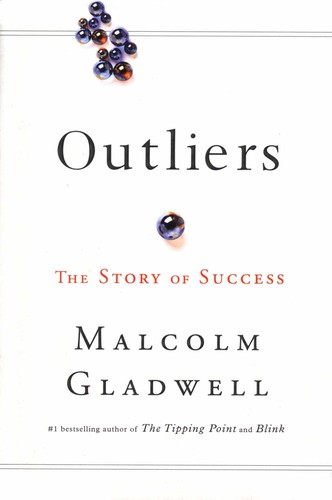
Outliers
by Malcolm Gladwell
★ Top 5 book of 2008 · #5 on Best Books of 2008
Gladwell asks what sets high achievers apart and argues we focus too much on who successful people are and too little on where they come from. Culture, family, generation, and upbringing explain figures from software billionaires to the Beatles.
Best for: Curious readers interested in what really shapes success and extraordinary achievement
Outliers is #5 on BookWard's Best Books of 2008, out of 46 2008 books that cleared our data bar.
What Outliers is about
Malcolm Gladwell's Outliers, published in 2008, asks why some people achieve far more than others and argues that talent and effort are only part of the answer. He defines outliers as people who don't fit our usual picture of achievement, then looks at the circumstances around them: when they were born, what chances they were handed, and the culture and family they came from.
The book is built from vivid examples. It opens with Roseto, a close-knit Pennsylvania town with almost no heart disease, and moves on to elite Canadian hockey players, whose birthdays cluster early in the year because of youth league cutoffs. Gladwell also popularizes the 10,000-Hour Rule, using the Beatles' long run of live shows in Hamburg and Bill Gates's early access to a school computer as illustrations.
Elsewhere he looks at Christopher Langan and J. Robert Oppenheimer. Organized in two parts, Opportunity and Legacy, the book is conversational and thought-provoking. It will appeal to readers who enjoy rethinking ideas about success and whether it is truly earned.
Outliers on the Best Books of 2008
Outliers came out in 2008. Of the 46 books first published in 2008 that met BookWard's data bar, it ranks #5 on our Best Books of 2008 list.
Why it made the list: 1,080 readers have shelved it on Open Library; readers rate it 4 out of 5 (118 ratings); 32 are reading it right now. The list ranks each year’s books on how many readers have picked them up, how highly readers rate them, and how many are reading them right now.
Nearby on the 2008 list
- The Last Straw Jeff Kinney, #3
- Amulet Kazu Kibuishi, #4
- Michelle Obama in Her Own Words Michelle Obama, #6
- The Graveyard Book Neil Gaiman, #7
See all Best Books of 2008 Best books by year
More years: Best Books of 2007 Best Books of 2009.
The numbers behind it
- Readers: 888 want to read it, 32 are reading it now and 160 have read it, according to Open Library.
- Ratings: 4 out of 5 from 118 Open Library ratings.
| Signal | This book (0 to 100) | Weight |
|---|---|---|
| Reach | 98 | 55% |
| Reader love | 57 | 25% |
| Being read right now | 85 | 20% |
Questions about Outliers
When was Outliers published?
Outliers by Malcolm Gladwell was first published in 2008.
Was Outliers one of the best books of 2008?
Outliers is #5 on BookWard's Best Books of 2008, out of 46 2008 books that cleared our data bar. 1,080 readers have shelved it on Open Library; readers rate it 4 out of 5 (118 ratings); 32 are reading it right now.
Why is Outliers on the Best Books of 2008 list?
1,080 readers have shelved it on Open Library; readers rate it 4 out of 5 (118 ratings); 32 are reading it right now.
More of the best books of 2008
- The Hunger Games Suzanne Collins, #1
- End of Days Sylvia Browne, #2
- The Last Straw Jeff Kinney, #3
- Amulet Kazu Kibuishi, #4
- Michelle Obama in Her Own Words Michelle Obama, #6
- The Graveyard Book Neil Gaiman, #7
See the full Best Books of 2008, the Top 100, or new books on Rising.
How we know
This page uses public data: Open Library reader counts and ratings, and Wikipedia page views for recent years. The description is paraphrased from real source text. Rankings reflect reading interest, not quality or sales, and can be affected by data gaps. Lists update monthly.
Suits adult and older teen readers who like accessible big-picture nonfiction.
Depends on the edition you pick.
Success has a postcode and a birthday, not just talent. 54% taste match
 BookWard’s take
Success has a postcode and a birthday, not just talent
Outliers argues that the usual question, what are successful people like, is the wrong one. Gladwell asks where they come from instead, and builds the case through hockey birthdays, Bill Gates, the Beatles and a law firm founder. It hooks at once, opening with a small Pennsylvania town and a quirk of youth hockey eligibility, and it is idea-led, with the stories serving the argument rather than the reverse. Where I'd push back is on rigor: the evidence is anecdotal in places, and the famous 10,000-hour rule has been disputed by the authors of the original study. The voice is unmistakable and the prose plain, so it moves fast. Read it for the provocation, then check the claims.
A compact argument of nine chapters plus an introduction and epilogue, so it stays brisk, which fits BookWard's love of tight books.
Short chapters built around one vivid case each keep it moving quickly, close to BookWard's preferred speed.
Reframing success as a product of birth date, culture and opportunity gives familiar achievers a genuinely new angle.
Plain, clear and conversational, with very little ornament, which is close to BookWard's mildly plain leaning.
It runs on a central argument rather than plot or inner lives, landing in the middle on this dial.
The message that opportunity and circumstance shape success carries a quietly constructive note about how society could widen the field.
A conventional two-part layout of opportunity and legacy, with an introduction and epilogue.
Wry in spots but essentially a serious inquiry into achievement and fairness.
Largely benign subject matter with only mild tragedy and inequality in the background.
Curious and engaging rather than heavily emotional.
See all 50 dialsEvery position, side by side with this book
Where it lines up
- PaceBookWard 8 · book 8
- Shock for effectBookWard 9 · book 9
- Authorial voiceBookWard 9 · book 9
Where it pulls apart
- Familiar tropesBookWard 10 · book 4
- Internal logicBookWard 10 · book 5
- ExpositionBookWard 2 · book 8
A compact argument of nine chapters plus an introduction and epilogue, so it stays brisk, which fits BookWard's love of tight books.
It opens on the Roseto town mystery and a hockey birthday puzzle, so the pull is immediate, just as BookWard likes.
The success-book genre is crowded with self-help advice, but flipping the question to where people come from feels fresher than the usual formula.
The chain from anecdote to sweeping conclusion has gaps, and the 10,000-hour claim has been disputed, which sits below BookWard's airtight standard.
Short chapters built around one vivid case each keep it moving quickly, close to BookWard's preferred speed.
Reframing success as a product of birth date, culture and opportunity gives familiar achievers a genuinely new angle.
People such as Gates and Oppenheimer serve the thesis, so they are sketched through their circumstances rather than drawn in depth.
The epilogue loops back to the author's own background and closes the argument neatly, which suits BookWard's taste for resolution.
Mostly measured, though the closing personal turn adds some warmth that stays short of syrupy.
Several findings are offered as surprises designed to land, which leans on the reveal more than BookWard prefers.
Evidence is largely anecdotal and selectively chosen, and the 10,000-hour rule has been disputed by the original study's authors, a real mismatch with BookWard.
Gladwell's conversational, story-first voice is instantly recognisable, a strength BookWard rewards.
Every story exists to prove a thesis about success, so the ideas lead, further toward argument than BookWard's story-leaning taste.
The author states his conclusions outright after each case, far more explained than BookWard's preference for showing.
Each chapter opens a fresh case, so the energy holds from start to finish, matching BookWard's wish for sustained pull.
Plain, clear and conversational, with very little ornament, which is close to BookWard's mildly plain leaning.
It runs on a central argument rather than plot or inner lives, landing in the middle on this dial.
The message that opportunity and circumstance shape success carries a quietly constructive note about how society could widen the field.
A conventional two-part layout of opportunity and legacy, with an introduction and epilogue.
Wry in spots but essentially a serious inquiry into achievement and fairness.
Written for general readers and easy to follow, which is easier going than BookWard's slightly demanding average.
The author's voice leads throughout, though it moves among many subjects and cultures.
Cases are grouped by theme rather than date, but each is narrated in a mostly straightforward way.
Entirely grounded in real people, places and statistics.
A rotating roster of real figures, from hockey players to Gates to the Beatles, adds up to a fairly sizable cast.
Spans whole cultures and generations, but through close-up stories rather than an epic sweep.
It dwells on circumstances, habits and external factors more than on private thoughts.
Mostly narration and analysis, with only occasional quoted speech.
Not a feature of the book.
The Canadian hockey rinks, Silicon Valley and rice paddies are mostly accessible settings to a general reader.
Published in 2008 and drawing on figures across the past century, so grounded in a recent past.
The debates it started about luck and effort stay relevant, though some examples now feel tied to the 2000s.
The author speaks plainly in his own voice, so there is no unreliable narrator.
It leans on a clear message that success is not purely earned, though fairness questions stay open.
Scenes are painted briefly in service of the argument, not lingered over.
Storytelling dominates over data tables, so it reads as narrative nonfiction.
The epilogue links the thesis to the author's own family background, adding a personal edge.
A standalone work.
Built on counterintuitive revelations, such as hockey birthdays, that arrive in nearly every chapter.
It nudges readers to rethink meritocracy without being hostile or hard to take.
Largely benign subject matter with only mild tragedy and inequality in the background.
Curious and engaging rather than heavily emotional.
Mild, dry asides rather than broad comedy.
Essentially absent.
Essentially absent.
Touches on class, culture and opportunity without making partisan arguments the point.
Clear, accessible language throughout.
The author argues a firm thesis and steers the reader toward it.
Explains the past to make better choices ahead, balanced between looking back and forward.
It suggests that better systems could unlock hidden talent, a mildly idealistic stance.
Review written by BookWard, dial version 1, November 2026.
Who is Outliers right for?
Suits adult and older teen readers who like accessible big-picture nonfiction. Nothing graphic, though it discusses inequality and the idea that success is not purely earned.
Written for general readers and easy to follow, which is easier going than BookWard's slightly demanding average.
Largely benign subject matter with only mild tragedy and inequality in the background.
Curious and engaging rather than heavily emotional.
Essentially absent.
Book CompanionOutliers: ideas, characters, themes
Success comes less from individual brilliance than from the opportunities, culture, timing and family backgrounds that surround a person.
- The hockey birthday effect. Youth leagues group players by calendar year, so those born early are bigger and get more coaching, giving them a compounding head start.
- The 10,000-hour rule. Gladwell claims world-class expertise takes roughly 10,000 hours of correct practice, though the original study's authors dispute his use of it.
- Opportunity shapes outcomes. Cases like Bill Gates and the Beatles show that rare access to practice and timing helped turn talent into extraordinary achievement.
- Intelligence is not enough. Comparing Christopher Langan and J. Robert Oppenheimer, the book argues that very high intelligence leads to different fortunes depending on upbringing and support.
- Culture and legacy matter. The second part examines how cultural background and inherited circumstances influence how people reason, decide and succeed.
Characters
Bill Gates
Microsoft co-founder
Used as a case of how early access and practice helped build extreme wealth.
The Beatles
Musical group
Presented as an example of how intense early experience helped shape one of history's most successful acts.
Christopher Langan
Exceptionally intelligent man
Contrasted with Oppenheimer to show that intelligence alone does not guarantee success.
J. Robert Oppenheimer
Theoretical physicist
The foil to Langan, whose circumstances led to a very different outcome.
Joseph Flom
Law firm builder
Shown building Skadden, Arps into a major firm, illustrating how background and timing can shape a career.
Themes
Success depends on access and timing as much as on talent.
Inherited cultural habits influence how people think, work and decide.
The book questions how far successful people deserve the praise they receive.
Sustained, well-directed effort over many hours is treated as a key ingredient.
Family and generational background carry forward into later achievement.
Discussion questions
- Does knowing about the hockey birthday effect change how you think about talent and fairness?
- How convincing is the 10,000-hour rule given that the original researchers dispute it?
- Which of Gladwell's case studies feels strongest, and which feels weakest?
- If opportunity matters this much, what should schools, teams or employers do differently?
- How does the personal epilogue change the way you read the rest of the argument?
Personalize your Book Companion
This is the general edition. In BookWard, the Companion is written for you: your reading profile, your notes, and spoiler-safe to the page you are on.
Buy, listen or borrow Outliers
Each link opens a search for this book on that store, in a new tab.
Read on a device
Borrow
Reviews and community
If you liked Outliers
Gladwell on snap judgments: brisk, vivid, and sometimes too neat
The Power of HabitCharles DuhiggHabit science told through stories, with a framework you can use
The Obstacle Is the WayRyan HolidayStoic advice for setbacks, told through famous lives
Ego Is the EnemyRyan HolidayA short, sharp case that your own ego is the obstacle
Find your own best books
Add what you have read, rate it, and BookWard will recommend what to read next.
Free to start. No credit card needed.