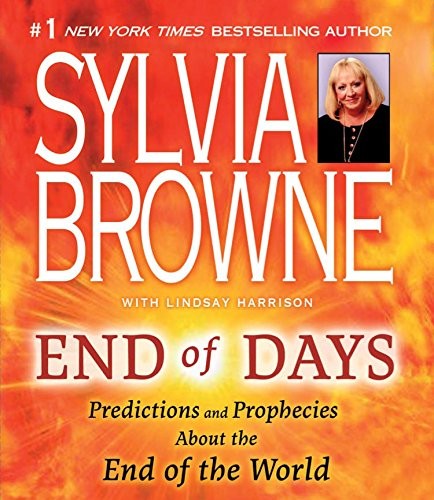
End of Days
by Sylvia Browne
★ Top 5 book of 2008 · #2 on Best Books of 2008
Psychic Sylvia Browne tackles anxieties about humanity's future, asking what the next fifty years will bring and what the 2012 Mayan prediction really means. She also interprets Nostradamus and the Book of Revelation, and considers what a final hour might look like.
Best for: Readers curious about prophecy, psychic predictions, and where the world is heading
End of Days is #2 on BookWard's Best Books of 2008, out of 46 2008 books that cleared our data bar.
What End of Days is about
Sylvia Browne, a popular psychic, wrote this 2008 book for readers who feel uneasy about where the world is heading. She argues that religious wars, global terrorism, and genocide have helped bring on what she calls the Anxiety Age, and she asks what the next fifty years may hold.
She takes on some of the best-known doomsday material, including the Mayan calendar's prediction that the world ends in 2012, the prophecies of Nostradamus, and the Book of Revelation. She also imagines how humanity's final hours might unfold, and considers whether anything can be done to head off a catastrophe of biblical proportions. The tone is earnest and speculative, suited to readers curious about prophecy and spirituality.
End of Days on the Best Books of 2008
End of Days came out in 2008. Of the 46 books first published in 2008 that met BookWard's data bar, it ranks #2 on our Best Books of 2008 list.
Why it made the list: 734 readers have shelved it on Open Library; readers rate it 4.4 out of 5 (35 ratings); 60 are reading it right now. The list ranks each year’s books on how many readers have picked them up, how highly readers rate them, and how many are reading them right now.
It earns Being read right now.
Nearby on the 2008 list
- The Hunger Games Suzanne Collins, #1
- The Last Straw Jeff Kinney, #3
- Amulet Kazu Kibuishi, #4
See all Best Books of 2008 Best books by year
More years: Best Books of 2007 Best Books of 2009.
The numbers behind it
- Readers: 646 want to read it, 60 are reading it now and 28 have read it, according to Open Library.
- Ratings: 4.4 out of 5 from 35 Open Library ratings.
| Signal | This book (0 to 100) | Weight |
|---|---|---|
| Reach | 89 | 55% |
| Reader love | 85 | 25% |
| Being read right now | 96 | 20% |
Questions about End of Days
When was End of Days published?
End of Days by Sylvia Browne was first published in 2008.
Was End of Days one of the best books of 2008?
End of Days is #2 on BookWard's Best Books of 2008, out of 46 2008 books that cleared our data bar. 734 readers have shelved it on Open Library; readers rate it 4.4 out of 5 (35 ratings); 60 are reading it right now.
Why is End of Days on the Best Books of 2008 list?
734 readers have shelved it on Open Library; readers rate it 4.4 out of 5 (35 ratings); 60 are reading it right now.
More of the best books of 2008
- The Hunger Games Suzanne Collins, #1
- The Last Straw Jeff Kinney, #3
- Amulet Kazu Kibuishi, #4
- Outliers Malcolm Gladwell, #5
- Michelle Obama in Her Own Words Michelle Obama, #6
- The Graveyard Book Neil Gaiman, #7
See the full Best Books of 2008, the Top 100, or new books on Rising.
How we know
This page uses public data: Open Library reader counts and ratings, and Wikipedia page views for recent years. The description is paraphrased from real source text. Rankings reflect reading interest, not quality or sales, and can be affected by data gaps. Lists update monthly.
Best suited to adult readers and curious older teens interested in prophecy and spirituality.
Depends on the edition you pick.
Sylvia Browne forecasts the next fifty years and the end of the world. 35% taste match
 BookWard’s take
Sylvia Browne forecasts the next fifty years and the end of the world
End of Days is a popular-psychic take on apocalypse, built around questions like what the Mayan calendar's 2012 date really means and how Nostradamus and the Book of Revelation should be read. On rigor it fails badly, since predictions offered on a psychic's authority are anecdotal rather than evidenced. The voice is a stronger point: Browne's calm, reassuring register is entirely her own, and the subject gives the book an opening that hooks at once. It is idea-led, leans on familiar prophecy tropes, and explains outright instead of showing anything in scene. Read it as a window into one well-known worldview about doom and comfort, not as a tested account of the future.
Big questions about the next fifty years and the final hours keep the subject moving at a reasonable clip, close to BookWard's liking for speed.
The apocalypse genre is crowded and the ideas are largely recycled prophecy, well short of BookWard's appetite for originality.
The language aims for plain, accessible clarity instead of ornament, a little plainer than BookWard's middle ground.
With no plot and no characters, drive comes from the questions themselves, so neither pole fits well.
The author promises wisdom and a way out of the Anxiety Age, tilting the outlook toward comfort over despair.
The subject and the serene tone leave little room for humor.
Apocalypse, genocide and catastrophe are the subject, softened by a reassuring tone.
Fear and comfort both play a part, at moderate intensity.
See all 50 dialsEvery position, side by side with this book
Where it lines up
- Authorial voiceBookWard 9 · book 8
- OpeningBookWard 10 · book 8
- PaceBookWard 8 · book 6
Where it pulls apart
- Familiar tropesBookWard 10 · book 2
- Internal logicBookWard 10 · book 3
- Rigor (nonfiction)BookWard 9 · book 2
The question of how the world ends is an instant draw, which matches BookWard's love of openings that grab at once.
Prophecy, Nostradamus and Revelation are well-worn territory, which runs against BookWard's wish to avoid familiar tropes.
Claims rest on psychic authority, so the reasoning cannot be airtight, which sits poorly with BookWard's demand for internal logic.
Big questions about the next fifty years and the final hours keep the subject moving at a reasonable clip, close to BookWard's liking for speed.
The apocalypse genre is crowded and the ideas are largely recycled prophecy, well short of BookWard's appetite for originality.
This is a book of predictions and explanations, so there are no deeply drawn characters, which BookWard would miss.
A forecast book can land on a clear sense of what is coming, which suits BookWard's liking for resolution.
Browne offers reassurance and serenity as a selling point, so it leans warm where BookWard prefers restraint.
Doom scenarios are the draw, but the tone is soothing, so the darkness is framed instead of wallowed in.
Predictions from a psychic are anecdotal and untestable, the sharpest mismatch with BookWard's strong preference for rigor.
Browne's calm, confident, reassuring register is unmistakably her own, which BookWard values.
The book is built entirely around ideas and predictions, far more than story, though BookWard leans story-led.
Prophecies are explained outright to the reader, the opposite of BookWard's preference for showing in scene.
The language aims for plain, accessible clarity instead of ornament, a little plainer than BookWard's middle ground.
With no plot and no characters, drive comes from the questions themselves, so neither pole fits well.
The author promises wisdom and a way out of the Anxiety Age, tilting the outlook toward comfort over despair.
The subject and the serene tone leave little room for humor.
A popular psychic title like this is pitched at general readers and asks little effort of them.
One author speaks throughout, so there is a single viewpoint.
A book on prophecy and the future inevitably ranges across past prophecies, present anxieties and what lies ahead.
Psychic visions and prophecy put the book well into the supernatural, far from grounded.
A book of this kind rests on one authorial voice rather than a populated cast.
The end of the world and the next fifty years is about as epic as a subject gets.
Mostly concerned with external world events, though framed through spiritual belief.
A book of predictions and explanation leans on exposition, with little room for dialogue.
Romance has no place in a book about global prophecy.
Readers meet familiar fears but an unfamiliar spiritual framework for interpreting them.
Framed around the Anxiety Age of terrorism and religious wars, and the 2012 date, it is rooted in its moment.
Pinned to specific dates and a particular era of anxiety, it is of its moment.
The author speaks directly with confidence, so the narrator is sincere though the claims are not checkable.
Good and evil are drawn in broad, clear strokes, in the manner of religious prophecy.
Prophecies and scenarios are described, but the book is not rich in scene-setting.
It mixes explanation of prophecies with predictive storytelling, landing in the middle.
A psychic author offers personal authority and wisdom, so the perspective is more personal than detached.
Predictions can startle, but the structure is not built on plot turns.
It reassures more than it provokes, though readers face frightening ideas.
Apocalypse, genocide and catastrophe are the subject, softened by a reassuring tone.
Fear and comfort both play a part, at moderate intensity.
Humor is largely absent.
War, genocide and catastrophe are the backdrop, but a book of prediction and interpretation is not built around scenes of violence.
No sexual content is expected.
Religious wars and global terrorism are central context, though not partisan.
Plain, direct language with no dense or dialect-heavy passages.
Browne asserts her views openly and with certainty throughout.
Looking ahead to the next fifty years and the end times, it is oriented toward the future.
It offers a hopeful, spiritual way through catastrophe, more idealistic than cynical.
Review written by BookWard, dial version 1, November 2026.
Who is End of Days right for?
Best suited to adult readers and curious older teens interested in prophecy and spirituality. It discusses war, terrorism, genocide and the end of the world, which may unsettle anxious readers.
A popular psychic title like this is pitched at general readers and asks little effort of them.
Apocalypse, genocide and catastrophe are the subject, softened by a reassuring tone.
Fear and comfort both play a part, at moderate intensity.
War, genocide and catastrophe are the backdrop, but a book of prediction and interpretation is not built around scenes of violence.
Book CompanionEnd of Days: ideas, characters, themes
Sylvia Browne argues that prophecy can be read as a guide to what is coming and that serenity is the right response to the so-called Anxiety Age.
- The Anxiety Age. The book opens from the idea that religious wars, terrorism and genocide have left people unusually fearful about the future.
- The next fifty years. Browne sets out to say what is coming in the coming half-century.
- The Mayan calendar and 2012. It takes up the claim that the Mayan calendar predicts the world ending in 2012 and asks what will really happen.
- Great prophecies. Nostradamus and the Book of Revelation are examined for what they are said to mean.
- The final hours. The book considers what would unfold if the world really were ending, and what, if anything, can prevent catastrophe.
Themes
The belief that the future can be foretold through visions or ancient texts.
How anxiety about global events is met with a calming, serene voice.
The role of religious wars and belief in shaping a sense of coming doom.
The idea of a final reckoning for humanity and how it might unfold.
Discussion questions
- Why do predictions of the end of the world draw so much attention in anxious times?
- What kind of evidence would make a prophecy believable to you?
- How does a calm, reassuring tone change the way frightening claims land?
- The Mayan calendar date of 2012 came and went; how should readers weigh prophecies afterward?
- Is there a difference between comfort and certainty in a book like this?
Personalize your Book Companion
This is the general edition. In BookWard, the Companion is written for you: your reading profile, your notes, and spoiler-safe to the page you are on.
Buy, listen or borrow End of Days
Each link opens a search for this book on that store, in a new tab.
Read on a device
Borrow
Reviews and community
If you liked End of Days
A former Pentagon insider's personal case for taking UAP seriously
Confessions of an Economic Hit ManPerkins, JohnA first-person insider tale about loans as a tool of empire
Start with WhySimon SinekOne big idea, built on Apple, King and Kennedy
Becoming SupernaturalJoe DispenzaA meditation manual dressed as science, big on promise
Find your own best books
Add what you have read, rate it, and BookWard will recommend what to read next.
Free to start. No credit card needed.