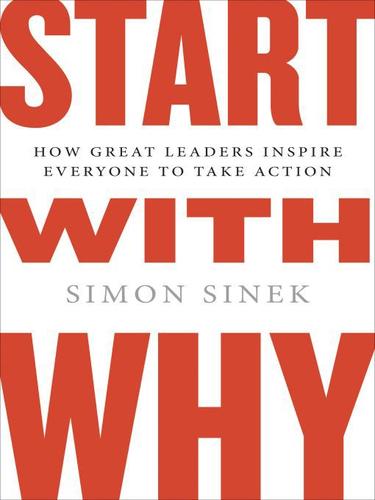
Start with Why
by Simon Sinek
★ Top 25 book of 2011 · #11 on Best Books of 2011
Simon Sinek argues that the most successful leaders and organizations share one habit: they begin by clarifying why they do what they do. He shows how that purpose can strengthen culture, hiring, products, sales, and marketing.
Best for: Leaders and teams wanting to clarify purpose and inspire others
Start with Why is #11 on BookWard's Best Books of 2011, out of 53 2011 books that cleared our data bar.
What Start with Why is about
Why do some leaders and companies win loyal followers while others only win a sale? Simon Sinek sets out two ways of moving people: pushing them with tricks and incentives, or inspiring them. He argues that inspiration lasts longer and works better. Most organizations can say what they make, and some can explain how they do it, but very few can say why they exist at all. According to Sinek, the leaders people follow tend to start from that last question and work outward, the reverse of the usual habit.
He draws on figures such as Martin Luther King Jr., John F. Kennedy and Steve Jobs, along with the early aviation pioneers and the founders of Southwest Airlines. He then turns the idea into practical advice on company culture, hiring, product development, sales and marketing. Written in an easy, encouraging voice, it will help managers, founders, marketers and anyone trying to find a clearer sense of purpose in their work.
Start with Why on the Best Books of 2011
Start with Why came out in 2011. Of the 53 books first published in 2011 that met BookWard's data bar, it ranks #11 on our Best Books of 2011 list.
Why it made the list: 1,290 readers have shelved it on Open Library; readers rate it 4.1 out of 5 (52 ratings); 53 are reading it right now. The list ranks each year’s books on how many readers have picked them up, how highly readers rate them, and how many are reading them right now.
Nearby on the 2011 list
- We'll Always Have Summer Jenny Han, #9
- Miss Peregrine's Home for Peculiar Children Ransom Riggs, #10
- Outwitting the Devil Napoleon Hill, #12
- The Lean Startup Eric Ries, #13
See all Best Books of 2011 Best books by year
More years: Best Books of 2010 Best Books of 2012.
The numbers behind it
- Readers: 1,168 want to read it, 53 are reading it now and 68 have read it, according to Open Library.
- Ratings: 4.1 out of 5 from 52 Open Library ratings.
| Signal | This book (0 to 100) | Weight |
|---|---|---|
| Reach | 81 | 55% |
| Reader love | 51 | 25% |
| Being read right now | 77 | 20% |
Questions about Start with Why
When was Start with Why published?
Start with Why by Simon Sinek was first published in 2011.
Was Start with Why one of the best books of 2011?
Start with Why is #11 on BookWard's Best Books of 2011, out of 53 2011 books that cleared our data bar. 1,290 readers have shelved it on Open Library; readers rate it 4.1 out of 5 (52 ratings); 53 are reading it right now.
Why is Start with Why on the Best Books of 2011 list?
1,290 readers have shelved it on Open Library; readers rate it 4.1 out of 5 (52 ratings); 53 are reading it right now.
More of the best books of 2011
- Sapiens Yuval Noah Harari, #1
- The Song of Achilles Madeline Miller, #2
- Thinking, Fast and Slow Daniel Kahneman, #3
- Steve Jobs Walter Isaacson, #4
- The Son of Neptune Rick Riordan, #5
- Shatter Me Tahereh Mafi, #6
See the full Best Books of 2011, the Top 100, or new books on Rising.
How we know
This page uses public data: Open Library reader counts and ratings, and Wikipedia page views for recent years. The description is paraphrased from real source text. Rankings reflect reading interest, not quality or sales, and can be affected by data gaps. Lists update monthly.
Suits adults and older teens interested in work, leadership or starting something.
Depends on the edition you pick.
One big idea, built on Apple, King and Kennedy. 41% taste match
 BookWard’s take
One big idea, built on Apple, King and Kennedy
Start with Why makes a single argument and keeps returning to it: inspiration beats manipulation, and the leaders who last begin with purpose before product. It leans on Martin Luther King Jr., John F. Kennedy and Steve Jobs as its proof. Where I part company with it is in how it teaches. The book explains its framework outright instead of letting scenes carry it, so it reads as an idea-led work with little depth of character and a steady, unshowy voice. Rigor is the other tension. This is anecdote and pattern-spotting, not a controlled study, and it falls well short of the standard I like to see in nonfiction. The pace is brisk, though, and the opening states its thesis straight away, which I appreciate. Read it as a clear, repeatable lens on leadership, not a proof.
A focused single-thesis business book that stays compact rather than sprawling, which suits BookWard's taste for tight reading.
Short chapters and a quickly explained framework keep it moving, close to BookWard's preference for momentum.
The why-first framing is a memorable angle, but it sits among many inspirational leadership books and is not wholly new.
The writing is plain and conversational, with no ornament, a little plainer than BookWard's middle ground.
With no plot or characters in the story sense, it leans neither way, but is closer to being driven by people's examples.
Its core message is that purpose can inspire people and nations, an optimistic outlook that fits BookWard's tilt.
It moves through a conventional, building sequence of argument and examples, fitting BookWard's modest tolerance for form.
The tone is earnest and motivational, with little humor, so it reads firmly serious.
Nothing here is dark; the material is uplifting and professional.
It aims to stir motivation, but the feeling stays moderate rather than intense.
See all 50 dialsEvery position, side by side with this book
Where it lines up
- PaceBookWard 8 · book 7
- EndingBookWard 8 · book 7
- Shock for effectBookWard 9 · book 8
Where it pulls apart
- Familiar tropesBookWard 10 · book 3
- ExpositionBookWard 2 · book 9
- Internal logicBookWard 10 · book 6
A focused single-thesis business book that stays compact rather than sprawling, which suits BookWard's taste for tight reading.
It states its central question and thesis almost immediately, giving a clear early pull that BookWard values.
Leadership-book conventions and well-worn icons like Jobs and King make it familiar territory, short of BookWard's appetite for freshness.
The argument follows a clear, consistent pattern, though it relies on selected examples rather than tight proof, so it falls short of airtight.
Short chapters and a quickly explained framework keep it moving, close to BookWard's preference for momentum.
The why-first framing is a memorable angle, but it sits among many inspirational leadership books and is not wholly new.
Figures appear as illustrations of a point, so they stay types, well short of the deeply drawn people BookWard prefers.
The book resolves its argument and tells readers how to apply it, giving a satisfying, closed finish.
It leans on inspiring, uplifting appeals, though it avoids pure schmaltz, so it lands in the middle on restraint.
Nothing here relies on shock; the book is plainly motivational, which BookWard is happy with.
It argues through anecdote and pattern rather than rigorous evidence, well below the rigor BookWard wants from nonfiction.
Sinek's confident, evangelizing tone is recognizable, though it reads as polished business-book style more than singular.
The whole book exists to deliver one idea, so it is firmly idea-led, further than BookWard's story-leaning taste.
It explains its framework outright and repeatedly, the opposite of BookWard's preference for showing in scene.
A single repeated idea can feel stretched in the middle, though short chapters keep it mostly steady.
The writing is plain and conversational, with no ornament, a little plainer than BookWard's middle ground.
With no plot or characters in the story sense, it leans neither way, but is closer to being driven by people's examples.
Its core message is that purpose can inspire people and nations, an optimistic outlook that fits BookWard's tilt.
It moves through a conventional, building sequence of argument and examples, fitting BookWard's modest tolerance for form.
The tone is earnest and motivational, with little humor, so it reads firmly serious.
Accessible language and a simple framework make it easy going, which BookWard accepts without complaint.
One authorial voice carries the argument throughout, a narrower lens than BookWard typically enjoys.
The argument builds linearly, even as examples span history from aviation pioneers to Apple.
It deals entirely with real organizations and leaders, firmly grounded.
A handful of recurring figures like King, Kennedy and Jobs anchor the argument, keeping the cast small.
It frames purpose as relevant from companies to nations, though the day-to-day focus is organizational.
It is about why people act and decide, which pulls it toward motivation and inner drive over bare events.
As a non-narrative argument, it has virtually no dialogue.
Romance plays no part in a book about leadership and purpose.
The business and public-life settings are familiar to most readers.
Its examples and concerns, including smartphones and devices, sit in a broadly contemporary frame.
The core idea about purpose may endure, but its business-culture examples are tied to a particular period.
The author speaks directly and plainly, so the narration is reliable.
It presents inspiration as clearly better than manipulation, leaving little ambiguity about its stance.
Descriptions serve the argument rather than scene-setting, so the book stays fairly sparse.
It tells its argument through stories of leaders and companies, leaning narrative over analytical.
The author writes as an engaged advocate, giving a personal rather than detached stance.
It stands alone as a complete argument.
There are no plot surprises; the thesis is announced up front and developed in order.
It reassures more than it unsettles, though it does push readers to rethink how they lead.
Nothing here is dark; the material is uplifting and professional.
It aims to stir motivation, but the feeling stays moderate rather than intense.
Any humor is mild and conversational, closer to dry than broad.
No violence features in a book about leadership and inspiration.
Sexual content does not appear.
It draws on civic figures and calls for collective progress, but is not a political book.
The language is plain and easy to follow.
Sinek argues forcefully and advocates his view throughout, far from neutral.
It frames purpose as the route to better futures, tilting the outlook forward.
It firmly believes inspired leadership can change organizations and the world, a strongly idealistic stance.
Review written by BookWard, dial version 1, November 2026.
Who is Start with Why right for?
Suits adults and older teens interested in work, leadership or starting something. Nothing sensitive appears.
Accessible language and a simple framework make it easy going, which BookWard accepts without complaint.
Nothing here is dark; the material is uplifting and professional.
It aims to stir motivation, but the feeling stays moderate rather than intense.
No violence features in a book about leadership and inspiration.
Book CompanionStart with Why: ideas, characters, themes
Lasting influence comes from inspiring people around a clear purpose, the why, rather than manipulating them with incentives.
- Inspiration versus manipulation. There are two main ways to move human behavior, and Sinek argues inspiration is the more powerful and sustainable.
- Why, how, what. Most organizations can say what they do and some how, but very few can state why they exist.
- Purpose creates culture. Clear purpose can pull a team or nation together around a common interest.
- Examples as proof. Martin Luther King Jr., John F. Kennedy, Steve Jobs and Apple, and Southwest Airlines serve as illustrations.
- Applying it widely. The idea is meant to shape culture, hiring, product development, sales and marketing.
Characters
Martin Luther King Jr.
Example of purpose-led leadership
Cited as someone who inspired people around a cause rather than a plan.
John F. Kennedy
Example of inspiring a nation
Used to show how a clear purpose can unite people toward a shared goal.
Steve Jobs
Example from business
Appears alongside Apple's culture as a model of purpose driving products and loyalty.
Themes
Knowing why you do what you do before deciding what or how.
Moving people through belief rather than pressure or incentives.
Guiding others by shared purpose, not by authority.
The shared beliefs that hold a team or organization together.
Taking risks to solve problems others accept as fixed.
Discussion questions
- Does the why-how-what idea match how you see organizations you know?
- Where does inspiration end and manipulation begin?
- Are the chosen examples enough to prove the pattern?
- How would you state the why of your own work or team?
- Can a strong purpose survive when a business grows large?
Personalize your Book Companion
This is the general edition. In BookWard, the Companion is written for you: your reading profile, your notes, and spoiler-safe to the page you are on.
Buy, listen or borrow Start with Why
Each link opens a search for this book on that store, in a new tab.
Read on a device
Borrow
Reviews and community
If you liked Start with Why
A self-taught learner's practical blueprint for mastering hard skills fast
MindsetCarol S. DweckOne big idea, two mindsets, applied to work, love and parenting
No Excuses!Brian TracyA 21-chapter push to swap excuses for self-discipline
The Compound EffectDarren HardySmall habits, big results: a short, forceful self-help pitch
Find your own best books
Add what you have read, rate it, and BookWard will recommend what to read next.
Free to start. No credit card needed.