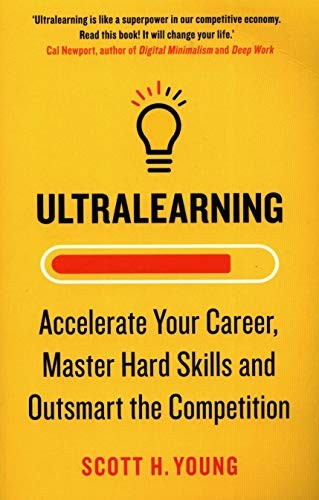
Ultralearning
by Scott Young
★ Top 25 book of 2019 · #14 on Best Books of 2019
Scott Young explains how he picked up four languages and worked through a full MIT computer science curriculum within a year. He lays out seven principles meant to help anyone learn faster and more effectively.
Best for: Ambitious self-teachers wanting practical methods to master languages, degrees or new skills
Ultralearning is #14 on BookWard's Best Books of 2019, out of 83 2019 books that cleared our data bar.
What Ultralearning is about
Scott Young argues that what you learn matters less than how you learn it. He taught himself the entire four-year MIT computer science curriculum within a year and learned four new languages, and his book presents seven ultralearning principles. He is critical of a culture of passive learning and sets out a more active way to pursue ambitious goals, from speaking a language fluently to gaining the equivalent of a degree in far less time, or mastering several skills to launch a product or business. The tone is practical and encouraging. It will help self-taught learners, career changers and anyone who wants to build new abilities without waiting for a classroom.
Ultralearning on the Best Books of 2019
Ultralearning came out in 2019. Of the 83 books first published in 2019 that met BookWard's data bar, it ranks #14 on our Best Books of 2019 list.
Why it made the list: 468 readers have shelved it on Open Library; readers rate it 4.3 out of 5 (14 ratings); 23 are reading it right now. The list ranks each year’s books on how many readers have picked them up, how highly readers rate them, and how many are reading them right now.
Nearby on the 2019 list
- Gideon the Ninth Tamsyn Muir, #12
- Find Me André Aciman, #13
- Maybe You Should Talk to Someone Lori Gottlieb, #15
- Daisy Jones & the Six Taylor Jenkins Reid, #16
See all Best Books of 2019 Best books by year
More years: Best Books of 2018 Best Books of 2020.
The numbers behind it
- Readers: 428 want to read it, 23 are reading it now and 17 have read it, according to Open Library.
- Ratings: 4.3 out of 5 from 14 Open Library ratings.
| Signal | This book (0 to 100) | Weight |
|---|---|---|
| Reach | 76 | 55% |
| Reader love | 67 | 25% |
| Being read right now | 84 | 20% |
Questions about Ultralearning
When was Ultralearning published?
Ultralearning by Scott Young was first published in 2019.
Was Ultralearning one of the best books of 2019?
Ultralearning is #14 on BookWard's Best Books of 2019, out of 83 2019 books that cleared our data bar. 468 readers have shelved it on Open Library; readers rate it 4.3 out of 5 (14 ratings); 23 are reading it right now.
Why is Ultralearning on the Best Books of 2019 list?
468 readers have shelved it on Open Library; readers rate it 4.3 out of 5 (14 ratings); 23 are reading it right now.
More of the best books of 2019
- Red, White & Royal Blue Casey McQuiston, #1
- A Good Girl's Guide to Murder Holly Jackson, #2
- Heartstopper, Volume 2 Alice Oseman, #3
- Guts Raina Telgemeier, #4
- The Silent Patient Alex Michaelides, #5
- Into the Pit (Five Nights at Freddy’s Scott Cawthon, #6
See the full Best Books of 2019, the Top 100, or new books on Rising.
How we know
This page uses public data: Open Library reader counts and ratings, and Wikipedia page views for recent years. The description is paraphrased from real source text. Rankings reflect reading interest, not quality or sales, and can be affected by data gaps. Lists update monthly.
Suits teens and adults who want to build skills on their own, with accessible language and no mature content.
Depends on the edition you pick.
A self-taught learner's practical blueprint for mastering hard skills fast. 42% taste match
 BookWard’s take
A self-taught learner's practical blueprint for mastering hard skills fast
Scott Young builds Ultralearning around seven principles drawn from his own projects, including learning four languages and working through the MIT computer science curriculum on his own in a year. That gives it a distinctive authorial voice: personal, confident, and rooted in what he actually did. It is driven by ideas more than by narrative, and it explains its material outright rather than dramatizing it in scene, which is not the way I tend to like a book to teach. The real question is rigor. The case rests heavily on personal accounts alongside research, so it reads as anecdotal at times. It moves briskly and states its premise right away, both of which I appreciate. It is practical and hopeful in outlook, though the familiar self-improvement framing keeps its originality moderate.
A full-length self-help book that develops seven principles with examples, neither slight nor sprawling.
The framing is fresh, but the advice overlaps with a crowded field of learning and productivity books.
The writing is plain and functional, built for clarity rather than ornament.
It is driven more by the method than by a narrative arc, with the author's experience as the thread.
It is built on the belief that anyone driven can master hard skills, which is strongly hopeful.
The seven-principles layout is conventional for a self-help guide.
It is earnest and instructional, with little attempt at humour.
The content is gentle and constructive from start to finish.
Its energy is motivational and measured rather than emotionally intense.
See all 50 dialsEvery position, side by side with this book
Where it lines up
- Shock for effectBookWard 9 · book 9
- PaceBookWard 8 · book 7
- Authorial voiceBookWard 9 · book 8
Where it pulls apart
- Familiar tropesBookWard 10 · book 4
- ExpositionBookWard 2 · book 9
- LengthBookWard 1 · book 5
A full-length self-help book that develops seven principles with examples, neither slight nor sprawling.
The self-improvement genre comes with familiar promises, so it only partly avoids well-worn moves, short of BookWard's bar.
The seven principles form a clear framework, though some claims rest on personal experience rather than tight argument.
The framing is fresh, but the advice overlaps with a crowded field of learning and productivity books.
It is a how-to built around the author's projects, so people are sketched in service of the method rather than drawn deeply.
The tone is motivational and warm toward the learner, more encouraging than restrained.
Nothing here is shocking; it is a constructive guide that never trades on darkness.
It mixes research references with the author's own projects, so the evidence is partly anecdotal against BookWard's high bar.
Young's first-person, results-driven voice is recognisable and makes his projects feel personal.
Its engine is a set of ideas about how to learn, with stories used as illustration, well past BookWard's story-led preference.
The method is explained outright, principle by principle, which is the opposite of BookWard's preference for scene.
The principle-per-chapter structure keeps each section purposeful, though some examples can feel repetitive.
The writing is plain and functional, built for clarity rather than ornament.
It is driven more by the method than by a narrative arc, with the author's experience as the thread.
It is built on the belief that anyone driven can master hard skills, which is strongly hopeful.
The seven-principles layout is conventional for a self-help guide.
It is earnest and instructional, with little attempt at humour.
The prose is accessible; the effort comes from applying the ideas, not decoding the text.
Told from Young's perspective, with others' stories brought in only as supporting examples.
It moves linearly through its principles, with brief looks back at the author's projects.
It deals with real skills and real study, firmly grounded.
The focus is on the author, with a few other learners appearing only briefly.
It stays on the individual learner's projects and habits, an intimate scope.
It balances mindset and technique with concrete actions like drills and practice, leaning slightly inward.
A guide of this kind has almost no dialogue.
Romance plays no part in this book.
The settings of study, work and travel for language learning are familiar to most readers.
Published in 2019 and tied to online learning and modern tools, it speaks to the present.
The core idea of focused, deliberate practice lasts, though specific tools and examples will date.
Young narrates his own experience directly and plainly, so the narrator is reliable.
The message is clear: deliberate effort and smart method win out, with little moral ambiguity.
Description is functional and brief, serving the method rather than painting scenes.
It blends personal narrative with a structured framework, tilting slightly toward the analytical.
The author's own projects drive the argument, making this a personal rather than detached account.
It stands alone as a self-contained guide.
A how-to offers few surprises beyond the occasional striking example.
It encourages a demanding, self-directed approach, which pushes readers more than it comforts.
The content is gentle and constructive from start to finish.
Its energy is motivational and measured rather than emotionally intense.
Any humour is light and dry, secondary to the instruction.
There is no violence in a book about learning.
There is no sexual content.
Politics are largely absent, apart from passing comments on education and credentials.
The language is plain and easy to follow.
Young argues for his method openly and takes strong positions on how people should learn.
It looks forward, giving readers a plan to build new skills from here.
It is optimistic about what dedicated learners can achieve, an idealistic stance.
Review written by BookWard, dial version 1, November 2026.
Who is Ultralearning right for?
Suits teens and adults who want to build skills on their own, with accessible language and no mature content. Nothing here is sensitive, though it assumes a readiness for sustained self-discipline.
The prose is accessible; the effort comes from applying the ideas, not decoding the text.
The content is gentle and constructive from start to finish.
Its energy is motivational and measured rather than emotionally intense.
There is no violence in a book about learning.
Book CompanionUltralearning: ideas, characters, themes
Anyone can master hard skills quickly by applying seven principles of intense, self-directed, deliberate learning.
- Learn by doing. Skills grow fastest through direct practice of the thing you want to be good at, not through passive study alone.
- Plan your project. Ultralearning treats a learning goal as an intense, self-directed project with a clear target and structure.
- Seven principles. The book organises its method into seven principles that guide how to set up and carry out a learning project.
- Learn from the author's projects. Young draws on his own experiences, including learning languages and working through the MIT computer science curriculum on his own in a year.
- Method over content. The central claim is that how you learn matters more than what you learn.
Themes
Taking charge of your own education rather than relying on classes or credentials.
Focused effort aimed at the specific weaknesses that limit improvement.
Getting more result from less time through smarter method.
The drive to stand apart by acquiring skills most people postpone.
Discussion questions
- Which of the seven principles would change how you learn most, and why?
- How convincing is a method built largely on one person's projects?
- What skill would you commit to as an ultralearning project, and how would you structure it?
- Does intense, self-directed learning replace formal education or only supplement it?
- What might make this approach harder for some learners than for the author?
Personalize your Book Companion
This is the general edition. In BookWard, the Companion is written for you: your reading profile, your notes, and spoiler-safe to the page you are on.
Buy, listen or borrow Ultralearning
Each link opens a search for this book on that store, in a new tab.
Read on a device
Borrow
Reviews and community
If you liked Ultralearning
One big idea, two mindsets, applied to work, love and parenting
Start with WhySimon SinekOne big idea, built on Apple, King and Kennedy
Get Better at AnythingScott YoungA clear framework for why some learning sticks and some stalls
Think Like a MonkJay ShettyA monk's habits, repackaged for a stressed, scrolling, overthinking world
Find your own best books
Add what you have read, rate it, and BookWard will recommend what to read next.
Free to start. No credit card needed.