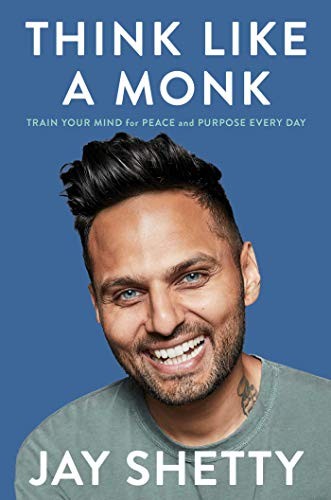
Think Like a Monk
by Jay Shetty
★ Top 10 book of 2020 · #8 on Best Books of 2020
Jay Shetty draws on his years as a monk to offer practical steps for handling negativity, overthinking, fear and the search for purpose. After leaving the monastic path, he went on to coach stressed friends and became a widely followed influencer.
Best for: Readers wanting practical ways to calm their minds, reduce stress and find purpose
Think Like a Monk is #8 on BookWard's Best Books of 2020, out of 65 2020 books that cleared our data bar.
What Think Like a Monk is about
Jay Shetty, host of the #1 podcast On Purpose, turns what he learned as a monk into practical steps for everyday life. He grew up in a family where you could become a doctor, a lawyer, or a failure, yet he skipped his college graduation to go to India and become a monk, meditating four to eight hours a day and devoting himself to helping others. After three years, a teacher told him he would have more impact by leaving that path to share his wisdom, so he moved back in with his parents in north London, heavily in debt.
The book argues that comparison kills love and that happiness cannot be found by looking for it. It also covers how to overcome negativity, stop overthinking, use fear, find purpose, and why kindness matters for success. It will help readers who feel stuck in worry or unsure what they are working toward.
Think Like a Monk on the Best Books of 2020
Think Like a Monk came out in 2020. Of the 65 books first published in 2020 that met BookWard's data bar, it ranks #8 on our Best Books of 2020 list.
Why it made the list: 1,725 readers have shelved it on Open Library; readers rate it 3.9 out of 5 (68 ratings); 74 are reading it right now. The list ranks each year’s books on how many readers have picked them up, how highly readers rate them, and how many are reading them right now.
It earns Being read right now.
Nearby on the 2020 list
- The Midnight Library Matt Haig, #6
- Credence Penelope Douglas, #7
- Piranesi Susanna Clarke, #9
- The Tower of Nero Rick Riordan, #10
See all Best Books of 2020 Best books by year
More years: Best Books of 2019 Best Books of 2021.
The numbers behind it
- Readers: 1,594 want to read it, 74 are reading it now and 57 have read it, according to Open Library.
- Ratings: 3.9 out of 5 from 68 Open Library ratings.
| Signal | This book (0 to 100) | Weight |
|---|---|---|
| Reach | 95 | 55% |
| Reader love | 35 | 25% |
| Being read right now | 92 | 20% |
Questions about Think Like a Monk
When was Think Like a Monk published?
Think Like a Monk by Jay Shetty was first published in 2020.
Was Think Like a Monk one of the best books of 2020?
Think Like a Monk is #8 on BookWard's Best Books of 2020, out of 65 2020 books that cleared our data bar. 1,725 readers have shelved it on Open Library; readers rate it 3.9 out of 5 (68 ratings); 74 are reading it right now.
Why is Think Like a Monk on the Best Books of 2020 list?
1,725 readers have shelved it on Open Library; readers rate it 3.9 out of 5 (68 ratings); 74 are reading it right now.
More of the best books of 2020
- Good Girl, Bad Blood Holly Jackson, #1
- The Inheritance Games Jennifer Lynn Barnes, #2
- The Psychology of Money Morgan Housel, #3
- The Ballad of Songbirds and Snakes Suzanne Collins, #4
- Heartstopper, Volume 3 Alice Oseman, #5
- The Midnight Library Matt Haig, #6
See the full Best Books of 2020, the Top 100, or new books on Rising.
How we know
This page uses public data: Open Library reader counts and ratings, and Wikipedia page views for recent years. The description is paraphrased from real source text. Rankings reflect reading interest, not quality or sales, and can be affected by data gaps. Lists update monthly.
Suits teens and adults looking for approachable guidance on stress, focus and purpose.
Depends on the edition you pick.
A monk's habits, repackaged for a stressed, scrolling, overthinking world. 39% taste match
 BookWard’s take
A monk's habits, repackaged for a stressed, scrolling, overthinking world
Jay Shetty draws on his years as a monk to offer practical steps on overthinking, negativity, fear, comparison and purpose. The framing is personal: a family that expected a doctor or a lawyer, a graduation skipped for India, then a return to north London in debt. That story gives the book its warmth and a distinctive authorial voice. It is story-led only in the loosest sense; this is an idea-led self-help book, and the ideas drive nearly every chapter. On rigor, it is closer to anecdote and teaching than to evidence, which is a real distance from what a skeptical reader might want. Familiar tropes are everywhere in the genre, and the monk-to-influencer arc is the hook that sets it apart. The pace is brisk and the reading is easy. If you want gentle guidance in plain language, it delivers. If you want airtight argument, look elsewhere.
The ideas are familiar wisdom; the monk-turned-influencer framing is the fresh part.
The language is plain and conversational, with little ornament.
The personal journey holds it together more than any plot.
The whole book argues that calm and purpose are within reach.
A conventional run of themed chapters, each building a lesson.
Lightly warm and playful at times, but the register stays earnest.
Gentle overall, touching on stress and unhappiness without dwelling.
Warm and sincere, kept at a moderate pitch.
See all 50 dialsEvery position, side by side with this book
Where it lines up
- Shock for effectBookWard 9 · book 9
- PaceBookWard 8 · book 7
- EndingBookWard 8 · book 7
Where it pulls apart
- Familiar tropesBookWard 10 · book 3
- Internal logicBookWard 10 · book 5
- ExpositionBookWard 2 · book 9
Self-help conventions run throughout, and the monk angle only partly freshens them.
Advice follows from short lessons and anecdotes rather than a tight chain of argument.
The ideas are familiar wisdom; the monk-turned-influencer framing is the fresh part.
Shetty himself is drawn with some depth, while others appear as brief illustrations.
Warmth and encouragement are central, so it leans sentimental against BookWard's restraint.
It does not trade in shock; its few hard moments serve a lesson.
It rests on teachings and stories more than evidence, short of what BookWard values.
Shetty's personal, upbeat teaching voice is recognisable, which BookWard rewards.
Ideas lead throughout, with stories used to illustrate each lesson.
Lessons are explained outright, the opposite of BookWard's love of showing in scene.
Short chapters on separate themes keep energy fairly even, though repetition creeps in.
The language is plain and conversational, with little ornament.
The personal journey holds it together more than any plot.
The whole book argues that calm and purpose are within reach.
A conventional run of themed chapters, each building a lesson.
Lightly warm and playful at times, but the register stays earnest.
Easy to read in short sittings, a touch gentler than BookWard's usual diet.
One voice throughout: Shetty's.
Entirely grounded in everyday life and practical routines.
A handful of recurring figures such as teachers and family, plus anonymous examples.
It is about one person's inner life and daily habits.
Attention stays on thoughts, habits and mindset rather than events.
Relationships come up as a topic, but romance is not a thread.
Everyday modern life with a stretch of monastic life in India.
Written for readers living now, with modern pressures like social media.
The core ideas are old, but the packaging is clearly of its moment.
Shetty speaks plainly in his own voice, with nothing hidden.
It tells you plainly what to value and what to change.
Description is sparse and serves the lesson rather than the scene.
It mixes personal story with direct advice, leaning toward story.
Written in the first person from Shetty's own experience.
A standalone book.
Few surprises beyond the arc of Shetty's own path.
Gently encouraging more than disturbing, though it asks you to change habits.
Gentle overall, touching on stress and unhappiness without dwelling.
Warm and sincere, kept at a moderate pitch.
The humor is light and friendly rather than sharp.
Essentially none.
Essentially none.
Not a political book.
Plain, accessible language throughout.
Shetty states his views directly and often.
Aimed at who you could become, while drawing on old traditions.
Strongly optimistic that kindness and purpose change lives.
Review written by BookWard, dial version 1, November 2026.
Who is Think Like a Monk right for?
Suits teens and adults looking for approachable guidance on stress, focus and purpose. Topics like anxiety and unhappiness appear, but the tone stays gentle and encouraging.
Easy to read in short sittings, a touch gentler than BookWard's usual diet.
Gentle overall, touching on stress and unhappiness without dwelling.
Warm and sincere, kept at a moderate pitch.
Essentially none.
Book CompanionThink Like a Monk: ideas, characters, themes
Ancient monastic habits can be turned into everyday practices that quiet the mind, reduce negativity and point you toward a purpose.
- Overcoming negativity. The book offers ways to notice and reduce negative thinking rather than feeding it.
- Stopping overthinking. It gives practical steps for quieting a restless mind.
- Comparison harms love. Shetty argues that measuring yourself against others undermines your relationships.
- Using fear. Fear is treated as something to work with and turn to use.
- Finding purpose. Purpose comes from service and kindness, not from chasing happiness directly.
Characters
Jay Shetty
Author and narrator
A former monk turned podcast host who shares what he learned in India.
Shetty's family
Source of expectation
They expected him to become a doctor or a lawyer, and doubted his choice to become a monk.
A monastic teacher
Guide
After three years, a teacher tells Shetty he could do more good by sharing his experience with the wider world.
Themes
Finding a reason for your work and life beyond success.
Paying steady attention to your thoughts rather than being ruled by them.
Treating generosity toward others as the base of lasting success.
Seeing yourself as separate from your passing thoughts.
Weighing family and social pressure against your own path.
Discussion questions
- Which of the book's habits could you realistically keep for a month?
- Why does comparison feel so natural, and does Shetty's case against it convince you?
- Does a monk's discipline translate to a busy modern life?
- How does Shetty's own story shape how much you trust his advice?
- Is chasing happiness directly really the wrong approach?
Personalize your Book Companion
This is the general edition. In BookWard, the Companion is written for you: your reading profile, your notes, and spoiler-safe to the page you are on.
Buy, listen or borrow Think Like a Monk
Each link opens a search for this book on that store, in a new tab.
Read on a device
Borrow
Reviews and community
If you liked Think Like a Monk
A self-taught learner's practical blueprint for mastering hard skills fast
Big MagicElizabeth GilbertGilbert's warm, anecdotal pep talk on living a creative life
Igniting SuccessLeo BaxterA short, upbeat motivation primer built on exercises and famous examples
101 Essays That Will Change The Way You ThinkBrianna WiestShort, quotable self-help essays you can read one idea at a time
Find your own best books
Add what you have read, rate it, and BookWard will recommend what to read next.
Free to start. No credit card needed.